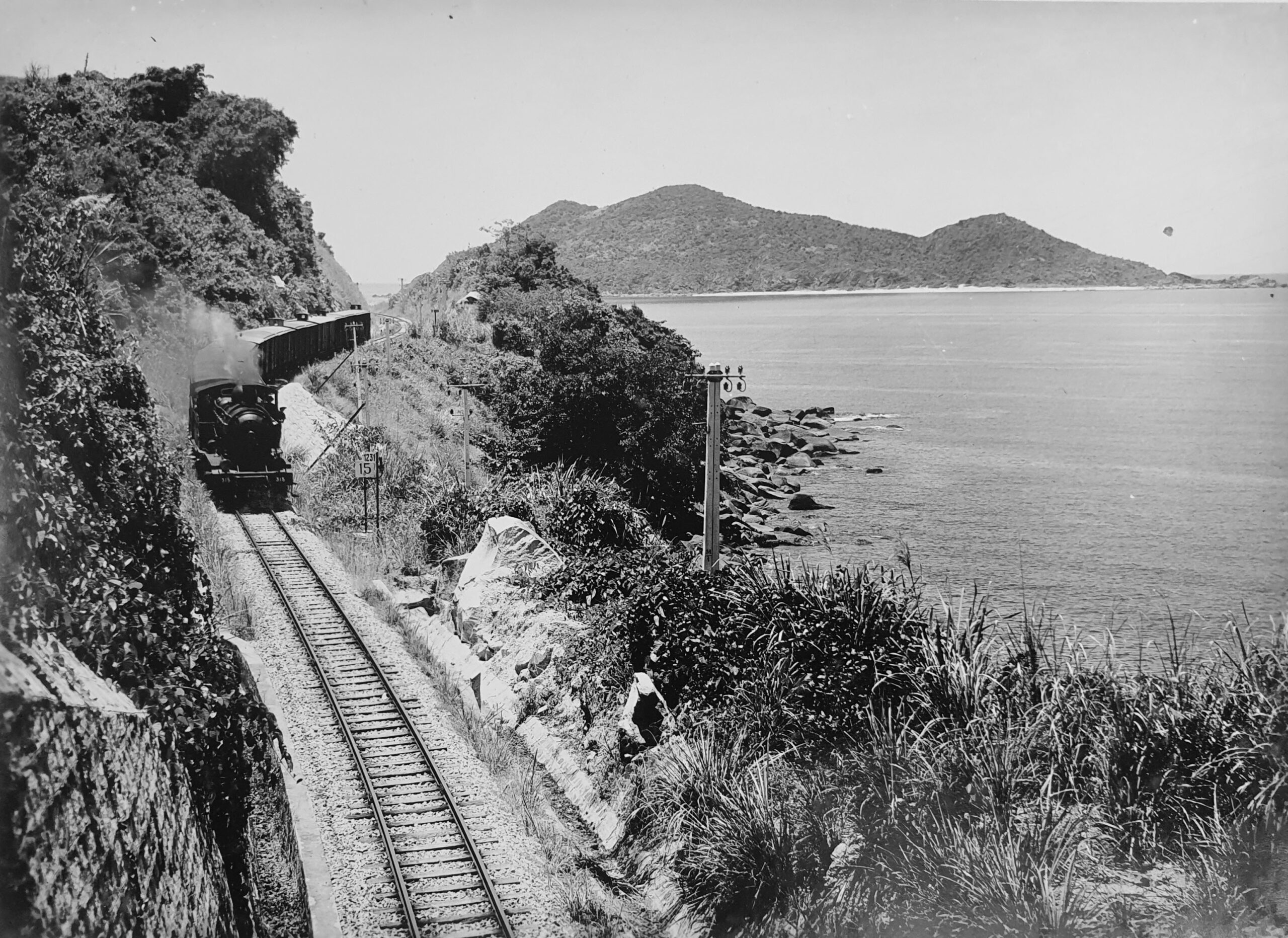
“Annam – On the cliffside section at Cape Varella, locomotive No. 315 (Class 230) approaches the Babonneau Pass with a northbound-to-southbound freight train,” ANOM 8 FI 336 1 Chemins de fer Réseaux non concédés, 1921-1935
Exactly 90 years ago, the Transindochinois or North-South railway line was completed, marking the culmination of French railway construction in Indochina.
Having just finished his term of office, Governor General René Robin decided to take his family on the very first through train all the way from Hà Nọi to Saigon, in order to catch the boat home to France. On the way he was joined by Emperor Bảo Đại, who accompanied him at a low-key ceremony to connect the final section of rail track together at Hảo Sơn on 2 September 1936.
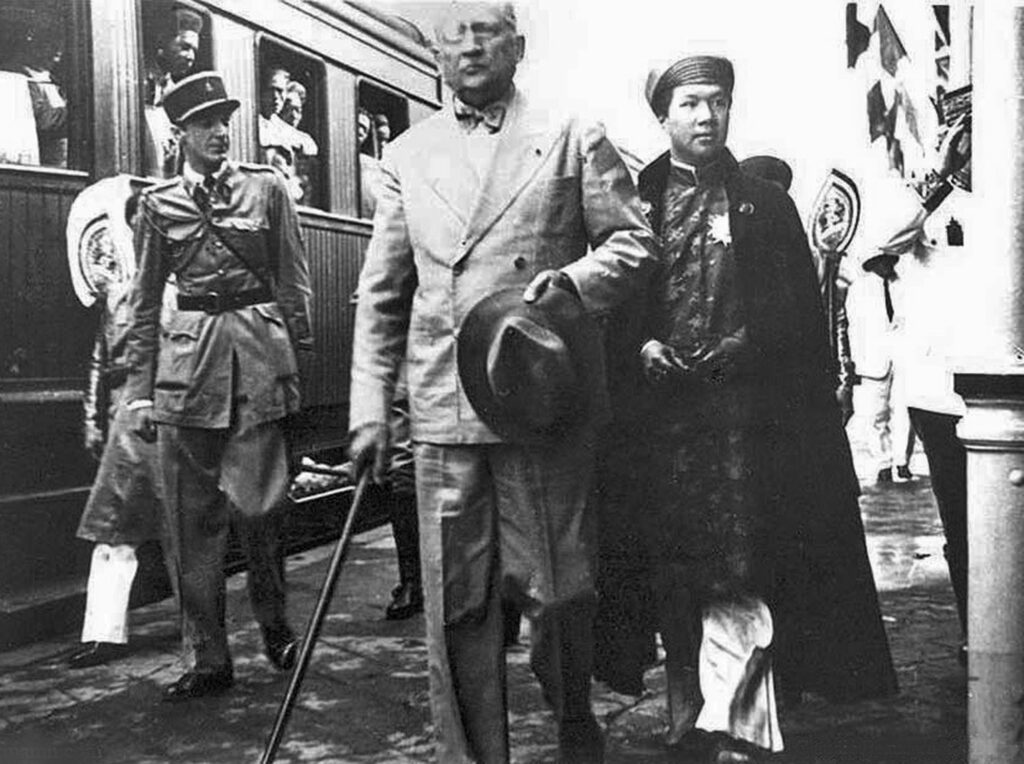
Annam, 2 September 1936 – H.M. Bảo Đại, Emperor of Annam and M. René Robin, Governor-General of Indochina arrive by special train to inaugurate the final section of the railway line between Tuy Hoà and Đại Lãnh
In fact, since a considerable amount of testing remained to be done before public services could commence, a second inauguration ceremony would be arranged at Hảo Sơn on Thursday 1 October 1936, this time involving the burial of ceremonial parchments in the base of a lineside monument which was then under construction at km 1221, 1km south of Hảo Sơn station.
The Emperor Bảo Đại once again presided, this time with Acting Governor Achille Silvestre and a representative of Marshal Long Yun, Governor of Yunnan.
On the same day, trains set out simultaneously from both Saigon and Hà Nội, heralded at both ends of the line by grand military reviews involving processions of ethnic groups in their traditional costumes.
In the seven days which followed, the launch of through train services between Hà Nội and Saigon was commemorated by special celebrations in both Hà Nội and Saigon, funded by a special grant of over 1 million francs.
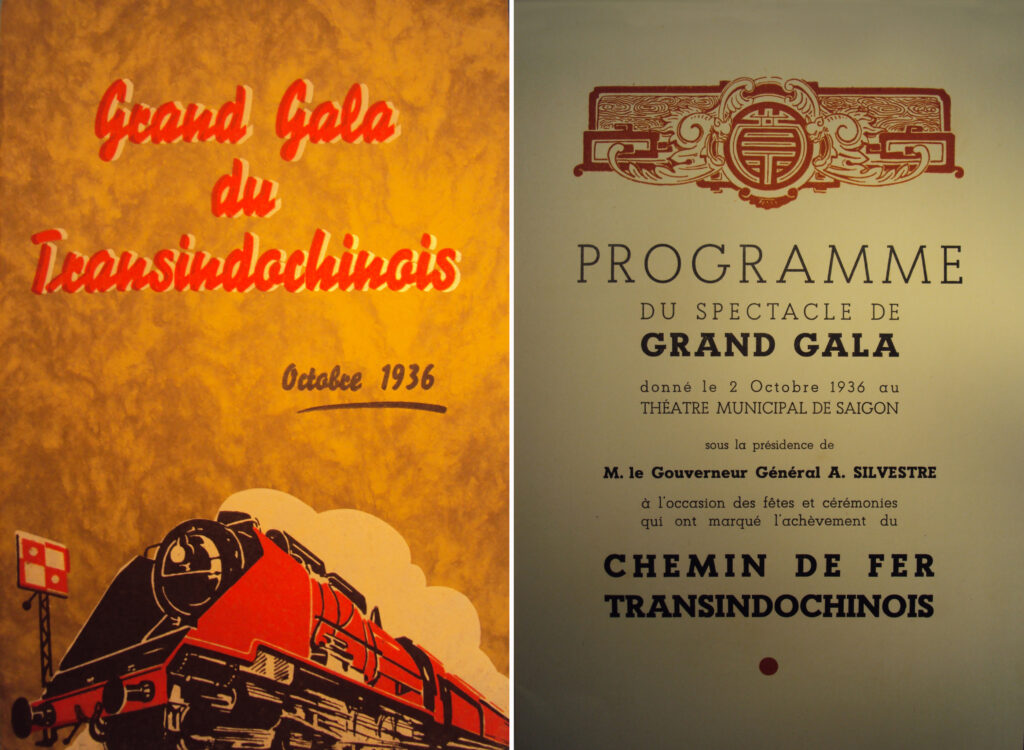
Programme for the Transindochinois Grand Gala performance, held on 2 October 1936 at the Saigon Municipal Theatre
In Saigon on 2 October 1936, the authorities staged a “Grand Gala Evening” at the Municipal Theatre, attended by Acting Governor Silvestre. This was followed by a week-long sports tournament known as the “Transindochinois Cup,” which was held in the Jardin de la Ville (now Tảo Đàn Park), and featured cycling, football and rugby. A special commemorative stamp was also issued by the Saigon Post Office to mark the occasion.
When the lineside monument at km 1221 was completed, its French inscription would read:
“Here, the Transindochinois, conceived by Paul Doumer to seal the unity of Indochina, was completed on 2 September 1936 with the connection of the railway from the Chinese border with the railway from Saigon.”
Here are translations of press articles covering the inaugural events of 2 September and 1 October 1936:
L’Avenir du Tonkin, 8 septembre 1936, p 7
THE DEPARTURE OF GOVERNOR GENERAL RENÉ ROBIN AND THE JUNCTION OF THE TRANSINDOCHINOIS
We can now organize sumptuous parties, double the number of guests and talk about a solemn consecration of the Transindochinois railway line; all this, we have no doubt, will be perfect, and the commemoration of such an event cannot have too much impact.
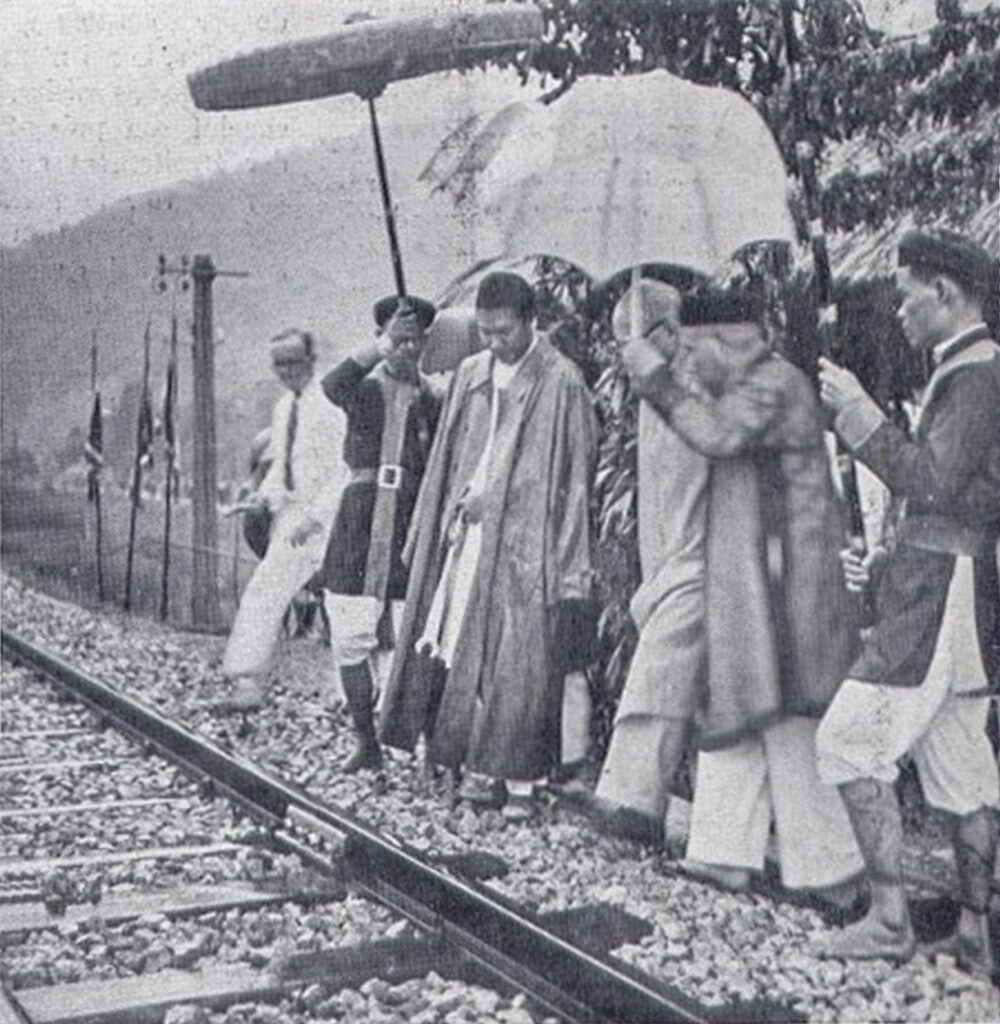
Hảo Sơn, 2 September 1936 – H.M. Bảo Đại, Emperor of Annam and M. René Robin, Governor-General of Indochina, tighten the fishplates on the final section of rail of the Transindochinois railway, L’Illustration, 10 octobre 1936
But we must nevertheless consider that the real inauguration of the line took place on Wednesday 2 September 1936, a little after five o’clock, in Hảo-Sơn, Phú-Yên.
It was just a small group – there were hardly more than 30 assistants around the Governor General and H.M. the Emperor of Annam, as both endeavoured, with long ceremonial spanners, to tighten the nuts which held the last fishplates to the section of rail which had just been brought there by workers. Nothing during the holidays will be able to match the spontaneous gesture of the engineers who participated so fully in the realisation of Paul Doumer’s gigantic project, nearly 40 years in the making, to request Governor General René Robin and the Emperor of Annam to come and lay the last rail of the long steel ribbon connecting China to the Siamese borders.
For this simple act will allow us to say happily that we have, in the Far East, completed a railway line which measures no less than 2,563 kilometres, the longest railway line that crosses the earth. Without being accused of exaggeration, we can consider this a truly historic event, especially since all those who participated in the accomplishment of this prodigious work requested the head of the colony and the sovereign who presides over the destiny of Annam – a country which is crossed from end to end – to consecrate by their presence its definitive completion.
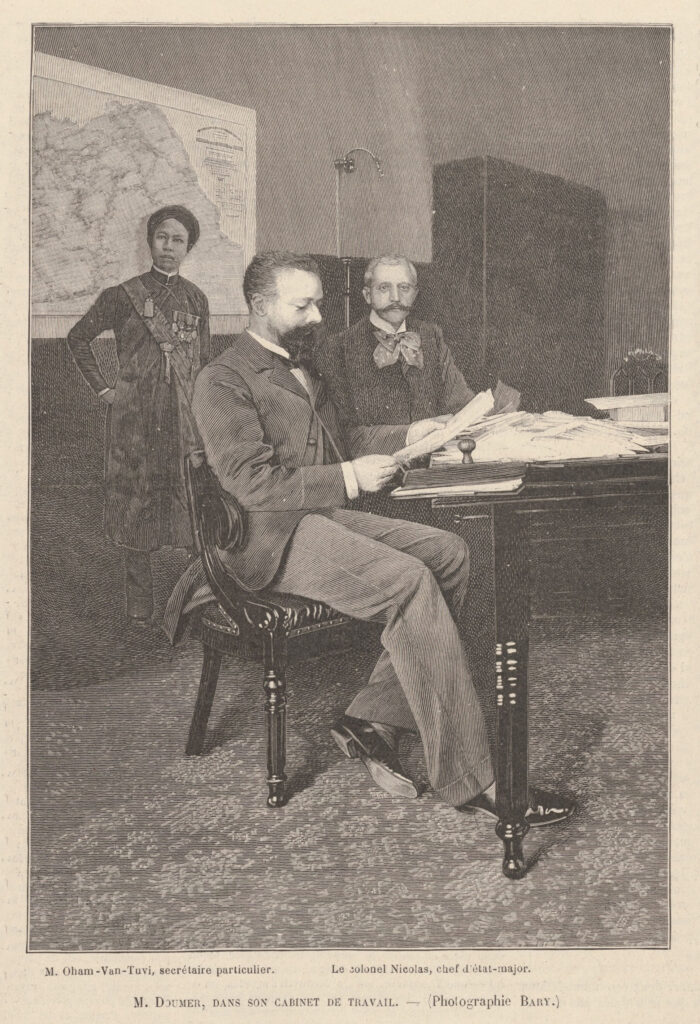
Governor General Paul Doumer in his study, photograph by Bary
With the laying of the last rail complete, the first train set off from the North all the way to the South, while just the day before, the trains coming from the North and those from the South bringing the materials necessary for construction, had to stop near this supreme cutoff.
It was in 1897 that the work was first imagined by Paul Doumer, who in 1902 inaugurated the first Hà Nội-Hải Phong section. René Robin, in 1936, thanks to the contribution of his active authority, just put the final point on it. Passing for the first time from Tuy Hoà to Nha Trang, the Transindochinois today links Yunnan-fou with Mỹ Tho, the borders of China with the banks of the Mekong.
We cannot fail to be surprised by the considerable delay which separates the conception from the realisation, but we must take into account certain considerations which delayed the completion: firstly, the return of Paul Doumer to France, then the absence of credit, and finally the Great War. In 1918, two gaps remained to be filled: one of 300 kilometres between Vinh and Đông Hà, the other of 532 kilometres between Tourane and Nha Trang. The first was carried out between 1924 and 1927 and the second from 1931 to 1936, the latter thanks to the subsidies provided by the law of 22 February 1931. Begun on 30 November 1931, the Tourane to Nha Trang section was completed less than five years later, after 532 kilometres of track had been laid across several deltas and mountains drilled in regions where obstacles were accumulating. Allow us to line up here a few figures which are luminous in their brutal conciseness: The earthworks involved the moving of 11,500,000 cubic metres of earth. The masonry amounted to 350,090 cubic metres. The structures, numbering 1,366, have a total length of 14,414 metres. The bridge over the Sông Đà Rằng alone stretches to 1,080 metres; it is the longest in Indochina after the Doumer Bridge.
The Transindochinois is now complete and it is a gigantic work – that word is not too strong. And the least informed layman will bow in wonder and can only admire the result of a bold enterprise which honours those who fortunately carried it out successfully.
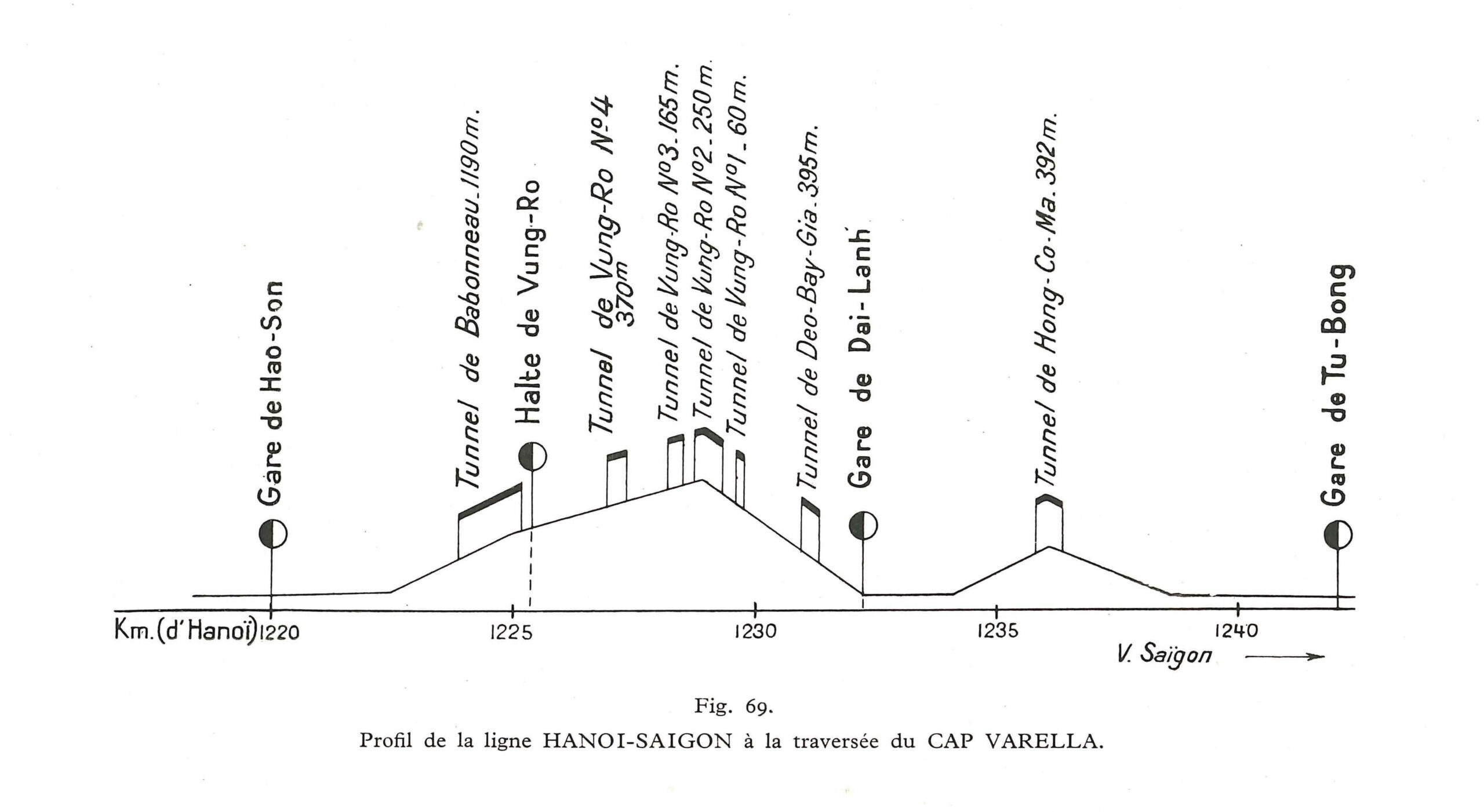
Profil de la ligne Hanoi-Saigon a la traversée du Cap Varella, Henri Lartilleux, Geographie des Chemins de Fer Français, Tome 1, Librairie Chaix, Paris, 1955 – thanks Jani Pintaric
The last section incorporated the greatest difficulty, the rigorous obstacle called the Varella Massif which stood mercilessly before those who wanted to overcome it. Let us praise the engineers: Especially M. Lefèvre, who was the great driving force behind this splendid achievement and whose value and qualities cannot be praised too highly. M. Bourgoin – who will never speak to me again because I am putting his name in print – but who deserves better than a citation. MM. Nicolas, Cousin, principal engineers, M. Michelin, engineer of the Varella subdivision, M. Revéron, architect, MM. Bosio, Gillet, Trilleau, engineers…
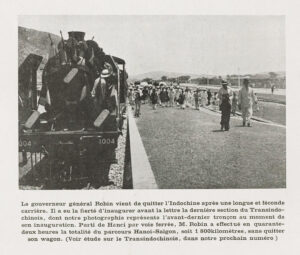
Governor-General Robin has just left Indochina following a long and fruitful career. He had the distinction of inaugurating—ahead of the official schedule—the final section of the Trans-Indochina Railway; our photograph shows the penultimate stretch at the time of its inauguration. Traveling by rail from Hà Nội, Mr. Robin covered the entire Hà Nội-Saigon route—a distance of 1,800 kilometers—in forty-two hours without once leaving his carriage. “l’Inauguration du Transindochinois, 2 septembre 1936,” Le Monde colonial illustré, octobre 1936, p 216.
We will add to this list the name of M. Gassier, whose brilliant faculties led him to be designated as Inspector General of Public Works. He knew how to utilise effectively all of the engineers during the accomplishment of the work, inspiring them to overcome all obstacles. We were promised completion of the work by October, and on 2 September the first train ran.
The special train which would connect the North to the South set off the previous day. This was also the train which would carry M. Robin and his family to Saigon to catch their ship back to France at the end of his posting. The Emperor and Empress were received on board the train in Huế and when the party arrived in Tourane, the Resident Mayor, M. Bon, the president of the Court, M. Gorsse, and the senior officials of the port of Annam were on the station platform to greet the Governor General and the Sovereign. The train subsequently stopped at PK 834+333 (Quảng-Nam) to allow the leader of the colony to inaugurate an important dam which will retain the water in order to distribute it methodically in the best interests of the inhabitants and their rice fields. The dam, which will irrigate 350 hectares, is 18 metres high, reaching the bottom of the valley, over a length of 220 metres. It is part of a set of works which will develop, in approximately 18 months, 30,000 hectares of rice fields. It is to M. Arnoux, engineer of Bridges and Roads in Vinh, that we owe the beautiful execution of this remarkable work.
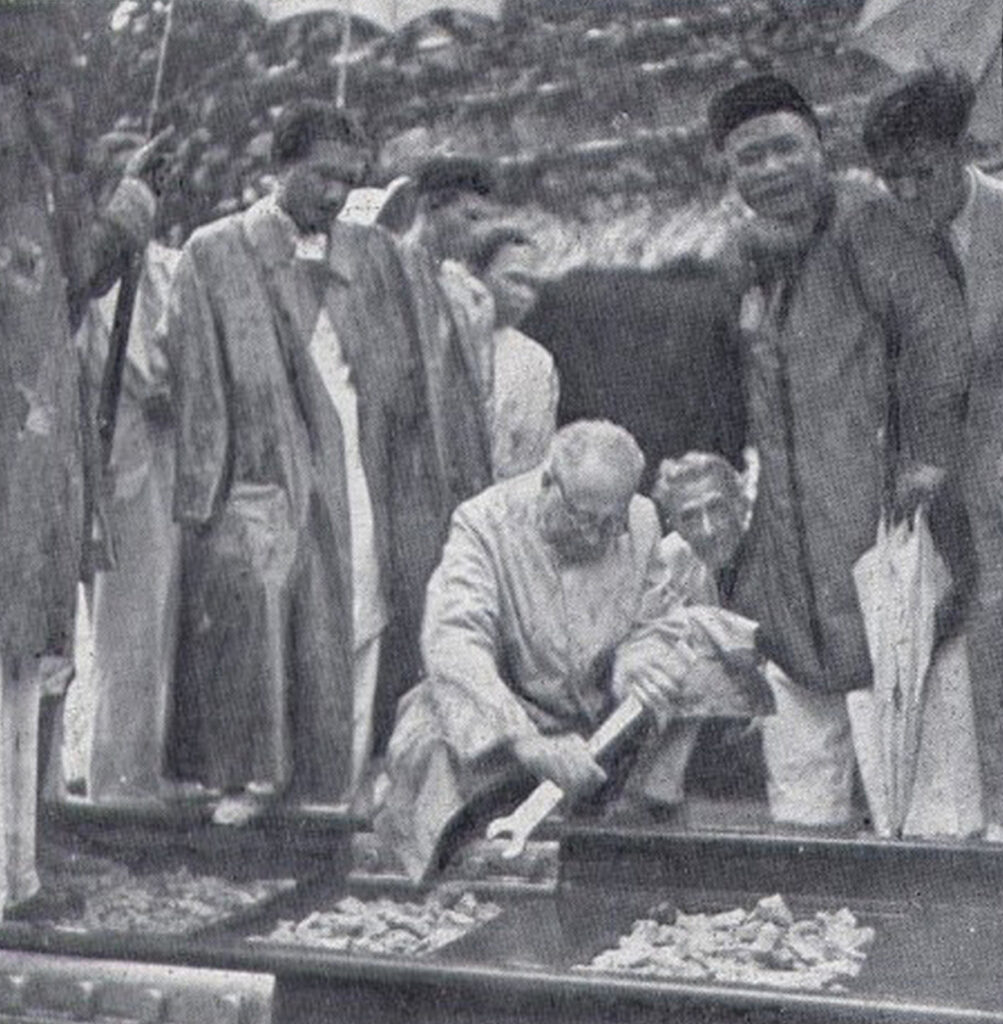
Hảo Sơn, 2 September 1936 – H.M. Bảo Đại, Emperor of Annam and M. René Robin, Governor-General of Indochina, tighten the fishplates on the final section of rail of the Transindochinois railway, L’Illustration, 10 octobre 1936
Lunch was served on the train by staff of the Métropole Hotel between Tam Quan and Diêu Trì. A big storm was due to fall on the region, towards Tuy Hoà, and when the train stopped at Hảo Sơn, the rain seemed to want to increase in intensity. Cars picked up the travellers at the station to take them past the final cutoff. Fortunately, we had planned a small hut construction which allowed everyone to shelter.
Workmen brought in the last rail and M. Bourgoin gave the Governor General and H.M. the Emperor of Annam nickel-plated spanners to enable them to tighten equally nickel-plated bolts on the nickel-plated joint. The rite was performed in the pouring rain at around 5.15am, while a few photographers tried to capture the event.
Thus was the junction between the North and the South completed, but to allow those present to clearly see all of the new tunnels that we were now going to pass through on the way to Nha Trang, a tourist train comprising a platform wagon with a glass viewing module on top pushed by locomotive No 211 was offered to travellers. Everyone took their place and the locomotive set off with a whistle, while our special train followed a few hundred metres behind. Thus we passed under the series of tunnels, the first of which was the Babonneau, which measures 1,283 metres in length.
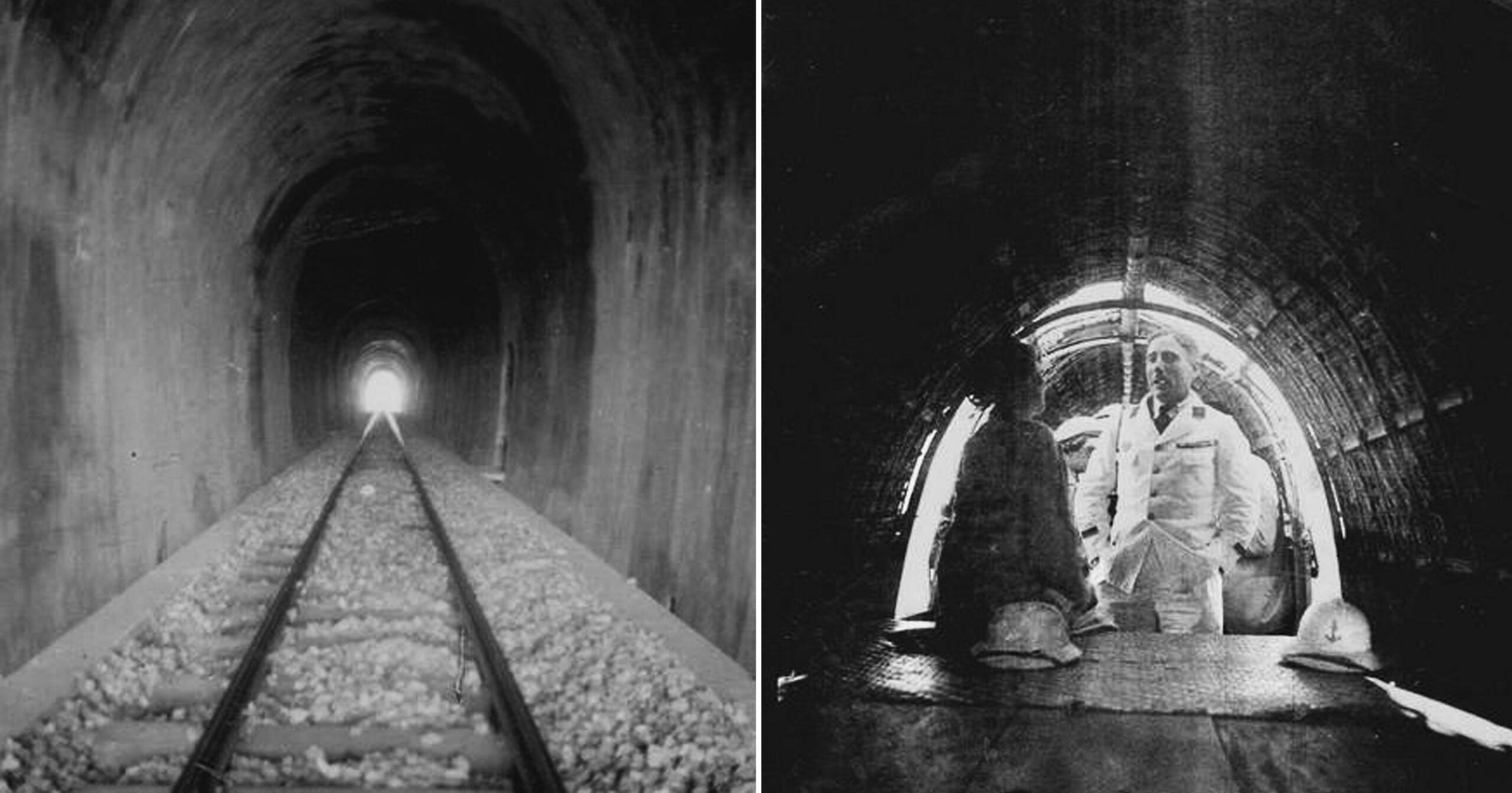
Officials and invited guests explore the new Babonneau Tunnel on a special flat wagon
At the exit of Babonneau, the platform opened onto the prestigious landscape that we discover on the Bay of Vũng Rô. This has attached its name to a set of four tunnels of lesser importance which between them provide magical views of this bay, allowing you to appreciate the charm of these picturesque coves – but alas! The twilight was already deepening. We passed through the Bãi-Gió tunnel, stopping shortly after at Đại Lãnh Station, where the engineers had prepared a reception. Everyone then returned to the special train which, for the first time, linked Hà Nội with Saigon. While we were still passing under the Dèo Cổ Mã, it was time for dinner and we sat down to eat.
Finally we reached Nha Trang where the first separation took place. Nha Trang station, like the previous ones, was very pleasantly decorated. A considerable crowd had invaded it and its surroundings. This is where the sovereign of Annam had to take leave of the Governor General.
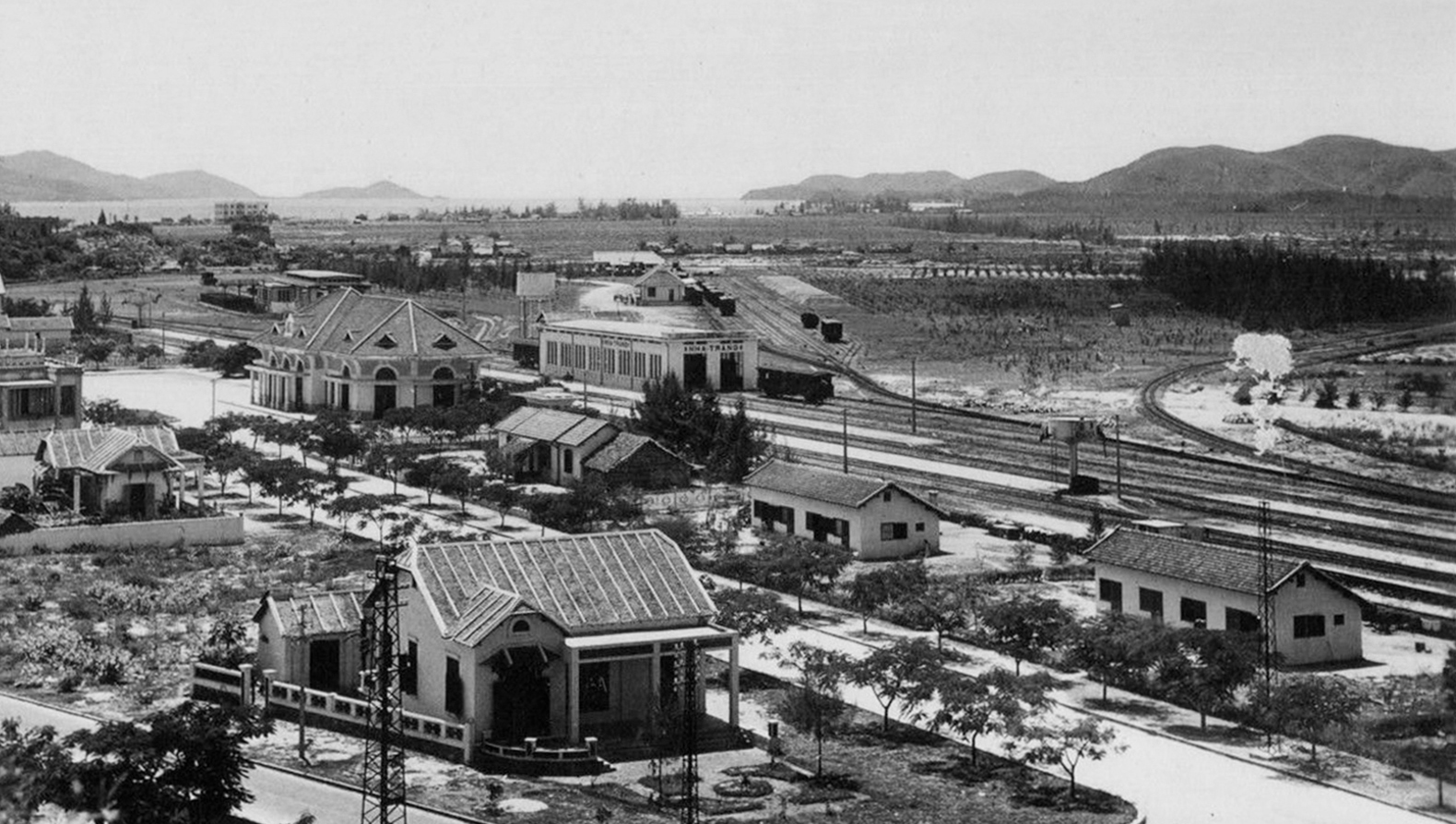
Annam – General view of the new Nha-Trang Station
H.M. Bảo-Đại did so with a spontaneity which did not fail to touch the entire audience by demonstrating the affectionate solidity of the close ties which have always united the representative of France and the young monarch. As M. Robin led him and the Empress to their car, at the threshold of the station, in front of the assembled crowd, H.M. Bảo-Đại gave him a warm hug. Madame Robin and Madame Nicolai then took leave of the Emperor and Empress who were heading back to Đà-Lạt. After bidding farewell to the Résident Supérieur and his Chief of Cabinet who were also leaving by car, M. Robin returned to his railway carriage and continued his journey with his family to Saigon.
The Transindochinois, in fact, will not be delivered to operation until after the final inauguration which will take place at the very beginning of October.
L’Avenir du Tonkin, 3 octobre 1936, p 7
THE INAUGURATION OF THE TRANSINDOCHINOIS
Governor General par interim Achille Silvestre
Saigon, 2 October 1936. — The Governor General par interim Achille Silvestre officially inaugurated the section of the Transindochinois railway from Tuy Hoà to Đại Lãnh on 1 October. We know that the last rails had been laid a month ago, in the presence of former Governor General René Robin. The line, after some completion work, is now ready to be delivered to operation. After the commissioning on 16 January 1935 of the Tourane to Quảng Ngãi section, on 1 July 1935 of that from Quảng Ngãi to Qui Nhơn, on 7 January 1936 of that from Quinhon to Tuy Hoà, and finally on 1 April of the Nha Trang to Đại Lãnh section, the last 30 kilometre stretch which has just been inaugurated completes the 1,723 kilometre rail corridor which now links Saigon to Hà Nội.
Trains from the North and the South, bringing the personalities invited to the ceremonies, arrived in the morning at Tuy Hoà: from the North, came a diesel railcar belonging to the Yunnan Company and two special trains, one of which included three carriages from the three railheads; Yunnan-fou, Hải Phòng and Na Cham; from the South came two special trains, one of which was exclusively reserved for French and indigenous personnel, engineers, drivers, employees and workers who, in various capacities, had collaborated in the construction.
At 11.30am, Governor General Silvestre, accompanied by M. Gauthier, his chief of staff, and Captain Solar, his orderly officer who had come from Saigon, arrived by automobile at the Tuy Hoà bungalow, where he was received by the Résident supérieur of Annam, M. Guillemain, the Inspector General of Public Works, H. E. Phạm-Quỳnh, M. Fugier-Garrel, Résident, and M. Trương-Như-Đính, Tuần-phủ of the province. He was joined there shortly after by H.M. the Emperor of Annam, who came from Đà-Lạt.
Invited guests at the inauguration ceremony
An official lunch brought together the personalities present, among whom we noted M. Hoang-Je-Koang, deputy to the Director of Reconstruction of Yunnan, specially delegated by Marshal Long-Yun to attend the ceremonies; His Highness Prince Nguyễn Phúc Vĩnh Cẩn; the general treasurer of Encausse de Ganties; Dr. Hermant, Inspector General of Public Health; M. Perroud, President of the Council of French Interests in Tonkin; M. Demolle, Vice-President of the Hà Nội Chamber of Commerce; M. Virgitti and M. Vinay, Resident Mayors of Hà-Nội and Hải Phòng; the president of the Mixed Chamber of Commerce and Agriculture of North Annam; the President of the House of People’s Representatives of Annam; M. Trương Văn Bền, Vice-President of the Saigon Chamber of Commerce; the Consul General of Japan in Hà Nội; M. Lacollonge, Director of the Northern Indochina Tourism Office; M. Reich, Director of the Société de Levallois-Perret; M. Hilaire, Director of the Indochina and Yunnan Railway; M. Lefèvre, Chief Engineer of the Circonscription des Chemins de Fer; Mr. Bourgoin, Chief Construction Engineer.
After lunch, the Governor General and the Emperor of Annam took their places in the trains which, after crossing the Sông Đà Rằng on a large bridge built by the Société de Levallois-Perret, embarked on the new line. In Hảo-Sơn, at the point where the last rails were joined just four weeks earlier, a short stop was planned.
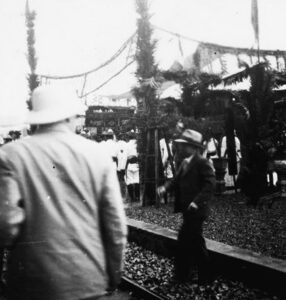
Invited guests at the inauguration ceremony
In front of the three pylons surmounted by the Gallic rooster and draped in the colours of France and Annam, symbolising the union of the North and the South under the aegis of the protecting power, a shelter had been erected. There were M. Rivoal, Governor of Cochinchina, M. Bussière, Administrator of the Saigon-Chợ Lớn region, M. Destenay, Resident of Nha Trang, as well as M. Hồ Đắc Ứng, Tuần-phủ of Khánh Hòa.
M. Hoang-Je-Koang, representing Marshal Long Yun, Governor of Yunnan, offered, on his behalf, in memory of this ceremony, an engraved silver plaque whose characters meant: “Communications are greatly facilitated.” He then gave a speech showing the importance of the Transindochinois, which now connects the capital of Yunnan to the main port of Indochina and will help to bring people together.
The head of the Indochinese Union thanked the representative of the Government of Yunnan, saying: “By accepting the invitation addressed to it, Yunnan contributes to strengthening the bonds of friendship which unite it with Indochina.”
This,” added M. Silvestre, “has already opened its doors widely to your compatriots. The economic instrument whose completion we are celebrating today will further contribute to making these links closer.”
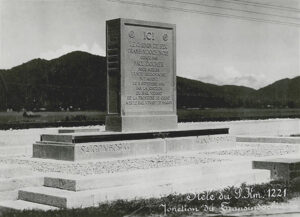
Still under construction at the time of the 1 October inauguration, the commemorative stele at Km 1221 would bear the following inscription: “Here, the Transindochinois, conceived by Paul Doumer to seal the unity of Indochina, was completed on 2 September 1936 with the connection of the railway from the Chinese border with the railway from Saigon.”
In closing, M. Silvestre wanted to recall that it was M. Robin, “whose memory is in our hearts,” who presided over the junction of the North and South rails on 2 September.
The main personalities present affixed their signatures to two parchments with the seals of the French Republic and the Emperor of Annam which established the memory of the two ceremonies: 2 September, junction of the rails, and 1 October, inauguration. These parchments were immediately sealed by M. Silvestre and the Emperor of Annam in the base of a stele which will rise between the colonial road and the track to indicate the point where the work designed by Paul Doumer was completed.
The Governor General and the Emperor then took their place in the railcar of the Yunnan Company, while their entourages were spread out on two equipped platform wagons which allowed a good view of the line. We thus passed through the Babonneau tunnel, the longest in Indochina with its 1,200 meters. We came out on the Vũng Rô cornice, which offers a magnificent view of the sea, the rocky promontories of Varella and the islands.
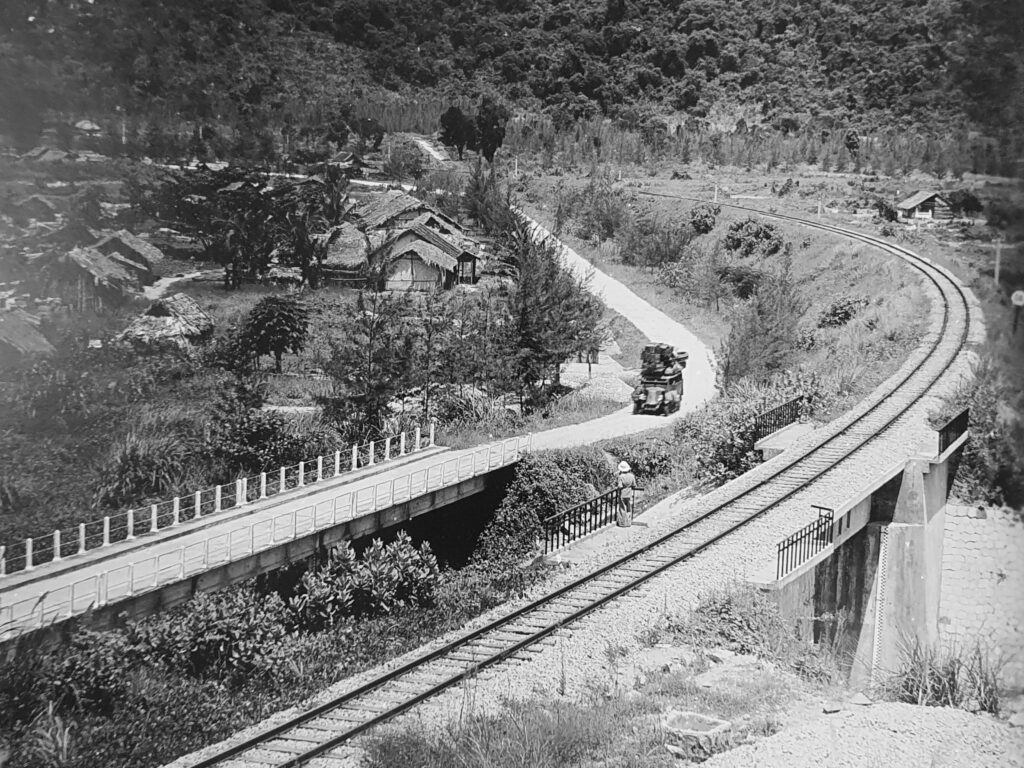
Région de Đại Lãnh, ANOM 8 FI 336 1 Chemins de fer Réseaux non concédés, 1921-1935
This section required major works, including deep rock trenches, tunnels, viaducts and retaining walls.
After the last Bay-Gio tunnel, we stopped at Đại Lãnh. There, in the presence of a considerable crowd, the Governor General presented numerous decorations to the engineers, contractors, construction managers and operators who collaborated on this magnificent work. M. Lefèvre received the plaque of the Grand Officer of the Dragon of Annam and M. Bourgoin the tie of Commander.
After taking leave of the Emperor of Annam and examining the exhibition of corals and fish installed in the station hall by M. Sérène, Director of the Nha Trang Oceanographic Institute, M. Silvestre and his guests took their seats in the inaugural trains which were to bring them to Saigon. As they passed, they were able to admire some very beautiful light decorations made in the Gia and Nha Trang stations.
At 9am on Friday morning, the government train arrived in Saigon. Travelling via the Boulevard de la Somme, it reached the Quai Le-Myre-de-Villers, opposite the locations which had been reserved for delegations from the countries of the Union, whose picturesque costumes added a note of bright colour to the sun.
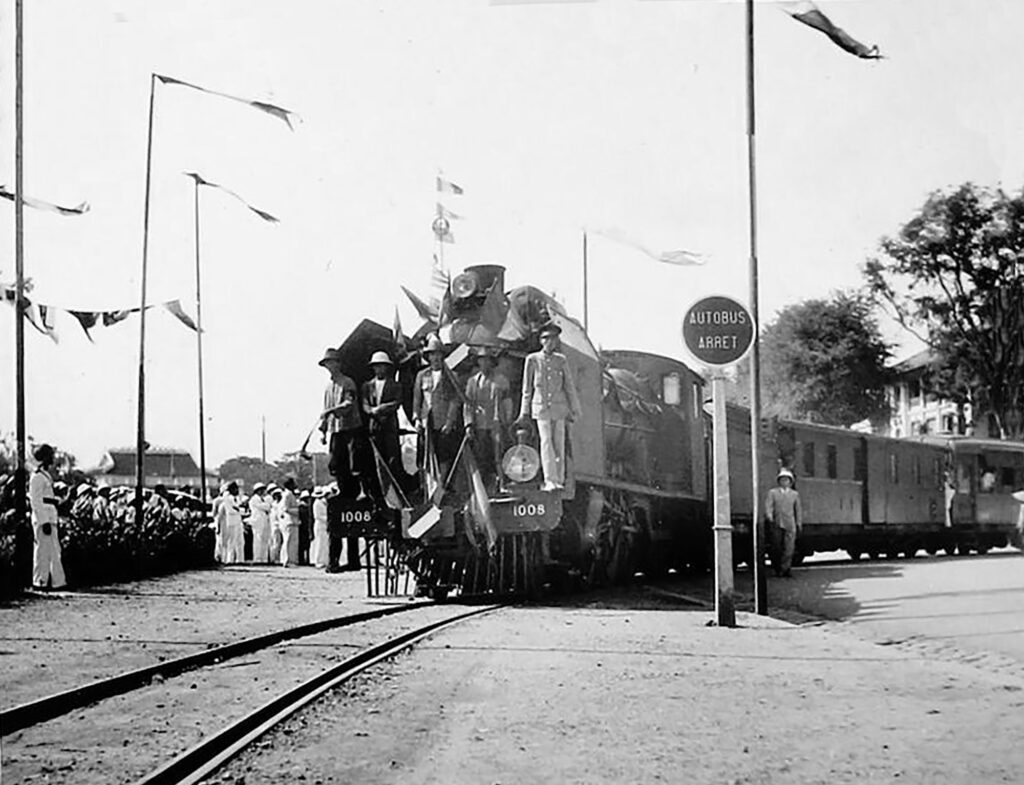
Saigon, 2 October 1936 – The inaugural Transindochinois train pulls up at the quai Le Myre de Vilers in Saigon. Une vie en Indochine. La collection de Delphine et Adrien Noblot, gendarme colonial (1904-1937), Inauguration du chemin de fer Transindochinois https://corpus-invisu.inha.fr/s/indochine-noblot/item/912
Throughout the abundantly decorated route, a crowd of several thousand people crowded into several rows, while a salvo of artillery rang out.
The train stopped directly in front of the official stand, in which were seated General Buhrer, Senior Commander of the Troops of Indochina, the Résident Supérieur of Cambodia, M. Thibaudeau, His Highness Prince Monireth representing the King of Cambodia, and several hundred other people. Military honours were paid to the Governor General, who was accompanied by H.H. Prince Vĩnh Cẩn, representing the Emperor of Annam, Governor Rivoal, the Résident Supérieur of Annam Guillemain, the Inspector General of Public Works, and many others.
M. Gassier, from a mobile platform equipped with a loudspeaker, gave a speech in which he recounted the history of Paul Doumer’s conception of this imperial work and its progressive realisation over 35 years. He showed what a major factor in economic progress and social progress this railway constituted, adding to a road network that foreigners admire and to agricultural development and sanitation works. M. Gassier ended with a vibrant tribute to the first pioneers, to all those soldiers, martyrs of duty, who suffered to study and build roads, railways, canals and dams.
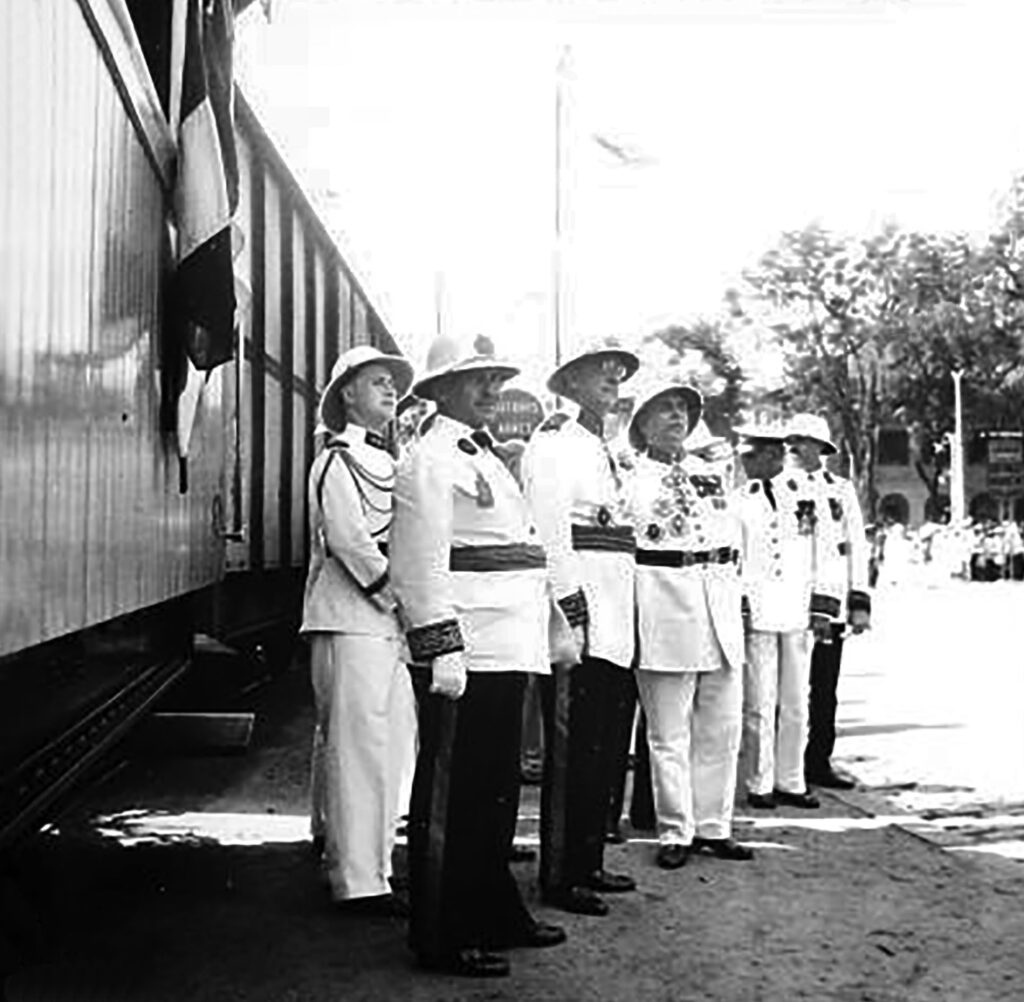
Saigon, 2 October 1936 – Officials have stepped off the inaugural train of the Transindochois railway: in the centre, wearing glasses, is Acting Governor General Achille Silvestre; to his left, General Burher; to his right, Rivoal, Acting Governor of Cochinchina. Une vie en Indochine. La collection de Delphine et Adrien Noblot, gendarme colonial (1904-1937), Inauguration du chemin de fer Transindochinois https://corpus-invisu.inha.fr/s/indochine-noblot/item/912
Governor General Silvestre responded with a speech which united in the same thought Governor General Paul Doumer who, leaving for France, went to Hải Phòng in 1902 by the first train from Hà Nội, and Governor General Robin who, in 1936, reached Saigon by the first convoy coming directly from Hà Nội to Saigon. After paying tribute to all the artisans of this work which highlighted the incessant collaboration of France with its daughter in Asia and underlining the services that the Transindochinois is called upon to provide, the Governor General added: “It remains, of course, a lot to do. Who would think of contesting it? No one intends to represent the current situation as the definitive end of an evolution which would be suddenly stopped when, on the contrary, it continues without stopping surely, to the extent of the possibilities. And it does so at a pace which, in all conscience, we cannot complain about. When taking a look at the past, we consider what this country was like half a century ago and we measure the progress made in all areas since that time.”
The speeches were followed by a military review with an airforce fly-past. Preceded by boy scouts, the garrison troops were presented by General Mouchet, commanding the Cochinchina-Cambodia division. The colonial infantry, the Annamite and Cambodian riflemen, the sailors, the artillery, the auto cannons and the tanks all paraded in an impeccable manner and were greatly acclaimed. A procession of ethnic groups delegated by the various countries of the Union ended in a picturesque way this magnificent festival which Saigon will long remember.
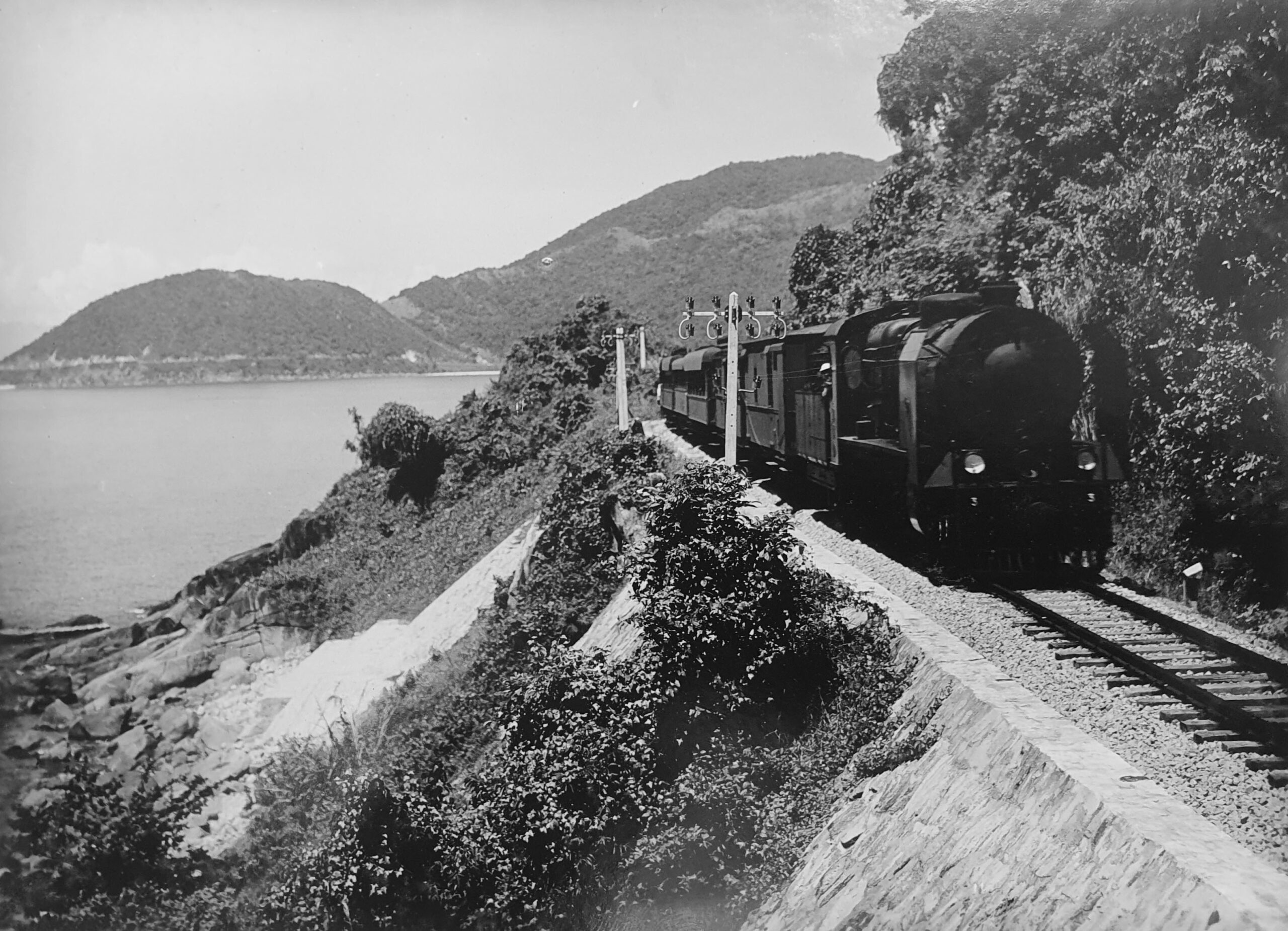
Corniche du Varella (PK 1231), ANOM 8 FI 336 1 Chemins de fer Réseaux non concédés, 1921-1935
Tim Doling is the author of The Railways and Tramways of Việt Nam (White Lotus Press, Bangkok, 2012) and also gives talks on Việt Nam railway history to visiting groups.
A full index of all Tim’s blog articles since November 2013 is now available here.
Join the Facebook group Railways and Tramways of Việt Nam for more information about Việt Nam’s railway and tramway history and all the latest news from Vietnam Railways.