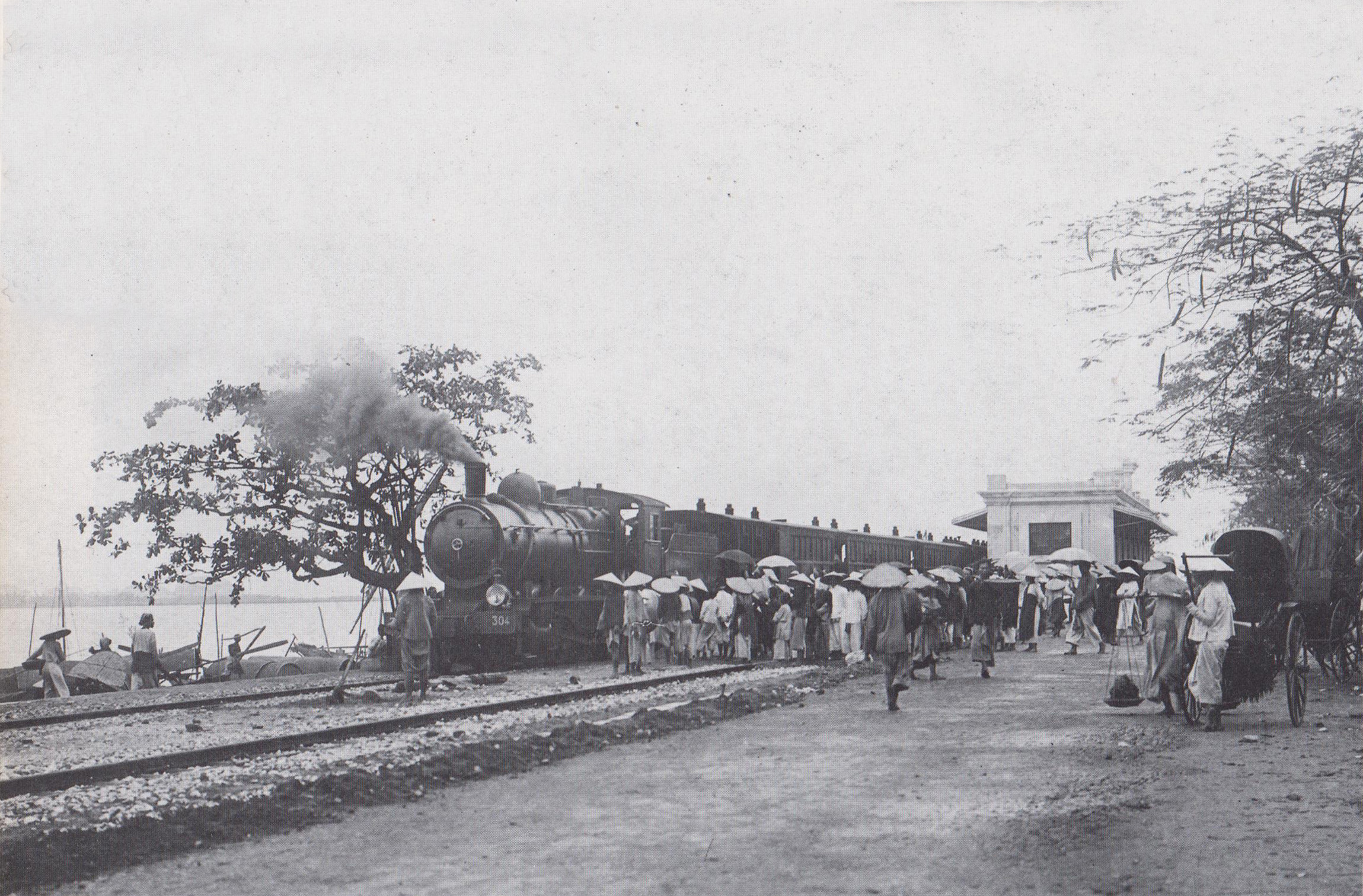
“Ten-wheel 230 locomotive No 304, departing from Tourane Marché, the starting point of the central Tourane-Hue section, which would be served only as a branch line from Tourane Centrale after the completion of the Transindochinois railway line,” Collection Paul Carenco
A railway sabotage incident in Tourane (now Đà Nẵng) on 26 April 1930 was initially suspected to be the work of nationalist or communist insurgents targeting the French colonial authorities. However, it was subsequently revealed to have been a failed assassination attempt on the King and Queen of Siam.
In the early morning hours of Saturday 26 April 1930, the 05.29 Tourane Marché to Huế passenger train was derailed at km 12+500, just 500m before it was due to cross the Nam Ô bridge. Investigations later revealed that the derailment had been caused by sabotage; five sections of track measuring around 80 metres had been unbolted and removed overnight. The locomotive and tender, a baggage car and two third-class passenger carriages were derailed and overturned. Fortunately there were no fatalities, but four passengers and seven members of railway and postal staff sustained minor injuries.
Despite the severity of the incident, repairs were carried out quickly and normal rail services between Tourane and Huế were restored by the morning of Sunday 27 April 1930.
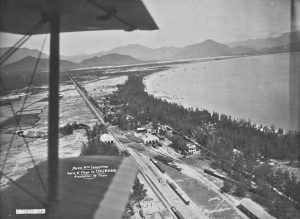
Gare et plage de TOURANE, ANOM 31 FI Agence FOM 2
This incident occurred during a highly-charged period in French Indochina. The abortive Yên Báy Mutiny, organised by the nationalist Việt Nam Quốc Dân Đảng (VNQDĐ) in February 1930, and the subsequent communist-led revolts of the Xô Viết Nghệ Tĩnh in the north-central provinces of Nghệ An and Hà Tĩnh which began in March 1930, had ignited armed resistance to oppressive French rule. Colonial officials suspected that the Tourane railway sabotage incident had similarly been carried out by either nationalist or communist agents and launched an investigation to find the perpetrators.
The incident sparked widespread fear among Tourane’s French community, many of whom feared that the railway sabotage might signal the start of a broader anti-French uprising in Annam. A delegation of civic leaders from Tourane immediately went to meet with Résident Supérieur Aristide Eugène Le Fol of Annam in Huế, urging the reinforcement of the French military presence in Tourane. The official response was that “the European section garrisoned in Tourane is more than sufficient for the time being.” Nonetheless, the authorities took the matter seriously. Le Fol, accompanied by “the Prime Minister of the Court of Huế,” travelled to Tourane on Monday 29 April to assess the situation.

King Rama VII of Siam, also known as King Prajadhipok (reigned 26 November 1925-2 March 1935)
It was subsequently revealed that the real target of the railway sabotage incident was King Rama VII (Prajadhipok) and Queen Rambai Barni of Siam, who were on an official visit to Indochina at the time. A reporter from the La Volonté Indochinoise newspaper uncovered this information, but faced significant delays in transmitting the story by post and telegram due to colonial censorship. Consequently the news of the assassination attempt would not be publicly disclosed until early May 1930.
After arriving in Indochina by royal yacht at Cap-Saint-Jacques, King Prajadhipok and Queen Rambai Barni had met Governor General Pierre Pasquier in Saigon. They then returned to Cap-Saint-Jacques with the intention of travelling by sea to Tourane and Huế. However, because of an impending typhoon, they had been obliged to dock in Nha Trang and travel by road from there to Tourane.
On the day of the incident, 26 April 1930, a special train had been arranged to take the royal couple from Tourane to Huế, where they would tour the Imperial Citadel and meet with senior court officials. At this time, the young Emperor Bảo Đại was still living in France.
According to state railway policy, a test train would be sent in advance of any official train service carrying an “illustrious figure,” to check security and ensure the safety of the track. Unfortunately, on this occasion, the “test train” was a scheduled passenger service, with a large number of local passengers aboard.
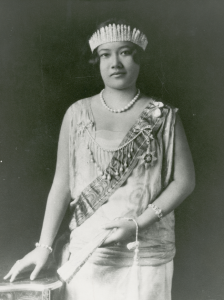
Queen Rambhai Barni of Siam (1904–1984)
In a fortunate twist of fate, the royal couple decided at the last minute to cancel their train journey in favour of traveling by car to Huế to enjoy the spectacular scenery of the Hải Vân Pass.
Setting out from Tourane along Route Coloniale No 1, they soon arrived at the scene of the derailment. A Thai source reports that King Prajadhipok, who was a passionate amateur filmmaker, stopped and used his own film camera to document the railway sabotage incident.
Following their official visit to Huế, the royal party returned by car to Tourane, sailed by royal yacht back to Nha Trang and continued their travels with a road trip to Đà Lạt. They eventually returned to Phan Thiết where, amidst greatly increased security, they caught a train back to Saigon before heading to Cambodia.
The failed assassination attempt on 26 April 1930 remains shrouded in mystery. Despite the investigation, the motives behind it have never been fully explained and the perpetrators were never apprehended. The incident nonetheless stands as an intriguing moment in the turbulent history of colonial Indochina.
Thanks to Stefan Hell for locating the sources on this incident:
L’Echo Annamite, 28 avril 1930, p 1, 29 avril 1930, p 1.
La Tribune Indochinoise, 28 avril 1930, p 4.
La Volunté Indochinoise, 27 avril 1930, p 4, 28 avril 1930, p 2, 30 avril 1930, p 2, 4 mai 1930, p 1.
Rom Bunnag, “King Rama VII’s Adventures in Indochina: Storms, Communism! Lady-in-Waiting Dies!” 18 January 2016, https://mgronline.com/onlinesection/detail/9590000005781
Tim Doling is the author of The Railways and Tramways of Việt Nam (White Lotus Press, Bangkok, 2012) and also gives talks on Việt Nam railway history to visiting groups.
A full index of all Tim’s blog articles since November 2013 is now available here.