Icons of Old Saigon – Etablissements Bainier Auto Hall, 1927

Bainier 1

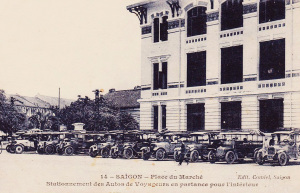
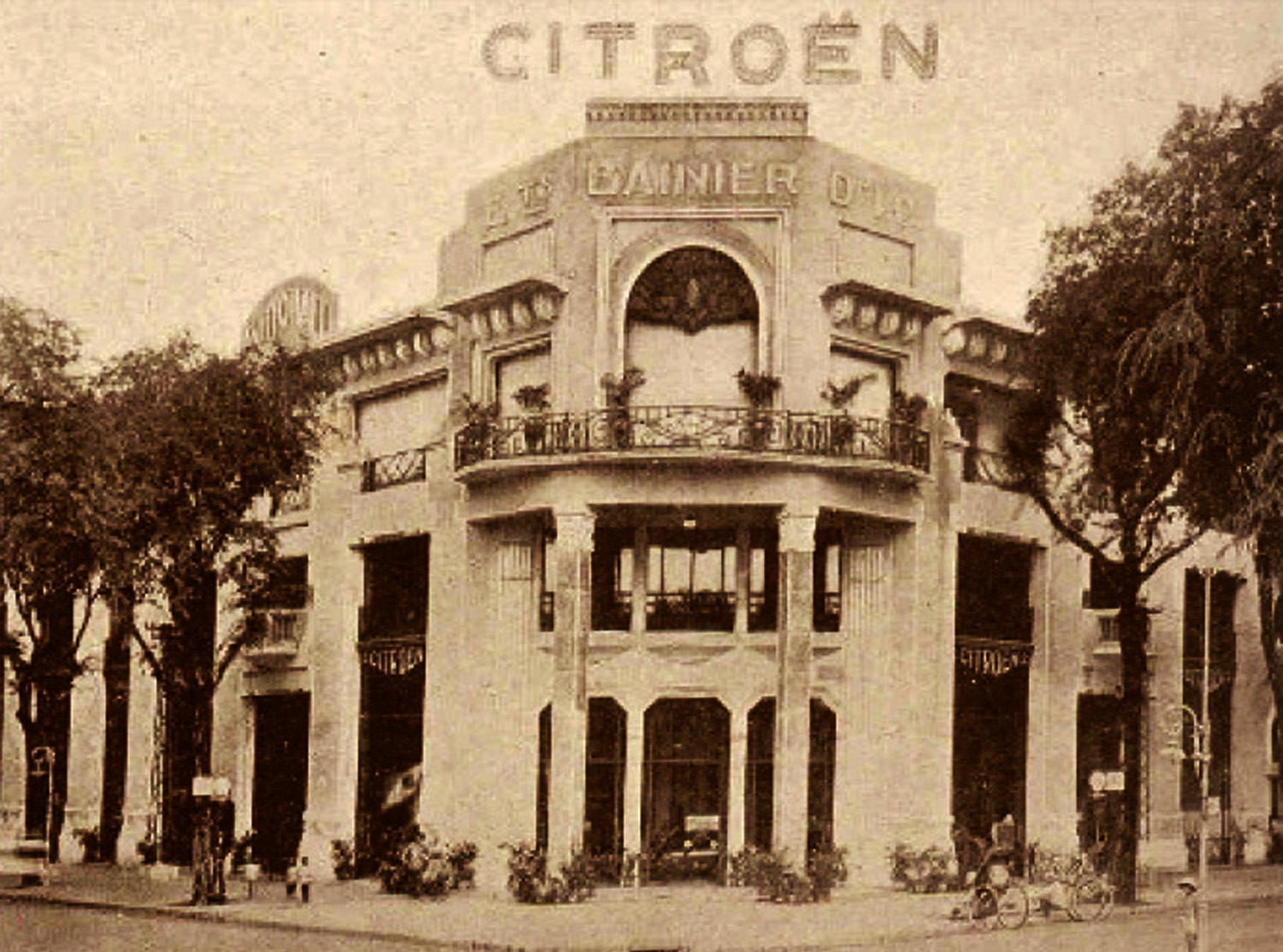
The Établissements Bainier Auto Hall, pictured soon after it opened in 1927.

This article was published previously in Saigoneer http://saigoneer.com

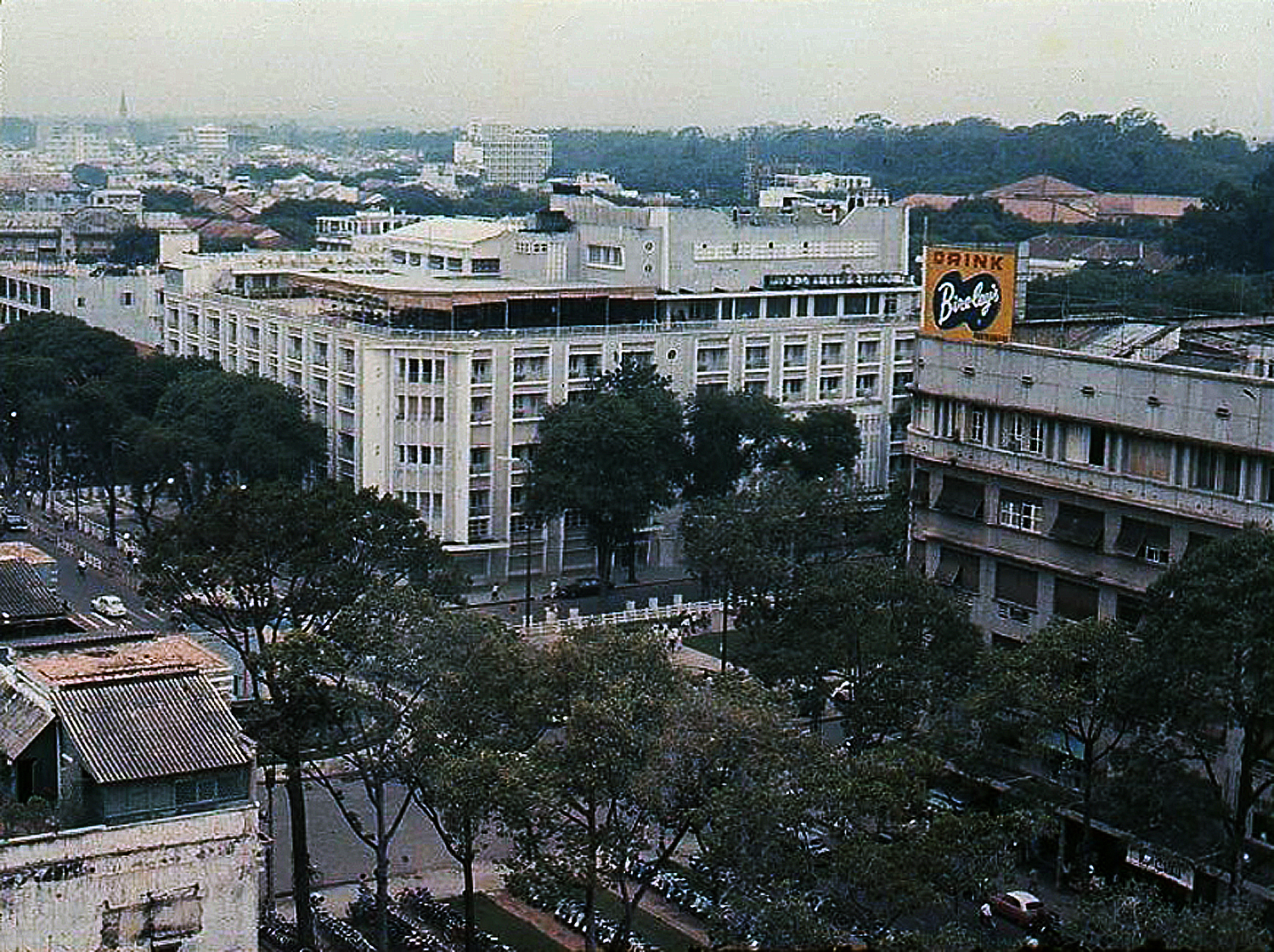
While foreign visitors still flock to the famous Rex Hotel, few have heard of the Établissements Bainier Auto Hall which preceded it, a building once feted as the greatest automobile dealership in Asia.

Little is known about the early life of company founder Émile Bainier, other than the fact that he was a skilled mechanic who arrived in Saigon and set up his own business in around 1908.

15A Paul Blanchy

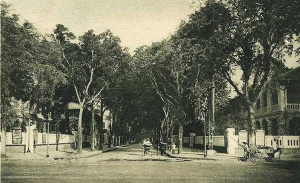
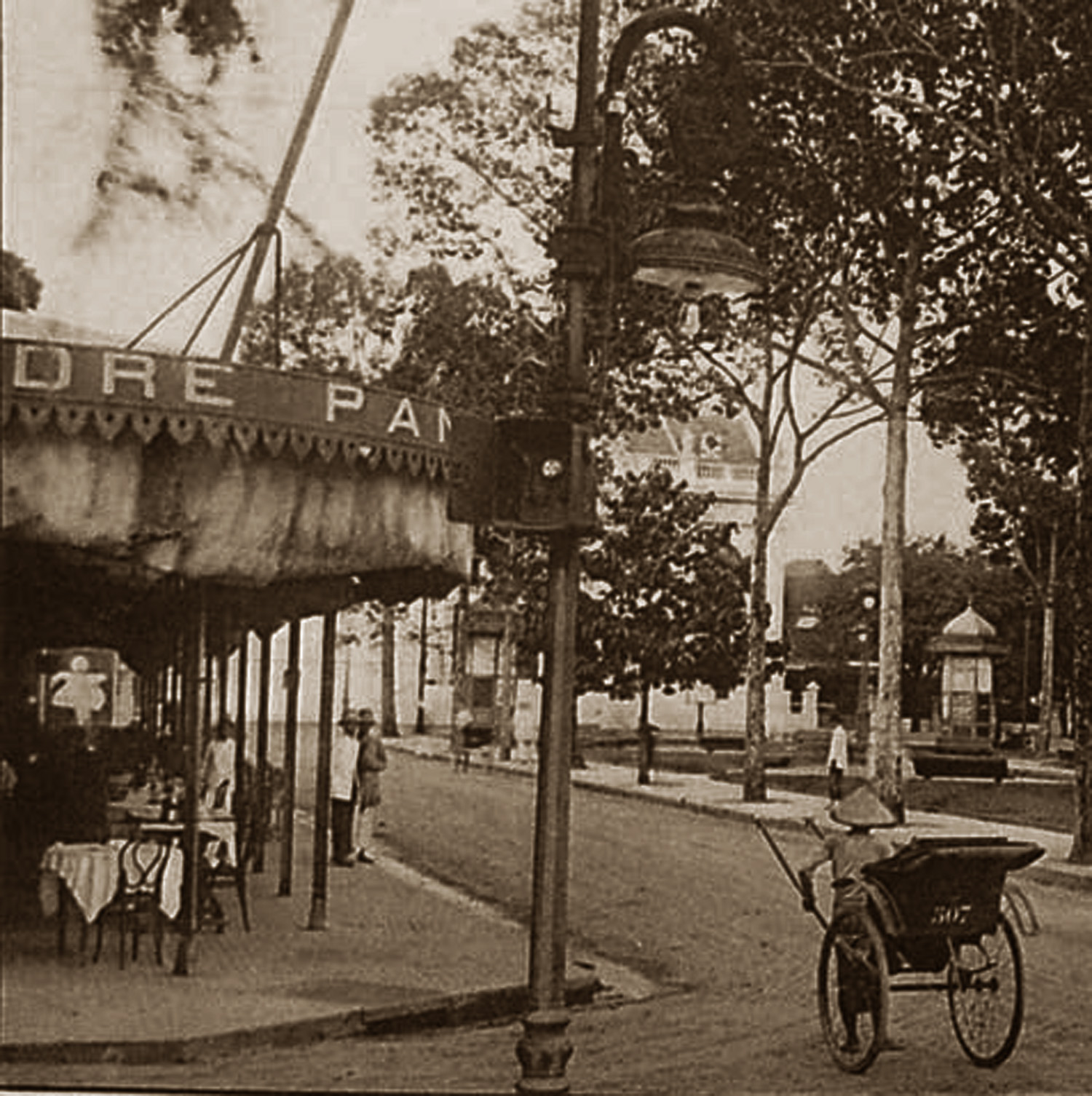
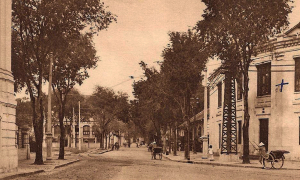
Rue Paul Blanchy [Hai Bà Trưng street], viewed from place Francis Garnier [Lam Sơn Square].

On 26 April 1909, it was Bainier who demonstrated to a group of distinguished guests the colony’s very first public bus. According to an article of that month in the Écho Annamite newspaper, “At 16h.30, the bus, driven by Monsieur Bainier, travelled a pre-planned route through the city. Arriving at the bottom of rue Paul Blanchy [Hai Bà Trưng street], it stopped at a garage in which a table had been set up, laden with glasses of champagne. After drinking to the success of this new form of locomotion which had thus been launched on our streets, the guests returned by the same route, observed by a great crowd of onlookers.”

In 1911, Bainier became the Director of the Garage Ippolito, a Peugeot dealership run by the Société d’automobiles Ippolito et Cie, which had made its name in 1901 by launching the very first automobile courier service from Saigon to Phnom Penh. However, in 1914, Bainier parted company with the Garage Ippolito and set up his own business, the Société Anonyme des Établissements Bainier. Initially based at 40 boulevard Bonnard, it specialised mainly in electrical and electro-mechanical equipment, but also sold auto-pousses and voiturettes (miniature automobiles).

First Bainier

The first Établissements Bainier Auto Hall at 21 boulevard Bonnard and 100-102 boulevard Charner, situated diagonally opposite the company’s later premises.

By 1920, the Société Anonyme des Établissements Bainier had moved to more imposing premises, the first Établissements Bainier Auto-Hall at 21 boulevard Bonnard [Lê Lợi boulevard] and 100-102 boulevard Charner [Nguyễn Huệ boulevard], where it became a full-blown automobile dealership, advertising itself as the exclusive agent for Darracq, Unic, Dodge Brothers and the recently-established Automobiles Citroën.

The company also acquired a fleet of service vehicles, and in 1922 it won the concession to run the thrice-weekly Saïgon-Phnom Penh bus and postal service, which departed from the Saigon Post Office at 6am on Tuesdays, Thursday and Saturdays. By this time, the company also had a large branch office in Phnom Penh, which launched the first metered Citroën taxi service in that city in 1925.

Unfortunately for Bainier, the reputation of his business sustained some damage in June 1926, when the Écho Annamite newspaper reported the case of a wealthy Vietnamese man who had bought a brand new Citroen 10CV car from the Bainier Auto-Hall. When he complained that it was not ready for collection at the agreed time, the man was subjected to racist comments by one of the European garage staff. In response, Bainier was obliged to issue a public apology and to declare in the newspaper that his company made no distinction between local and European clients and that, in fact, most of its sales were to local people.

Bainier C i

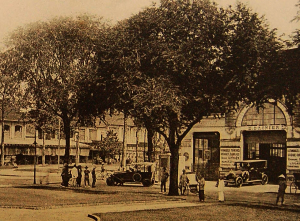
Another view of the Établissements Bainier Auto Hall, soon after it opened in 1927.

Despite this minor PR setback, the company’s sales and earnings increased steadily throughout the 1920s, largely due to its exclusive dealership of the increasingly sought-after Citroën marque. In 1926, seeking to build upon this success, Bainier commissioned the construction of a brand new Auto-Hall, situated diagonally opposite the old one at the junction of boulevards Charner and Bonnard.

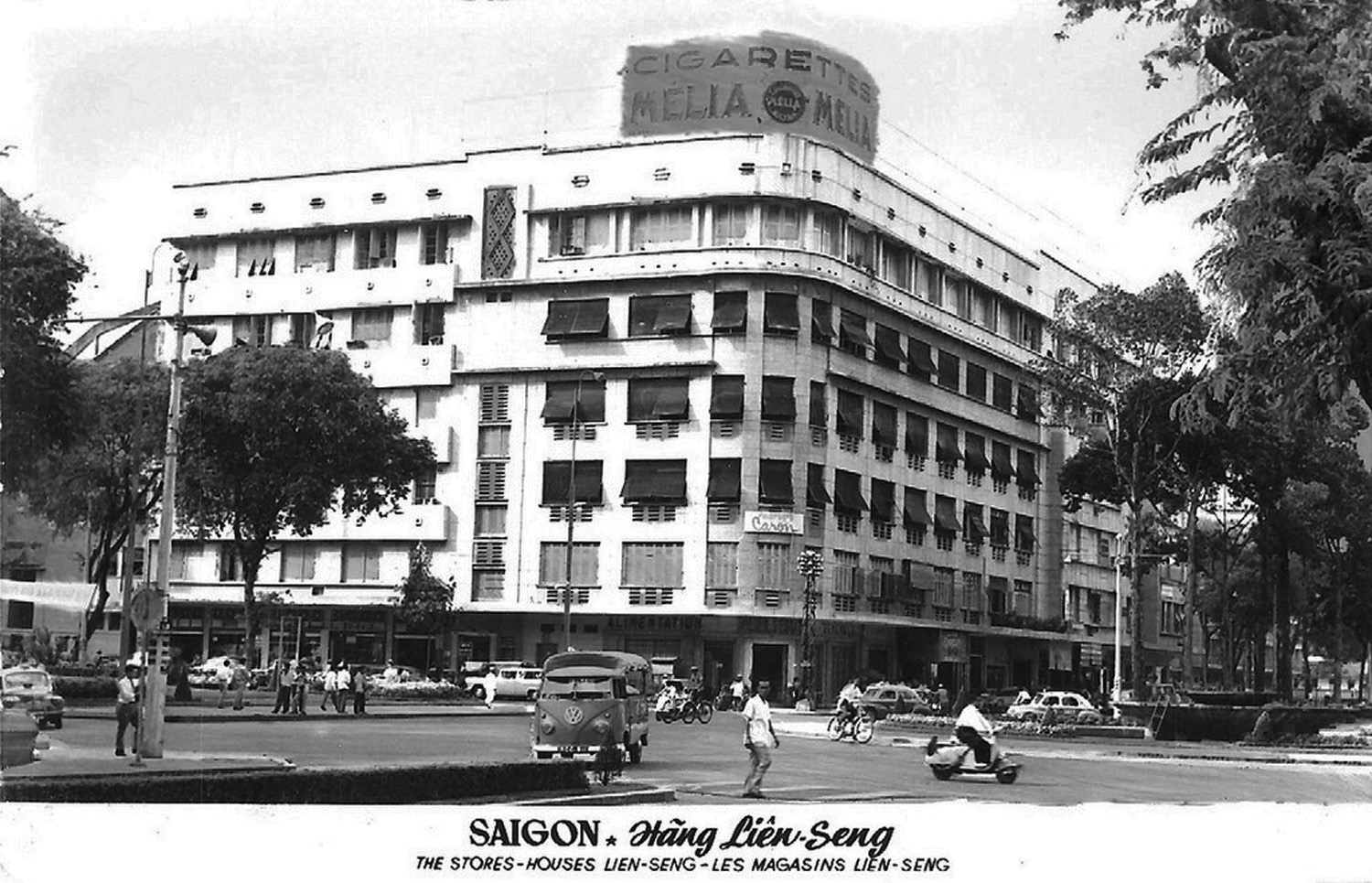
The new Établissements Bainier Auto-Hall was inaugurated in March 1927 amidst great fanfare. According to a report in the Écho Annamite newspaper of 21 March 1927, the new premises were located just across the road from the recently-opened Grands Magasins Charner, “of which they constitute a beautiful and worthy counterpart,” and “occupied the entire block leading up to rue d’Espagne [Lê Thánh Tôn street].”

“It has been said of the new Bainier garages that they are the most beautiful in the Far East, and that they yield nothing to similar ultra-modern buildings in proud America,” continued the press report. “Skeptics might think that this is pure advertisement. Well, they would be wrong, because we believe that it would be impossible to design garages more elegant or better suited to the purpose for which they are intended. Imagine a gigantic hall, with no columns obstructing the central area, where air and light circulate profusely, without recourse to a glass roof… Here, a system of overlapping corrugated roofs lets in the bright light of the tropical sun without any risk to the employees who work in the building. The builder has indeed created a masterpiece.”

Bainier 3

The “Grand Hall Bainier” viewed through its windows.

By this time, Établissements Bainier had branches in Saigon, Hà Nội, Tourane, Huế and Phnom Penh, totalling 16,800m² of floor space and employing a workforce of 25 Europeans and 300 local staff.

The remarkable design of the new Établissements Bainier Auto Hall in Saigon was reported widely by both local and international press, and the building quickly became an attraction in its own right. On 19 November 1927, the new “Grand Hall Bainier” was “generously made available” for a grand society ball organised to raise money for victims of the Great War. Then in 1928, the Paris newspaper La Lanterne reported that “His Majesty King Monivong of Cambodia, visiting the city of Saigon, stopped to visit the largest garage in the Far East, that of M Émile Bainier, exclusive concessionnaire of Automobiles Citroën in Indochina.”

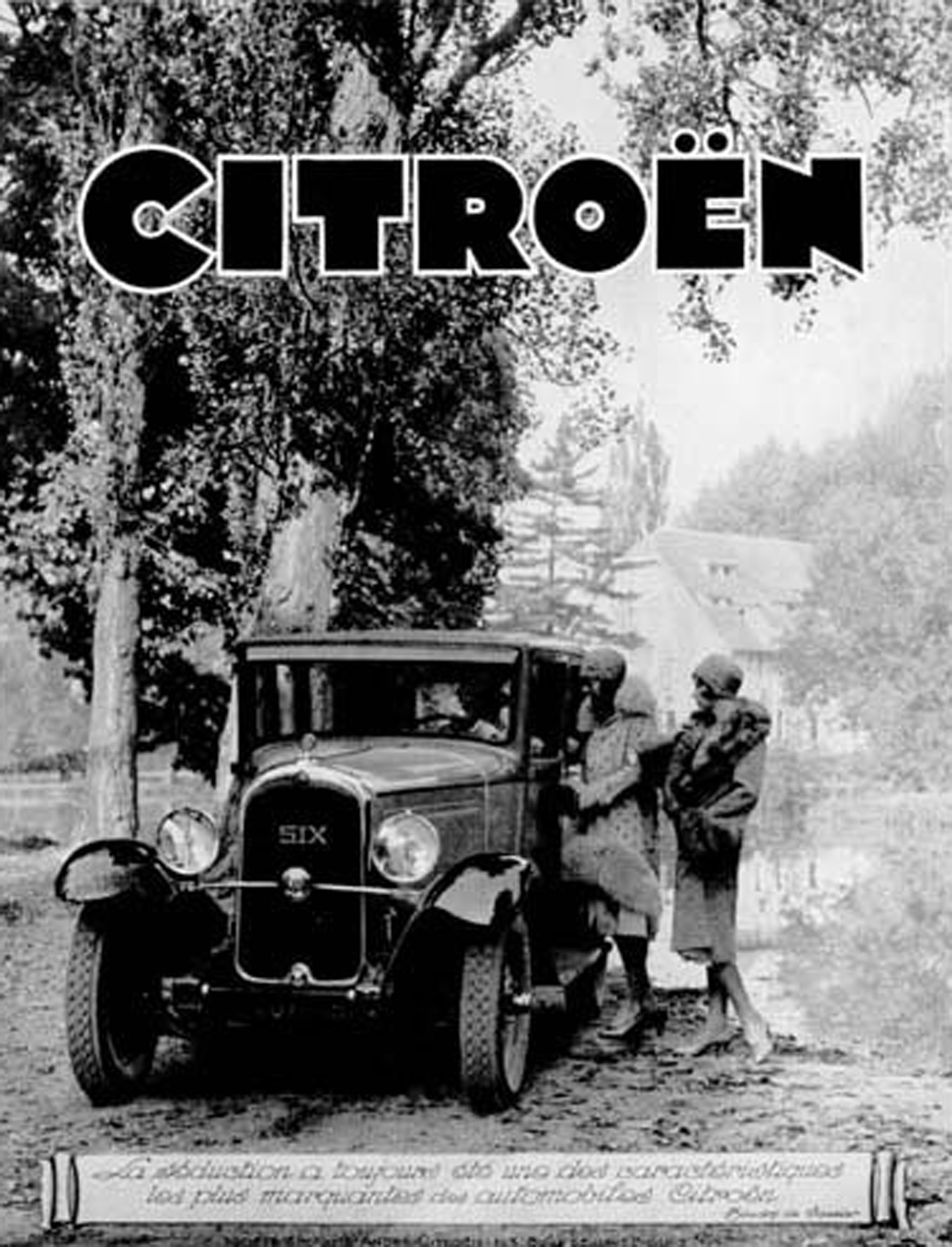
The following year, 1928, was one of the company’s most successful, thanks mainly to the “great sensation” caused by the release of the brand new six-cylinder Citroën C6, with its “moderate price and exceptional qualities.” The car sold spectacularly well in Cochinchina, and in that same year, Bainier himself was awarded the Order of the Légion d’Honneur for his services to the colony.

c6-ad

An advertisement for the six-cylinder Citroën C6 of 1928, one of the Établissements Bainier’s best-selling vehicles.

With the onset of the Great Depression in 1929, the company suffered a drastic loss of income, obliging it to downsize its operations. According to the annual reports of its Conseil d’Administration, the Société Anonyme des Établissements Bainier recorded significant business losses throughout the period 1931-1935. But the biggest blow came in 1933, when it lost the prized Citroën concession.

Établissements Bainier did not return to profitability until the late 1930s. By that time it had become the main Indochina dealer for Unic, Delahaye, Rosengart, Motoconfort and Mobylette cars and motor cycles. However, having lost the prestigious Citroën dealership, it never recovered its former pre-eminence.

For Émile Bainier, the 1930s were difficult years. When he died in early December 1941, the troubles of that period were alluded to by a brief obituary in Le Nouvelliste d’Indochine, dated 14 December 1941:

“Saigon has learned with great sadness of the death of M Émile Bainier, President and founder of the Société Anonyme des Établissements Bainier. We’ve lost one of our oldest residents, who has worked hard in this country for over 30 years, and his demise leaves deep regrets. A man of duty, honest, sometimes stubborn, but always fair and good, he was typically a self-made man who built his own destiny. He brought a remarkable lustre to the Cochinchina automobile industry and, like so many others, suffered many adversities without complaining. Through his hard and intelligent work, he repaired the damage which had been inflicted on his business. This was his last satisfaction.”

Bainier B i

A Mobylette advertisement of the early 1950s.

Bainier’s widow and her son Jacques Bainier continued to run the Établissements Bainier for the remainder of the colonial period, but some time after 1953 the garage was closed and the family sold up and returned to France. The new owners, Prince Nguyễn Phúc Ưng Thi and his wife Nguyễn Thị Nguyệt Nga, had the old building demolished and hired local architect Lê Văn Cấu to design in its place the six-storey Rex Hotel, Commercial Centre and Cinema. Following its completion, most of the complex was leased to the Americans. And the rest, as they say, is history.

IMAGE 8

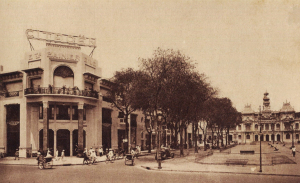
The exterior of the Établissements Bainier Auto Hall.

29citroen4-6

The Citroën C6 of 1928, one of the Établissements Bainier’s best-selling vehicles.

IMAGE 9

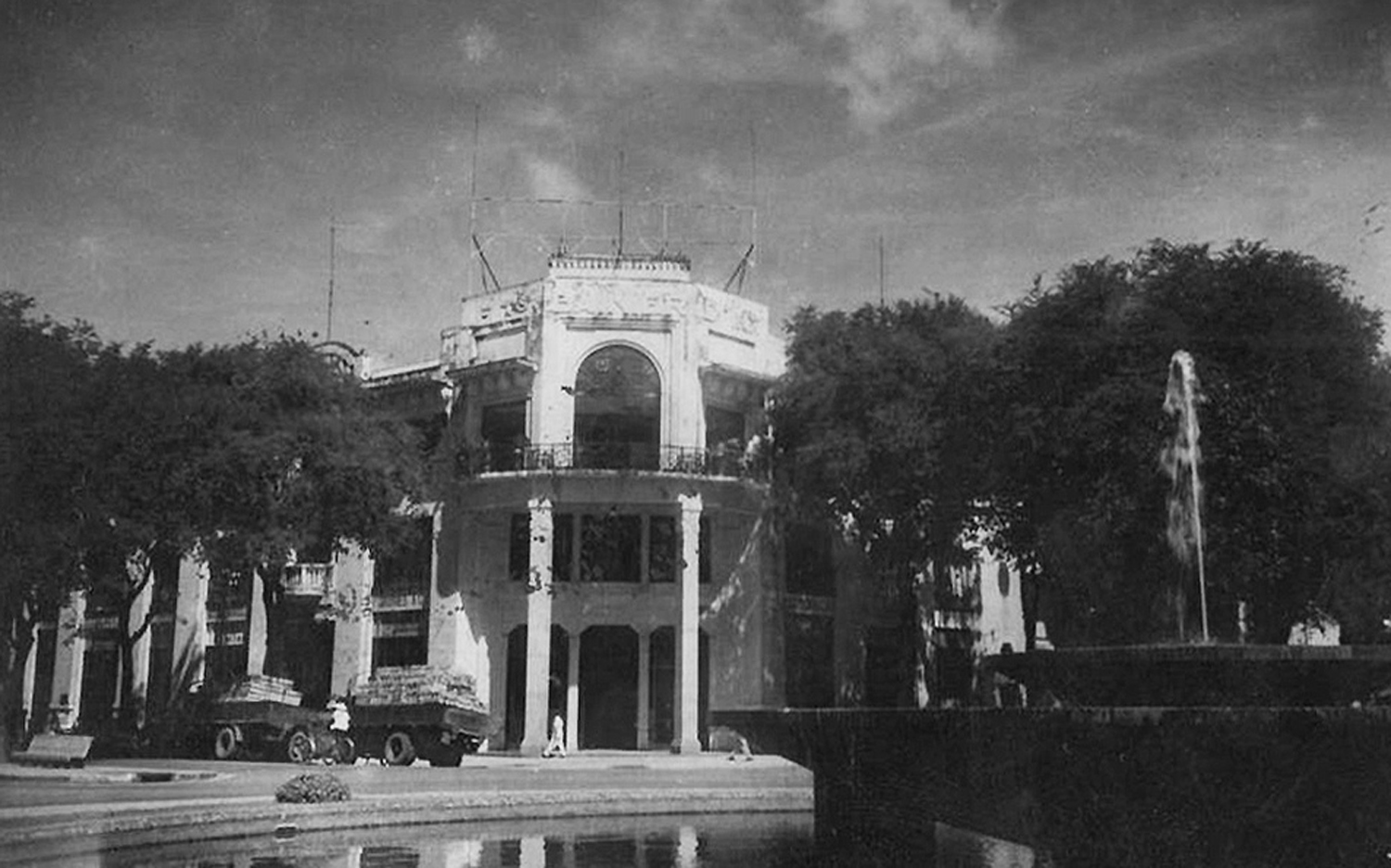
The Établissements Bainier Auto Hall in the early 1950s.

IMAGE 10

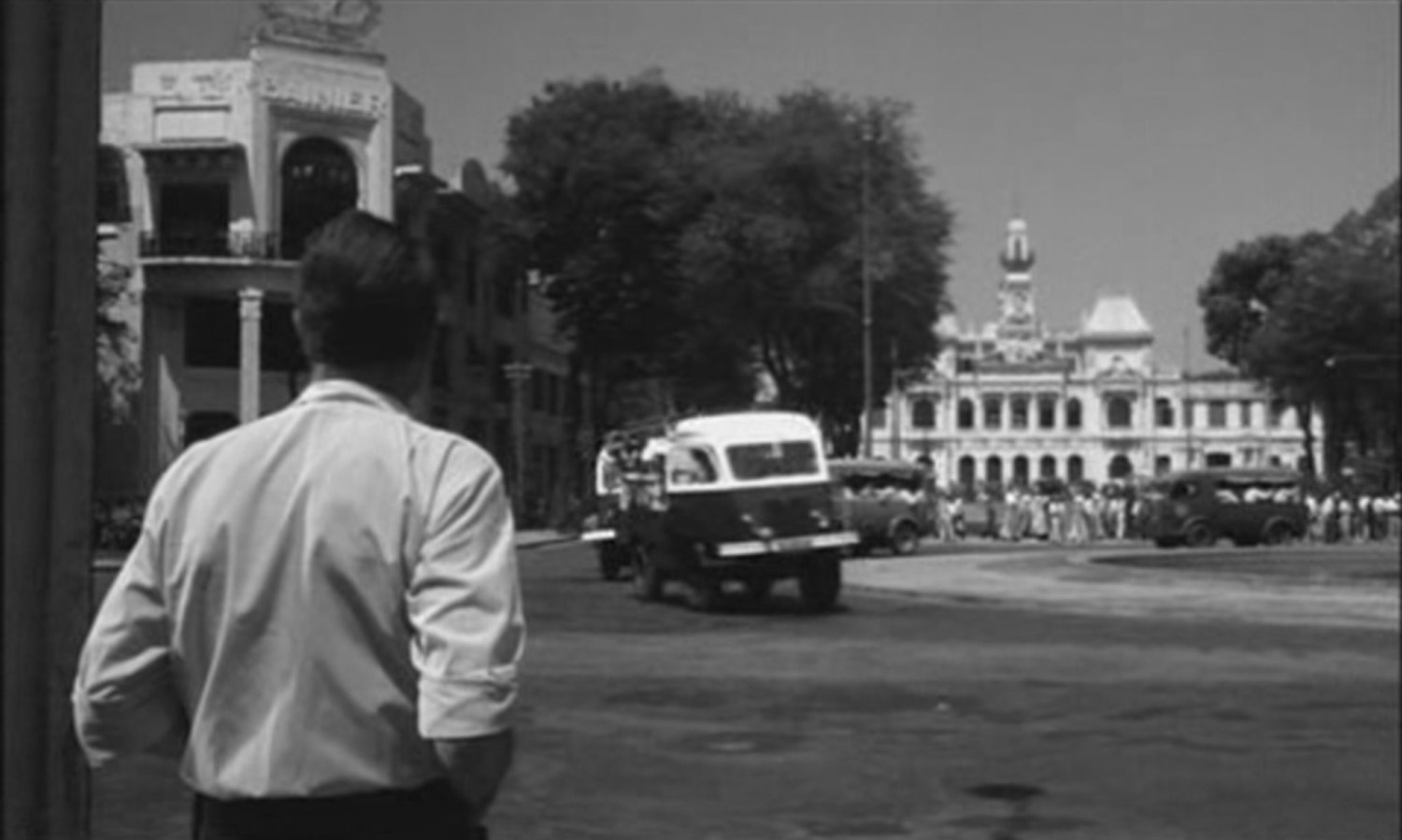
In this scene from the 1958 Joseph L Mankiewicz film of Graham Greene’s The Quiet American, Thomas Fowler (played by Michael Redgrave) stands outside the “big store on boulevard Charner” to witness the events of “Operation Bicyclette.” At the time the film was made, the Établissements Bainier Auto Hall was about to be demolished.

IMAGE 11

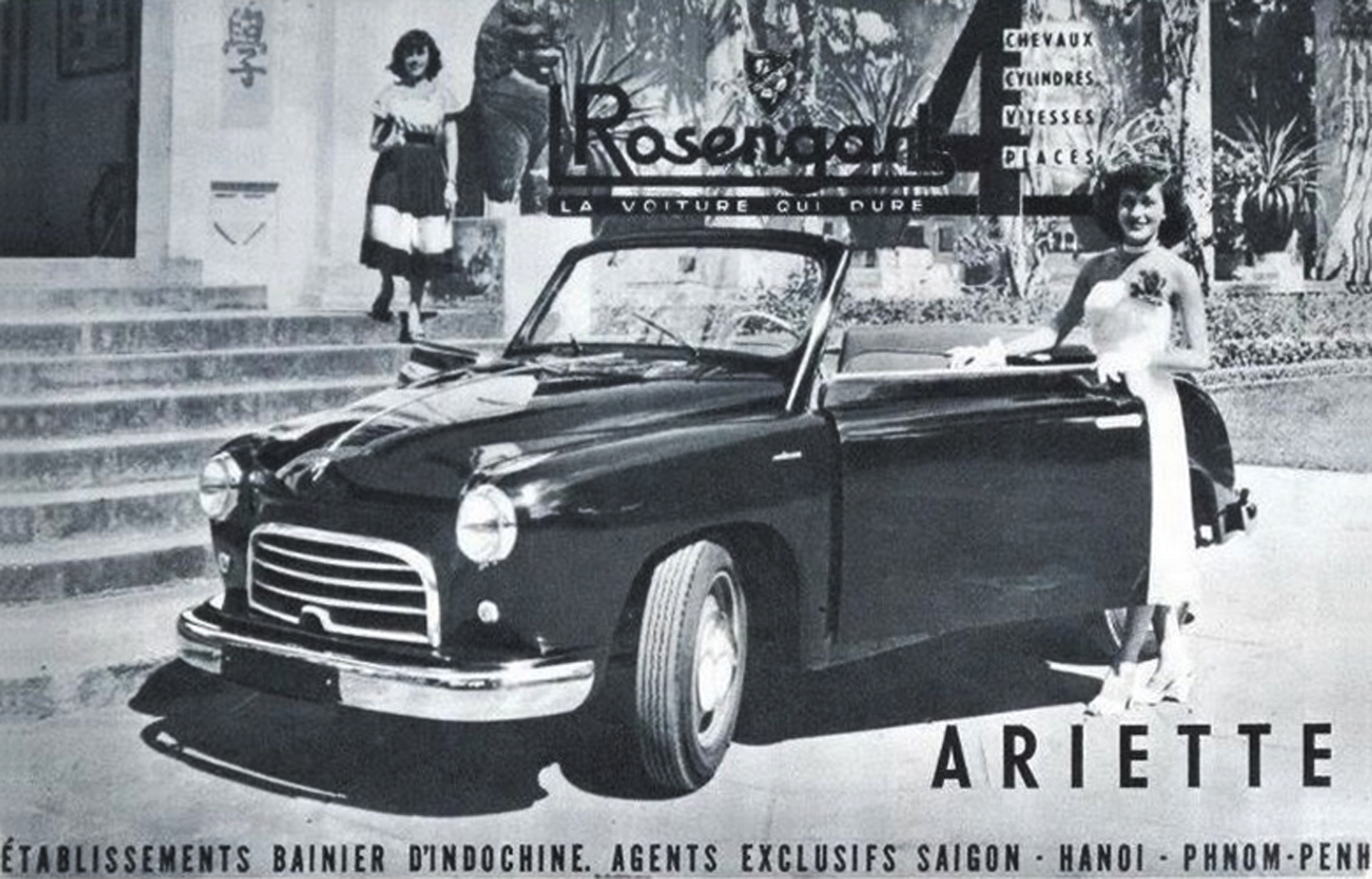
A Rosengart advertisement of the early 1950s.

IMAGE 12

The Rex Hotel Complex which replaced the Établissements Bainier Auto Hall in 1959, pictured in 1965.

Tim Doling is the author of the guidebook Exploring Saigon-Chợ Lớn – Vanishing heritage of Hồ Chí Minh City (Nhà Xuất Bản Thế Giới, Hà Nội, 2019)

A full index of all Tim’s blog articles since November 2013 is now available here.

Join the Facebook group pages Saigon-Chợ Lớn Then & Now to see historic photographs juxtaposed with new ones taken in the same locations, and Đài Quan sát Di sản Sài Gòn – Saigon Heritage Observatory for up-to-date information on conservation issues in Saigon and Chợ Lớn.

Saigon and Cho Lon – The Impressions of Colonial Lawyer George Durrwell in 1910, Part 3

090_001 (2)

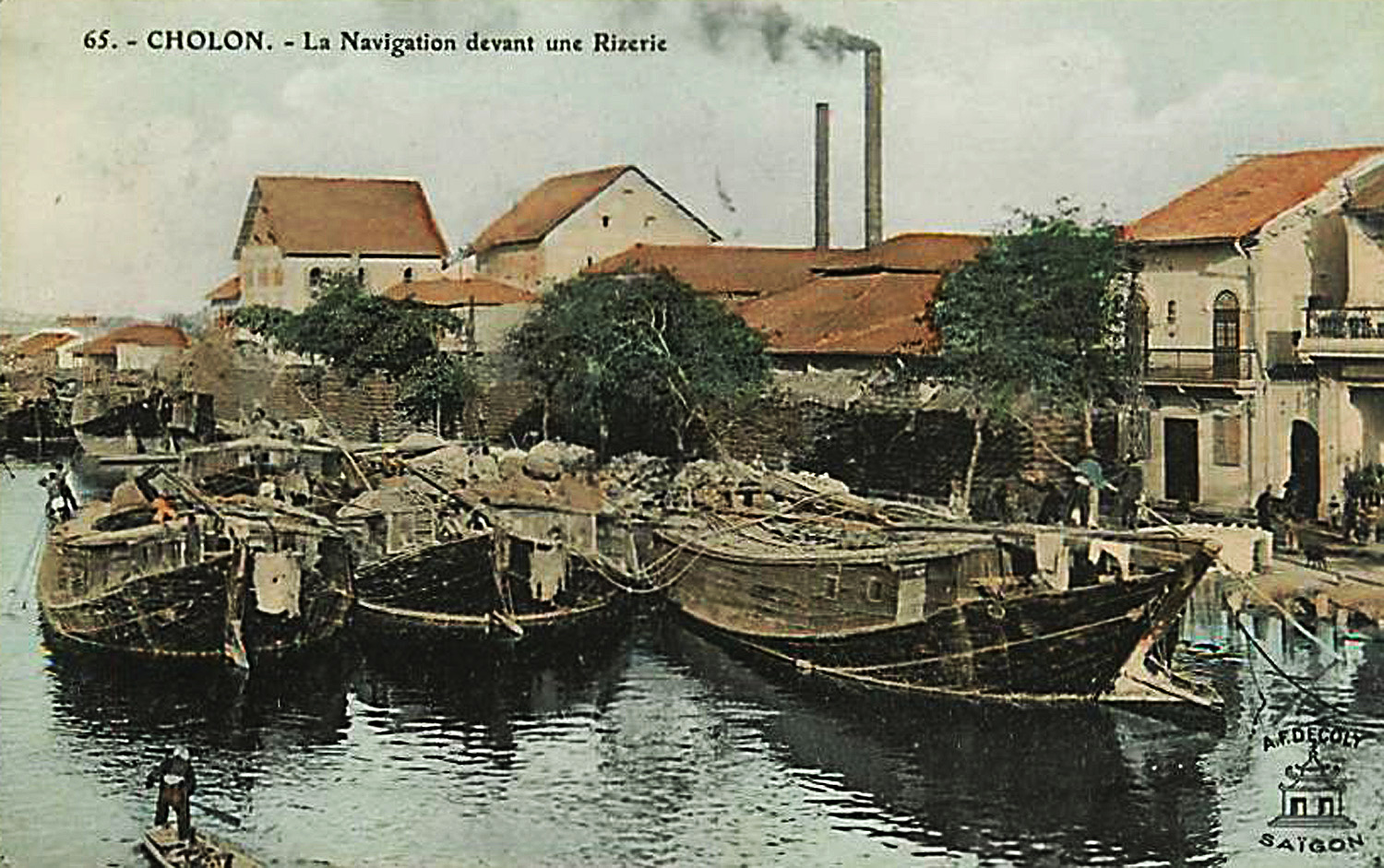
Chợ Lớn – barges in front of a rice factory

George Dürrwell spent nearly three decades working for the Cochinchina legal service. His 1911 memoirs, Ma chère Cochinchine, trente années d’impressions et de souvenirs, février 1881-1910 (My Dear Cochinchina, 30 years of impressions and memories, February 1881-1910) afford us a fascinating picture of life in early 20th century Saigon and Chợ Lớn. This is part 3 of a three-part excerpt from the book.

To read part 1 of this serialisation, click here.

To read part 2 of this serialisation, click here.

Let’s now complete our fantastic journey through the streets of Saigon, transporting ourselves along the boulevard Charner, that wide thoroughfare which runs parallel to the rue Catinat and which, in its animation, is somewhat reminiscent of one of the dreary main avenues in the dull city of Versailles. The boulevard runs from the central market as far as the new City Hall.
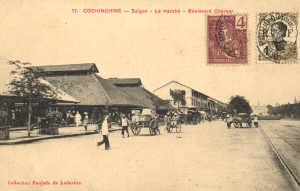
67 Boulevard Charner market

The old Saigon Central Market (1870-1914) on boulevard Charner

A market is always an interesting place to visit, and in every town and village here, it offers the astute observer an opportunity to observe an infinite variety of real-life scenes which reflect local customs. Each market is also a small agricultural show, where the region’s key products are all grouped together. In the Central Market of Saigon, where there is the most variety, Europeans and Asians – Annamites, Chinese and Indians – mingle and jostle, making such a visit even more captivating.

Yet how few of my fellow citizens have ever set foot in the Central Market? I don’t reproach them for this, having ignored it myself for many years, simply because of my lazy reluctance to get up at the early hour when it is at its busiest. However, I finally decided to visit, and if you make the effort to do the same, I can assure you that you will not regret it.
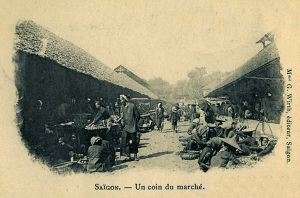
776_001

A corner of the old Saigon Central Market on boulevard Charner

Moreover, the time left to see this market is now short [at the time of writing, the new Halles Centrales, new Bến Thành Market, was being planned]. It seems, in fact, that all the picturesque corners of our old Saigon, of which the dilapidated, rotten, yet so characterful old Central Market is the real centre of attraction, are now condemned to disappear. It’s not for me to discuss here the rights and wrongs of this measure, although I have every reason to believe that not everyone will lose out as a result of the change. But let’s not dwell on this subject.

So, here we are in the old Central Market: it is 7am, and around us is an intense and noisy scene with traders and customers swarming incessantly back and forward.
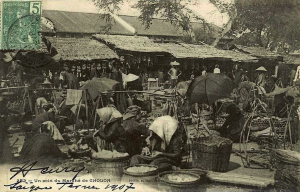
5188225635_b71087e859 Un coin du March de CHOLON_O

Another market scene

Here, in long rows at the edge of the sidewalk, one can see big baskets covered with large woven mesh, which serve as temporary cages for the various types of poultry brought every day by the little tram from Go-Vap. Nearby are piles of indigenous vegetables from the same source, including sweet potatoes and those long white turnips which grow in abundance on the sandy plains of Hoc-Mon.

Next to them, under the watchful eyes of merchants from the countryside, are spread out the seemingly infinite varieties of fruit which are produced throughout the year in this fertile land of Cochinchina. According to the season, these include: juicy yellow mangoes; mangosteens with their tasty white pulp; large oranges from Cai-Be, whose rough green skin contrasts starkly with the gleaming brilliance of small golden tangerines; bulging watermelons with rose coloured flesh; fragrant guavas; bunches of fresh indigenous lychees covered in spines which make them look like tiny curled hedgehogs; and more, many more. Not to mention the mountains of green and yellow bananas, that veritable national fruit of the earth in the land of Nam-Ky.
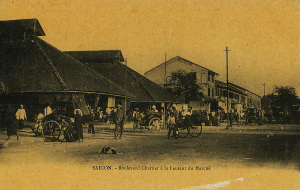
Charner Bvd Market A i

The front of the old Saigon Central Market on boulevard Charner

Further on, market gardeners from the suburbs obligingly spread out their green wares, pale reproductions of our vegetables from Europe, in the middle of which, marking a cheerful note, sit piles of scarlet peppers.

There, in a dark corner of the market, are the Chinese butchers, their appearance and that of their wares leaving much to be desired. They do business side by side with collectors of old scrap, rags and other rubbish. Frankly, that area is not the most attractive place to shop.

And here is the fish market, the best-stocked part of the market, but also the smelliest, due to the acrid and sickening stench of the muddy water.

Tough Indian collectors working for the market administration circulate, demanding sapeks from the traders. Their demands are often resisted loudly by the Annamite merchants, especially the women, and the police are frequently obliged to intervene.
606_001

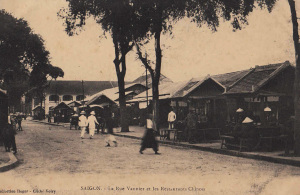
Chinese restaurants on rue Vannier

Along the rue d’Adran [Hồ Tùng Mậu street], right outside the market, small open-air Chinese restaurants are set up on rough benches. It’s here that our cooks and boys line up and gorge themselves at our expense on a variety of steaming concoctions, washed down with a fine drop of choum-choum.

The immediate vicinity of the market, especially the rue d’Adran, is as interesting to visit as the main market pavilions. Watching the crowds of people going back and forth busily in the narrow alleys, it feels like one has been transported into one of the most populated areas of the city of Cholon; indeed, apart from some merchants of Indian fabrics whose shops line the rue Vannier [Ngô Đức Kế street], Chinese commerce reigns supreme here.

On the occasion of the great religious and family celebration of Tết, the market lies idle for two days, and during this period it is impossible to find even a radish in exchange for its weight in gold.
Hotel de ville A i

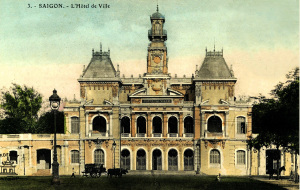
The Hôtel de ville (Town Hall) soon after its inauguration in 1909

The new City Hall is another great attraction of the boulevard Charner, located at the top end of the street. Like the Swing Bridge across the arroyo Chinois, this building has attracted much attention from the press, most of it lukewarm.

It can’t be disputed that the City Hall presents, both as a whole and in its detail, big imperfections. The main entrance steps, which should rise high above the ground in order to comply with the most elementary rules of perspective, exist only in a rudimentary state; the central belfry, which claims to recall the elegant architecture of some city halls in Flanders and the north, is narrow and mean; and the main interior staircase is woefully lacking.

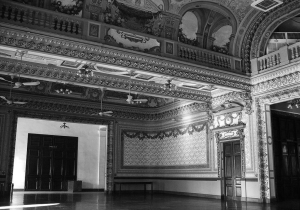
However, these gaps are largely redeemed by the admirable salle des fêtes, that most essential part of the building, even devoid of the lavish artistic decoration that has been bestowed on it, which is really worthy of our beautiful Saigon.
16042501

The salle de spectacles of the Hôtel de ville (Town Hall)

It is supplemented by other rooms especially assigned to the municipal council or reserved for weddings, including a charming reception room.

The solemn inauguration of the Town Hall took place just a few months ago, in February 1909, in the presence of the Governor General of Indochina, and it had the happy inspiration to coincide with the 50th anniversary of the French occupation of Saigon. The loyalty of the Annamites of Cochinchina was affirmed, on this occasion, by the willingness of all to respond to the invitation of the Mayor.

To follow the example of our cities in France, and especially the cities of the southwest, which, without exception, have spawned at least one great man, Saigon has decorated some of its squares with statues. However, these monuments have the merit of reviving genuine national or colonial glories. As for local celebrities, it has wisely been decided that for now their names should simply be given to streets in the city. Sic itur ad astra [“Thus you shall go to the stars,” from Virgil’s Aeneid book IX]
48 Rigault de Genouilly and Chambre de commerce

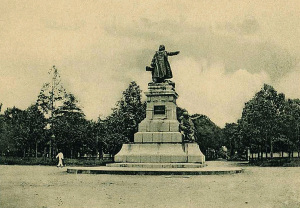
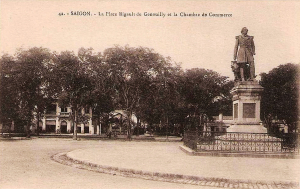
The statue of Admiral Rigault de Genouilly

Next to the Saigon River, facing the naval port, stands the figure of Admiral Rigault de Genouilly, that glorious sailor to whom France owes the conquest of the old capital of Nam-Ky, and who now seems to contemplate the scene of his former exploits from the top of his pedestal. Some 30 years ago, the inauguration of his statue was the object of a great patriotic gathering to which the entire population Saigon was invited.

The inauguration of the Rigault de Genouilly statue was an occasion which lacked nothing in solemnity: the highest authorities of the colony praised the hero of the day in the most generous terms; land and sea troops marched in parade in front of him; a poet celebrated the Admiral in pompous Alexandrine verse; and the youth of local schools performed a cantata featuring the chorus: Come, children of Annamite France, To the land of steam and electricity!

And in those few happy words was summarised the whole of our future programme.
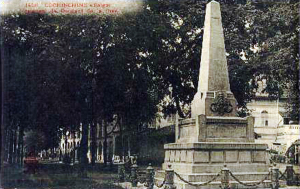
MONUMENT DE DOUDART DE LAGREE

The monument to Ernest Doudart de la Grée

Nearby, a modest pyramid was erected in memory of the famous explorer Ernest Doudart de la Grée. The description of this monument can be found in a technical report to the municipality by one of our former councillors: “It is,” says the report, “a monolith composed of three cemented blocks of granite.” So now you know.

Nor have we forgotten Commandant de la Grée’s faithful companion, the valiant Mekong River explorer Francis Garnier, who remains one of the purest and most sympathetic figures among our early Indochinese pioneers.
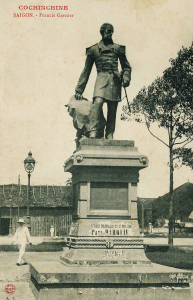
16 Francis Garnier statue

The statue of Francis Garnier

We gave his name to the small square in front of the place du Théâtre and erected a statue there to his memory. Dressed in his naval officer’s uniform, he seems ready to draw his sword in the service of colonial France, to the greatness of which he devoted his entire life. I must admit, however, that the attitude of the statue reminds one greatly of the Jean Rapp monument in one of the squares of the old Alsatian city of Colmar, and it is not the most attractive to look at.

Occupying pride of place in the place de la Cathédrale is a statue of Monsignor Pigneau de Béhaine, Bishop of Adran. In the last years of the 18th century, he was a wise counsellor to the great Emperor Gia Long, and the true inspirer of the Versailles Treaty which opened up Annam to French influence.
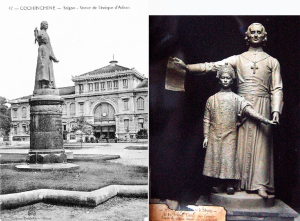
4137231145f526cba679o1

The Pigneau de Béhaine statue which once stood in front of the Cathedral

The statue, inaugurated in 1902, is the work of our friend Édouard Lormier, the author of the Monument aux sauveteurs (Lifeguard Memorial) in Calais, who created a real tour de force by treating a rather awkward subject with great artistic originality.

The statue depicts the venerable prelate in a standing pose, presenting him as a tall and commanding figure, thanks to his long, tightly buttoned cassock and the narrow plinth on which he stands. At his feet, in ceremonial costume, is his beloved pupil, the little prince Canh, eldest son of Gia Long, to whom he is seen presenting a copy of the alliance and pact of friendship signed between the two kingdoms. The physiognomy and attitude of the child is also charming, and the group, though somewhat mannered, creates, in short, a beautiful overall effect.
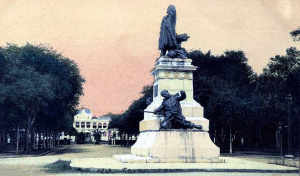
102 Gambetta statue

The Gambetta monument

Nearby, in the midst of the shaded lawns of boulevard Norodom, is Léon Gambetta himself. Wrapped in a large fur coat which seems somewhat inappropriate in our sunny Cochinchina, the great orator stands, head slightly thrown back, apparently addressing the crowds. His extended right arm seems to envelop the whole city with a sweeping and protective gesture. The two subjects flanking the monumental pedestal – a sailor and a mortally wounded naval infantryman – cut a fine figure, recalling the glorious role played Gambetta in the epic of the Défense nationale. The statue inspires the relentless admiration of all the good Nha-que who visit the capital.
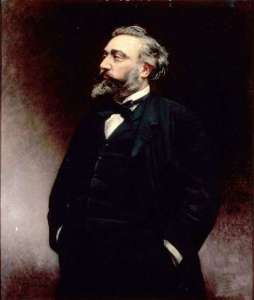
LéonGambetta

French statesman Léon Gambetta (1838-1882)

In fact, the Gambetta monument on boulevard Norodom has a history that could serve as a theme for some amusing production in the Théâtre du Palais-Royal. Here it is in a nutshell.

The premature death of Gambetta, which inspired genuine public mourning in France, also caused deep emotion here in Cochinchina. In response, seeking to interpret faithfully the common sentiment, our local assembly decided to perpetuate his memory by raising a dignified statue to him in one of our Saigon squares. The funds were voted by acclamation, and one of our honourables, then on leave in Paris, was charged with commissioning the work.

Our man, thus given a mandate, made his choice among the great artists of the capital, and that choice was good; a few months later, the desired monument arrived safely. Everything was going well.
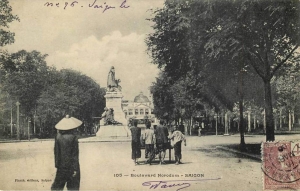
Gambetta B i

Another view of the Gambetta monument

But we had reckoned without the patriotic zeal of our deputy. The confusion resulting from his informal intervention was not long in coming. One morning, the mayor was informed that another large box labelled “statue – fragile” had just arrived at his address. A duplicate statue had been mistakenly produced and delivered to Saigon. The excitement was great, but so was the embarrassment, because a large monumental statue is rather more difficult to refuse than a simple parcel sent cash on delivery. The Mayor had a good practical solution: the duplicate was given to the deputy who had rashly ordered it, and he was obliged to pay for it. It was cruel but logical, and in our good Cochinchina, where money comes easy, a compromise solution was not even offered. In this way, Saigon is even now in possession of two Gambetta statues. The one we all know is proudly located in the sunlight of boulevard Norodom, while the other is stored and long forgotten, buried for years in the white wooden coffin in which it once made its long and unnecessary trip to our overseas territories.
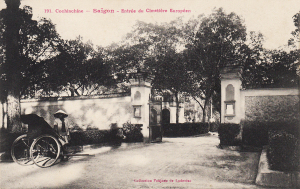
9241469314_1f58d4a19d_o

The main gate of the European cemetery

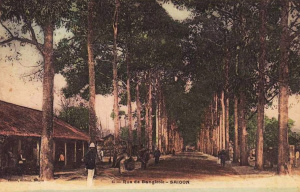
Arriving at the end of the long avenue lined with sao trees named rue de Bangkok, one reaches the entrance to the great Saigon necropolis, which is open to all.

It is here that Cochinchina keeps the remains of officials who have fallen foul of the deadly climate, old disillusioned settlers who have succumbed to hard work, bright future officers struck down far too early and poor young soldiers whose weeping mothers wait in vain for their return. Here they all sleep side by side, and alas, there are far too many of them!

The Saigonnais, who are always rather careless about tomorrow and even cheeky in the face of the death that awaits them, refer to this large cemetery by the graceful name of the “Jardin du père d’Ormay” (Father d’Ormay’s Garden).
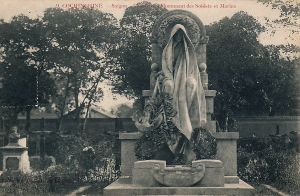
IMAGE 5

A military monument in the European cemetery

In order to explain this etymology, I must tell you that the said Father d’Ormay whose sympathetic memory has indeed remained very much alive in Saigon, once occupied the high functions of Director of the Public Health Service and of the Military Hospital.

Pierre Loti dedicated some beautiful pages of his work L’Indochine Coloniale – Un Pélerin d’Angkor to a description of this special garden. In heartfelt lines of poignant melancholy, he spoke of these French graves, dug so far from the land of France. However, none of them has been completely abandoned, and in default of family, all of the deceased may still count on a friendly hand to care for their graves and make floral tributes.

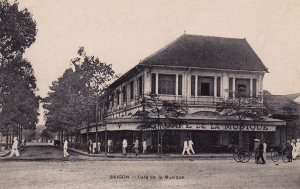
Saigon also has two other public parks, large exotic gardens with shady paths and flowerbeds. However, with the exception of the days of “La Musique,” they attract fewer visitors than the gloomy park we just left.
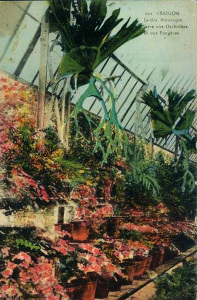
412_001

The orchid house at the Botanical Gardens

Only the Botanical Gardens sometimes offers asylum to amorous couples fleeing from prying eyes; indeed, if the plants in some mysterious corners of the orchid house could talk, they would undoubtedly disclose some curious revelations about the romantic intrigues which take place there. But hush! Let’s remain discreet and not interfere in matters that do not concern us.

Located at a distance of about four kilometres from Saigon, at the other end of the dreary Plain of Tombs, stands the Chinese city of Cholon. This is the “big market” of the colony, the rich industrial and commercial warehouse of our Cochinchina.

Two tramway lines and several roads connect the two cities with each other; and in the future, a wide boulevard will link them even more closely: however, a great many interests of all types, both public and private, are engaged in this enterprise, so we may have to wait a long time for its completion.
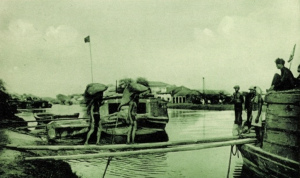
468_001

Junks being loaded in Chợ Lớn

Of all the channels of communication between Saigon and Cholon, the busiest and most active is unquestionably the arroyo Chinois [Bến Nghé Creek], the waterway along which the rice of fertile Cochinchina flows incessantly, from Cholon with its large factories to the port of Saigon where the international cargo ships are moored.

In order to account properly for the inexhaustible richness of this wonderful land of promise, it is necessary to travel, during the working hours of the day, along the Binh-Dong and Binh-Tay quays where rice paddy undergoes successive transformations in the large steam rice mills. It is here, from dawn to dusk, that we encounter at first hand the relentless hard work on which our economy is based.

Massive junks hasten, bow to stern, along the waterway, loading and unloading again and again.
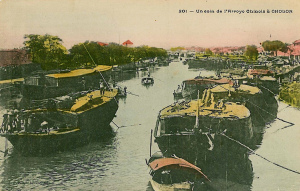
091_001 (2)

Junks on the arroyo Chinois in Chợ Lớn

Half-naked Chinese workers walk back and forth between the junks and the vast stores, their spines bent under the weight of heavy gunny sacks packed with grains.

Nothing interrupts the work of these beasts of burden; and one can not help admiring their tireless stamina, a vaguely disturbing activity that a whole race knows so well as their daily business of life.

It is by design that I refer to a vague uneasiness and apprehension about the hard work of the Chinese, because the coin has two sides. We must remember that these great labourers work only for themselves and for their country; all the money they amass so patiently, sapek by sapek, invariably leaves the producer countries and makes its way back to China, and there can be no doubt that its owners would follow at the first opportunity.
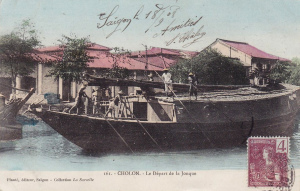
629_001

The departure of a junk in Chợ Lớn

In fact, with just a few exceptions, the Chinese merchant who has settled in our country is not fixed here. His only desire, his only dream for the future, is to make a fortune and then to return to his homeland. Ideally he will achieve this while he is still alive, so that he can enjoy with his family the fruits of his labours acquired abroad. However, if he only manages to return after his death, he will at least sleep peacefully in the field alongside his ancestors, near the family altar on which incense sticks will be burned to honour his memory.
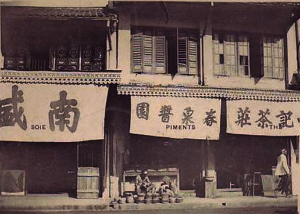
18 Merchants

A street scene in Chợ Lớn

An article published in the journal Dépêche coloniale under the title “The True Yellow Peril” (1 October-November 1909) is a well-documented study of this financial exodus which we suffer without being able to stop it. All those who have concern for the future of our colony will read it with interest and meditate fruitfully on its wise conclusions.

In the evenings, Cholon turns into a real fairyland city. Everywhere in the crowded streets and squares, in the markets and even in the shops and open-air restaurants that line the roads, countless lights shine out into the night. Among them, forming the keynote of this illumination, are large lanterns of isinglass on which Chinese characters are painted in large brush strokes, indicating the names of the proprietors and their multiple professions – the thousand and one trades in which the good Chinese, without distinction, are masters.

Gradually, the clubs begin to light up in their turn; theatres open their doors; brohels, gambling and opium dens prepare quietly to receive their customers; and all Cholon, that which we know and that which remains for us mysterious and closed, begins its search for pleasures more varied than innocent, a relaxation to the labour of the day.
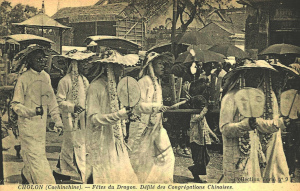
017_001 (2)

Representatives of the Chinese congregations taking part in the Procession of the Dragon in Chợ Lớn

Once a year, in early May, all Saigon travels to Cholon to attend the ritual “Procession of the Dragon,” which makes its way from pagoda to pagoda through the crowded streets of the city.

The Procession of the Dragon is a veritable feast of beautiful and colourful Chinese silk costumes and banners, which shimmer in the bright Nam-Ky sunlight. The banners seem to float in the wind, proudly displaying in broad embroidered characters the names and slogans of each Chinese congregation. Meanwhile, those taking part in the procession wear elegant silk festival costumes in soft shades of azure blue and mauve. Some carry subtlely decorated silk umbrellas.

But the undoubted highlight is the group of adorable Chinese children who play a major role in the procession. Their heavily made-up little faces and colourful silk costumes seem to transform them into cute, finely-modelled wax dolls.
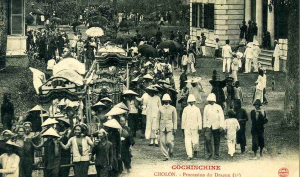
Inspection de Cholon Bureau 2

The Procession of the Dragon reaches the grounds of the Inspection de Cholon

Some ride on richly-decorated horses, while others are perched high on a float, where they emerge curiously from a gigantic blossoming pink or white lotus flower. Their hieratic appearance and apparent imperturbability complete the illusion; and we realise that all of the children are fully aware of the important role they play in the ceremony. Meanwhile, attentive and anxious fathers follow their brood step by step, ready to jump in and save them at the first sign of a fall or an accident.

Finally, at the very end of the procession, marches the hero of this great celebration, the fantasy dragon of Chinese legends. Its body, which exceeds 30 metres in length, is made from a rattan frame concealed by wide bands of scarlet silk, decorated with sparkling sequins. It is carried by a troupe of around 20 young men. The mission of those half-hidden under its body is to give the monster the appearance of life by recreating the soft undulations of a creeping beast. However, the real virtuoso of the troupe is concealed beneath the grotesque head, which moves up and down relentlessly until the final great ritual, in which the dragon bows down before the Mayor of Cholon as the crowd of onlookers presses around him.
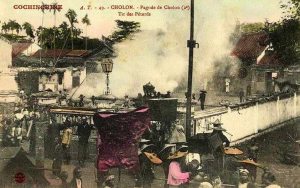
Pagoda 2

Firecrackers explode in the grounds of a Chinese Assembly Hall

The festival ends with the crowd storming a mountain of Chinese food, meats, cakes and sweets which has been set out in front of the Pagode des Sept-Congrégations. Needless to say, the assailants don’t take very long to devour everything.

Then, in the evening, the pagodas light up; noisy firecrackers explode everywhere and the feast continues more intimately in restaurants and private houses, not stopping until long into the night.

Close to Cholon’s busy industrial and commercial centre, one may find a quiet city of charity where all who are suffering may find succour and assistance, regardless of the nature of their infirmity. Thanks to this admirable initiative, the area contains a range of support establishments which can meet every need.
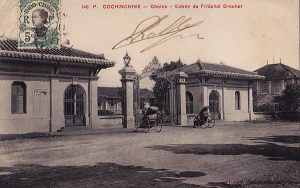
422_001

The Drouhet Hospital in Chợ Lớn

There is the Hospital Drouhet, a model hospital with wards and operating rooms equipped in accordance with the most modern rules of hygiene and comfort, and where the Europeans of the colony, officials and settlers, may find the illusion of home and all the amenities they can reasonably desire.

The natives have, moreover, not been forgotten and a beautifully landscaped hospice has made available to them.

Next to the Hospital Drouhet rise the elegant buildings of the Maternité, where all young expectant mothers, are welcomed and treated without distinction. A school for native midwives has been annexed to this building, which has become very popular with the local people, rendering invaluable service to the business of Annamite birth, once so neglected and so culpably compromised.
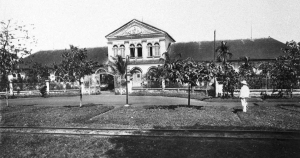
CHOLON 1909 - la Maternité

The Maternity Hospital in Chợ Lớn

Nearby is an asylum for blind children, where around 40 youngsters learn, alongside the first elements of primary education, the manual trade that will keep them later from want and ensure that their daily rice bowl remains full. This asylum is maintained under the intelligent direction of a French teacher who is also blind. Among all the infirmities that afflict our poor and unbalanced humanity, deprivation of sight has always seemed to me the most unjust and the most cruel. Thus, my concern has always been carried by preference towards those who are afflicted by it. If you agree with me, go and visit the blind children of Cholon: by the time you leave, your heart will be overflowing with charity.

Unfortunately, a nearby project devoted to the education of deaf children did not give as good practical results, for competitive reasons that it is better not to mention.
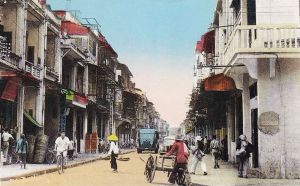
Rue Cantonnaise

Rue de Canton in Chợ Lớn

Finally, to end our pilgrimage, there is an old people’s asylum, created with the ingenious idea of providing facilities for elderly men and women without families who previously displayed their decay and misery on the streets of the city. I once made an official visit to this place and was saddened to find that one of its residents was the nephew of the great patriot Phan-Tan-Giang.

It was in the midst of this group of model institutions that the Société de Protection de l’Enfance (Child Protection Society), with the generosity of the Chinese city, built its orphanage on a gracefully conceded plot of land. More than 60 children, mostly those of mixed race who had ruthlessly been abandoned by their fathers, are currently sheltered and raised here. This work fills an important gap in social provision, and thus happily completes the works of the charities to which the administration of the city of Cholon is honoured to attach its name.

Tim Doling is the author of the guidebook Exploring Saigon-Chợ Lớn – Vanishing heritage of Hồ Chí Minh City (Nhà Xuất Bản Thế Giới, Hà Nội, 2019)

A full index of all Tim’s blog articles since November 2013 is now available here.

Join the Facebook group pages Saigon-Chợ Lớn Then & Now to see historic photographs juxtaposed with new ones taken in the same locations, and Đài Quan sát Di sản Sài Gòn – Saigon Heritage Observatory for up-to-date information on conservation issues in Saigon and Chợ Lớn.
Old Saigon Building of the Week – The “Y” Bridge, 1937

Pont en Y

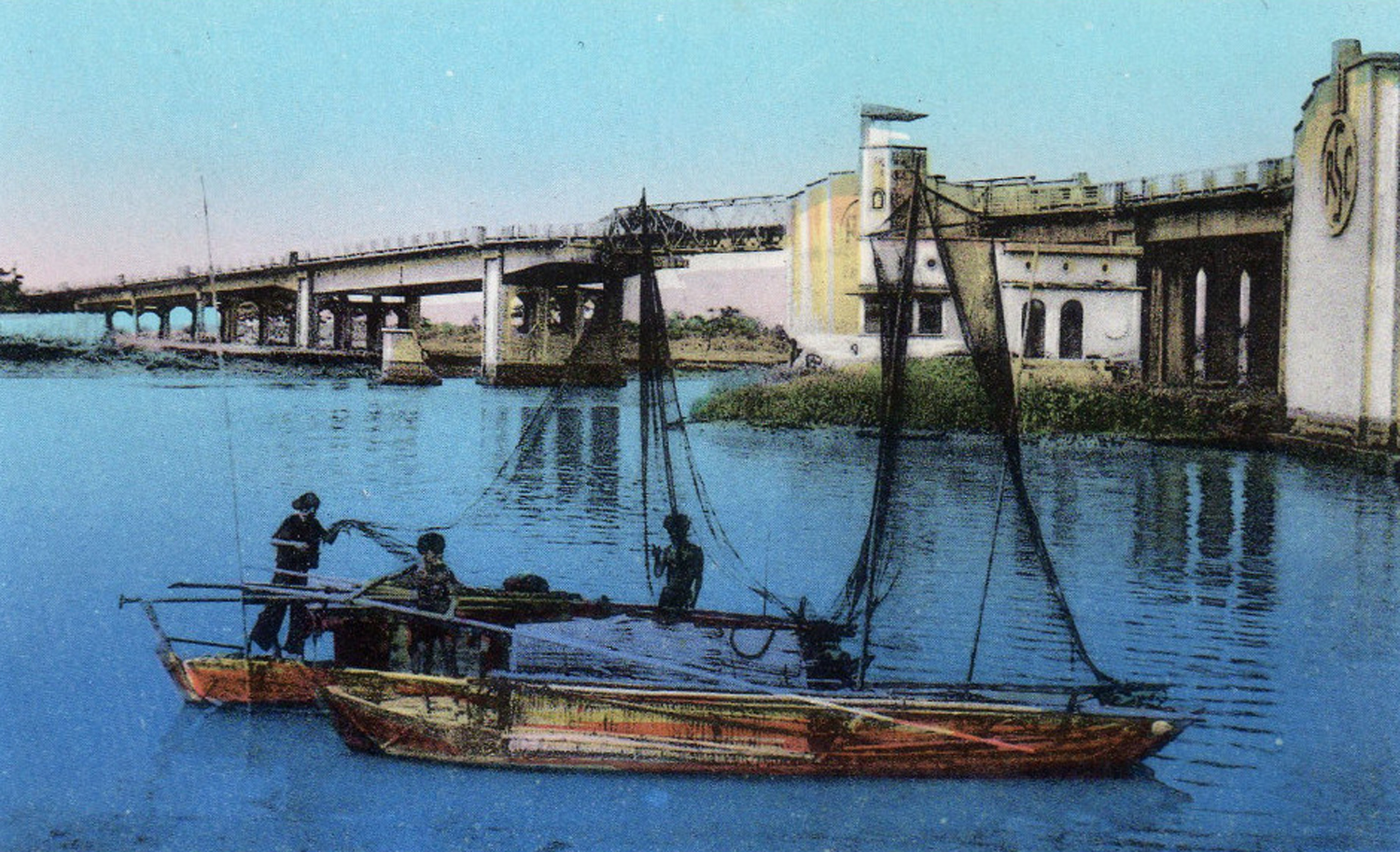
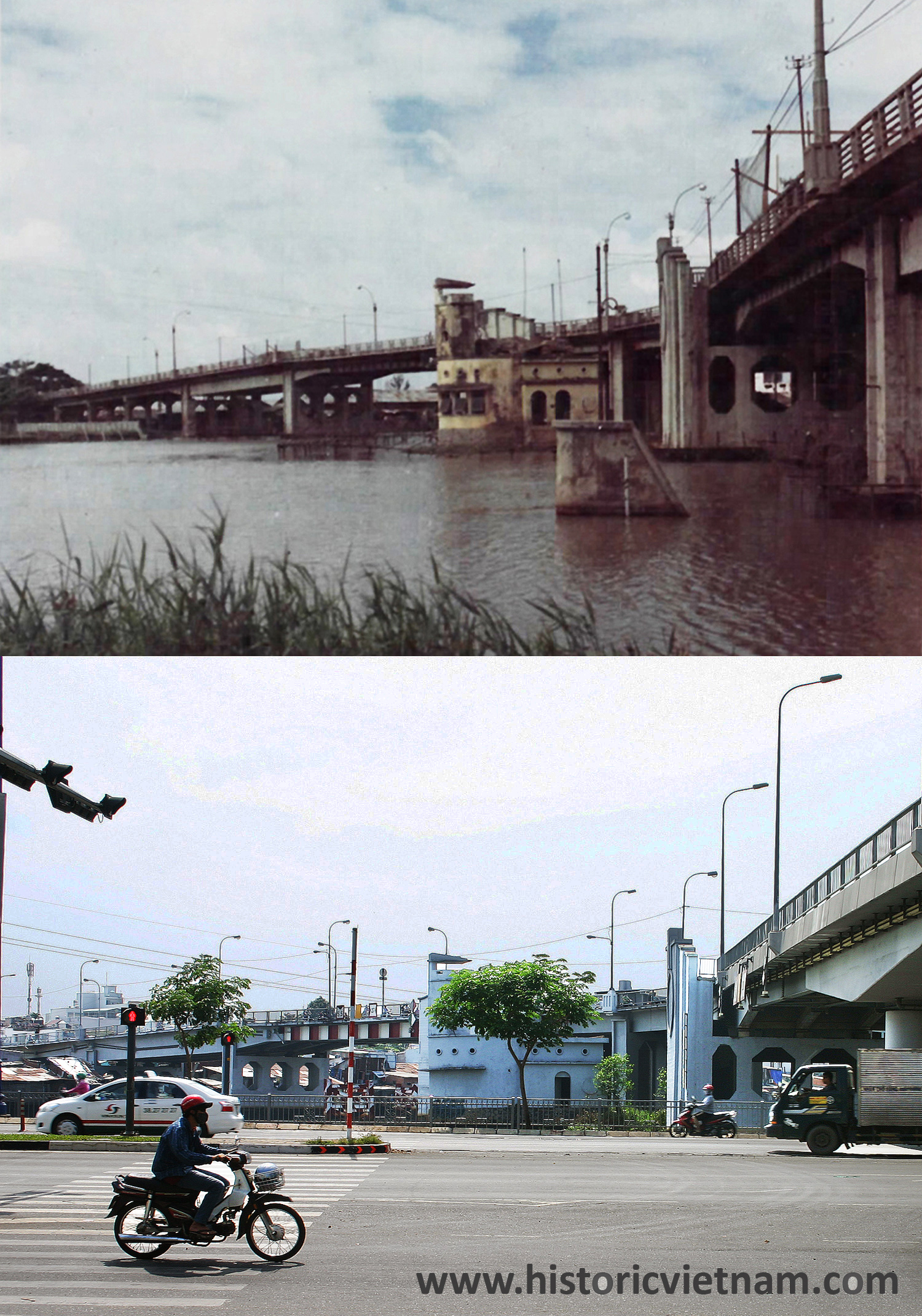
The “Y” Bridge in the 1940s

This article was published previously in Saigoneer http://saigoneer.com

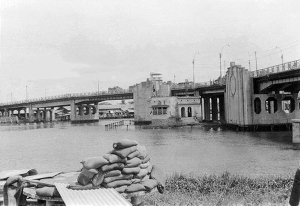
Built by the French during the latter years of the colonial era, Chợ Lớn’s “Y” Bridge became the focus of several important battles during the two Indochina Wars.

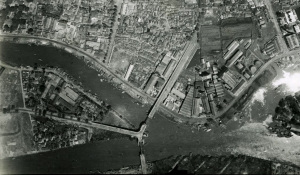
1950 Saigon Aerial View - Rạch Bến Nghé, cầu Chữ Y Indochine, Couverture, Saigon-Cholon - Photographie Aerienne 1950

An aerial view of the “Y” Bridge in 1950

The “Y” Bridge was originally conceived by the French in 1937 as part of a scheme to build a new municipal abbatoir in Chánh Hưng, immediately south of the existing Arroyo Chinois (Bến Nghé/Tàu Hủ creek) in what is now District 8. Known to the French as the pont Tripode or pont en Y, the bridge formed a crucial part of this scheme, because the construction of the “Canal de dérivation” in 1906 and of the “Canal de doublement” in 1919 to relieve congestion on the Arroyo Chinois had left much of the Chánh Hưng area ringed by waterways.

The design was drawn up by modernist architect René Nguyễn Khắc Schéou, and in 1938 the Cochinchina authorities voted just over 400,000 piastres from their regional budget to pay for the construction of the bridge. Then on 28 October 1939, according to the Bulletin économique de l’Indo-Chine, “Mr Governor General Brévié laid the first stone of the pont Tripode to serve the future slaughterhouse.”

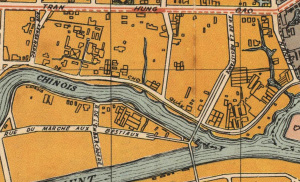
Saigon 1952

The “Y” Bridge marked on a 1952 map

In the wake of the Japanese invasion of 1940, construction of the bridge was placed on hold, but work eventually resumed and the pont Tripode was inaugurated on 20 August 1941. In the words of a Vichy government press release of 23 September 1941, “Its construction, carried out despite the circumstances, is a symbol of our constructiveness and confidence in the future. It meets multiple needs and will enable Greater Cholon to develop. With a length of 90 metres and a deck 8 metres wide, it required 8,900 tons of steel and more than 4,000 cubic metres of reinforced concrete for its construction. Its lateral and access roads required an additional 7,099 cubic metres of fill.”

Apart from its unusual configuration, the “Y” Bridge was regarded at the time of construction as a utilitarian work, and it may have lapsed into obscurity had it not been for the various battles which took place in its vicinity during the two Indochina Wars.

Y Bridge 1968

The “Y” Bridge in 1968

From as early as the 1920s, the neighbourhood immediately south of the bridge harboured various bands of thieves and outlaws. By the 1940s, it had become home to the Bình Xuyên, an organised coalition of gangs involved in racketeering, petty crime, river piracy and kidnapping.

After World War II, the Bình Xuyên emerged as a powerful military and political force, initially allying itself with the Việt Minh and staging a vigorous defence of the “Y” Bridge from 24 September until early October 1945 in order to prevent returning French troops from reoccupying the southern part of the city.

However, in 1947 it switched allegiance, offering money and military support to the French authorities and later to the State of Viêt Nam in exchange for legal recognition of its gambling, prostitution, money laundering and opium trafficking activities.

Following his rise to power in the spring of 1955, President Ngô Đình Diệm resolved to crush the Bình Xuyên, and during the subsequent “Battle for Saigon” (28 April-3 May 1955), VNA forces attacked its base of operations in Chợ Lớn, blowing up part of the “Y” Bridge to prevent Bình Xuyên reinforcements from entering Saigon. By the end of this operation, Bình Xuyên forces had been routed and driven from the city.

Vietnam War

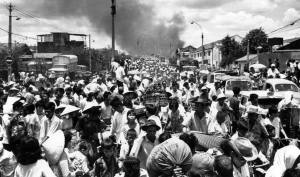
“Smoke rises from the southwestern part of Saigon on 7 May 1968 as residents stream across the “Y” Bridge to escape heavy fighting between the VC and South Vietnamese soldiers.” (AP Photo)

The “Y” Bridge was subsequently repaired, and in late May 1968 it once more became a battlefield during the National Liberation Front’s “Mini Tet” Offensive.
During six days of intense house-to-house fighting, the area around the bridge was devastated, but the bridge itself remained intact.

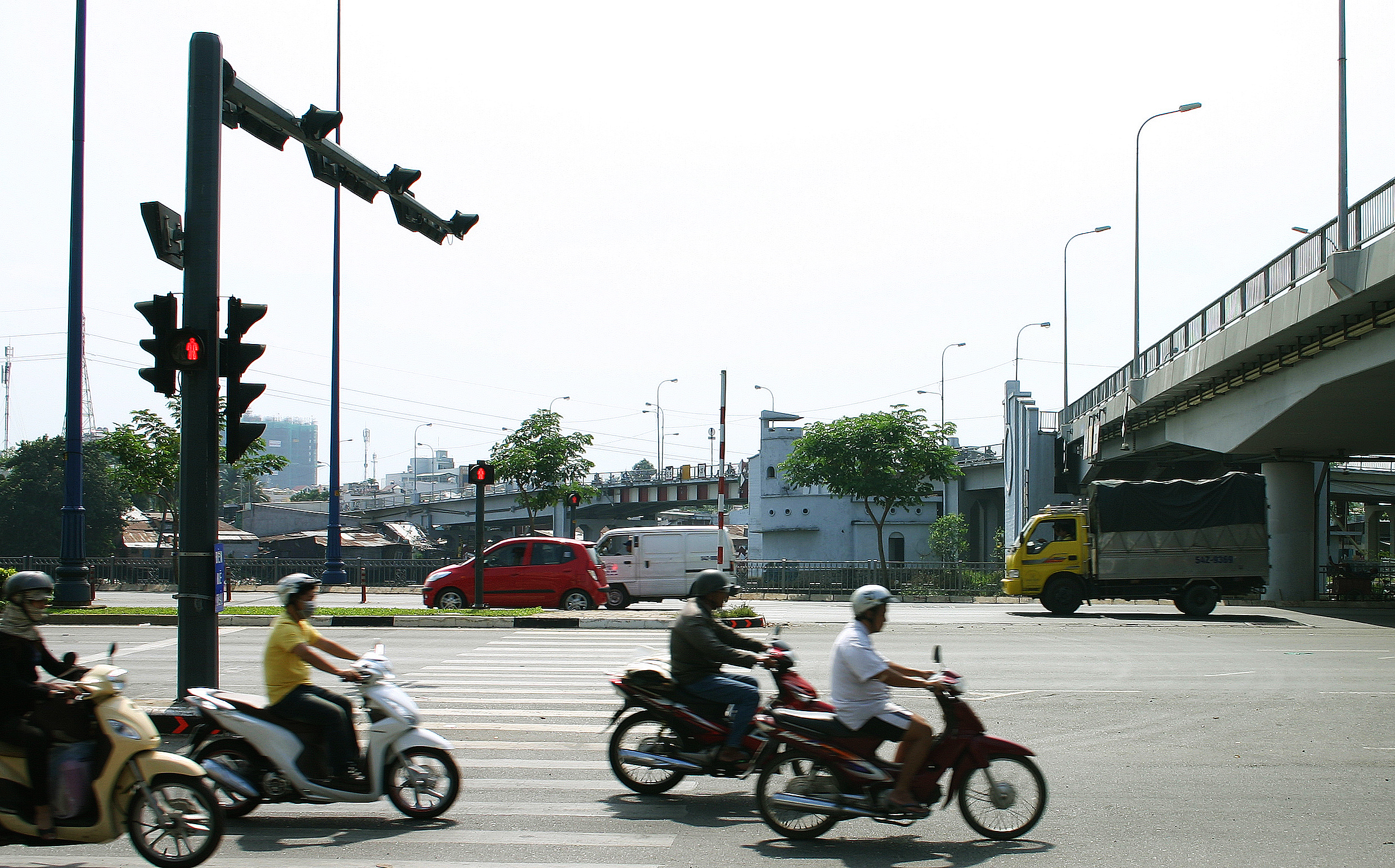
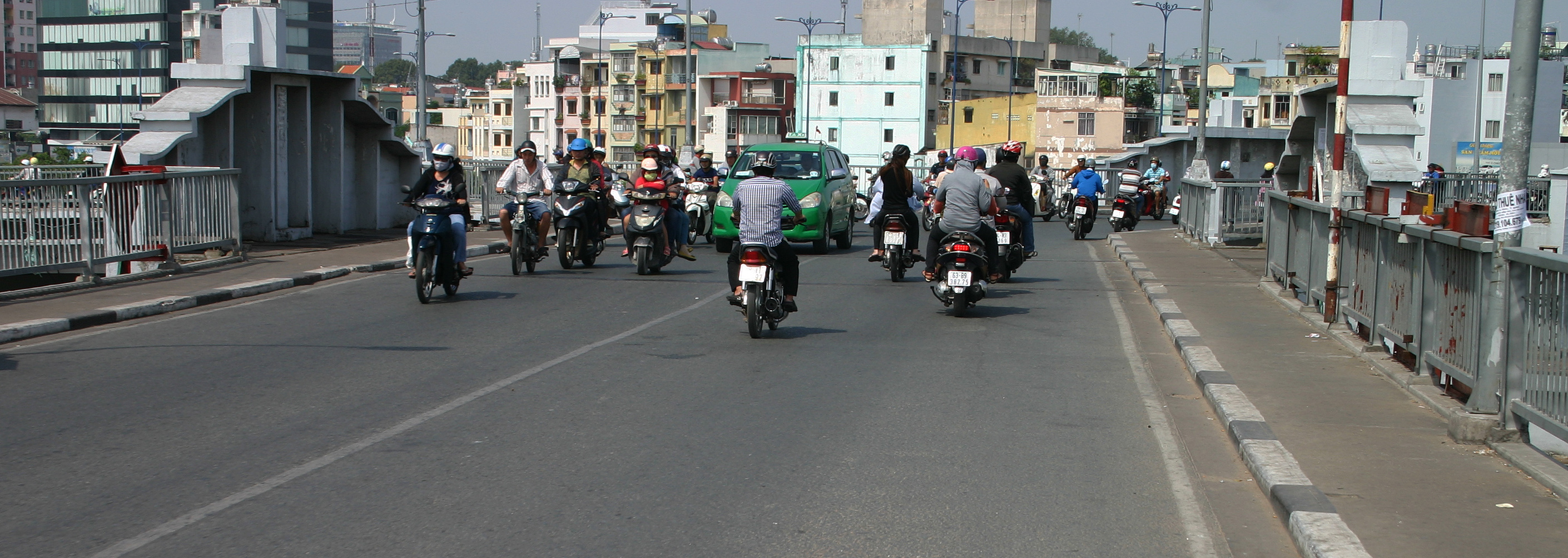
Refurbished in 1992, the old bridge was completely rebuilt in 2007 to permit higher clearance over the East-West Highway, retaining the original columns and abutments.

IMG_5026

The “Y” Bridge in 2015 viewed from the East-West Highway

IMG_5022

Traffic approaching the centre of the “Y” Bridge in 2015

The Y Bridge Then and Now

Tim Doling is the author of the guidebook Exploring Saigon-Chợ Lớn – Vanishing heritage of Hồ Chí Minh City (Nhà Xuất Bản Thế Giới, Hà Nội, 2019)

A full index of all Tim’s blog articles since November 2013 is now available here.

Join the Facebook group pages Saigon-Chợ Lớn Then & Now to see historic photographs juxtaposed with new ones taken in the same locations, and Đài Quan sát Di sản Sài Gòn – Saigon Heritage Observatory for up-to-date information on conservation issues in Saigon and Chợ Lớn.
Saigon and Cho Lon – The Impressions of Colonial Lawyer George Durrwell in 1910, Part 2

8600099416_9cd313a5f0_o

George Dürrwell spent nearly three decades working for the Cochinchina legal service. His 1911 memoirs, Ma chère Cochinchine, trente années d’impressions et de souvenirs, février 1881-1910 (My Dear Cochinchina, 30 years of impressions and memories, February 1881-1910) afford us a fascinating picture of life in early 20th century Saigon and Chợ Lớn. This is part 2 of a three-part excerpt from the book.

To read part 1 of this serialisation, click here.

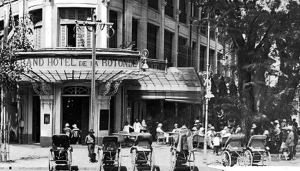
Grand Hotel De La Rotonde

The terrace of the Grand Hôtel De La Rotonde

It’s 6pm. The cafés fill with customers and groups begin to form around small tables. Gossipers’ tongues wag while the concert orchestras throw their discordant notes to the wind. The squares and the streets become increasingly animated and noisy, with pedestrians and carriages, automobiles and pousses-pousses crossing this way and that: all of Saigon is outdoors!

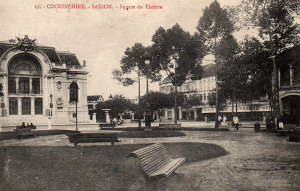
The focus of this exuberant scene is the Municipal Theatre, which presents a very stately air with its vast monumental staircase and high-arched open portico framing artistically sculpted allegorical figures. Flooded at this time of the evening by the last rays of a bright sun, its white façade is tinted a pale purple of infinite sweetness. Then suddenly, the curtain of night falls, almost without transition. Saigon is lit up, but the lighting is very poor, despite the pretty penny spent from the municipal budget on the profusion of electric lamps. This is truly “light hidden under a bushel.” Only the place du Théâtre forms a bright spot amidst the darkness.

496_001

The Saigon Municipal Theatre, inaugurated in 1900

From October to April, when the theatre season is in full swing, the entertainment of the evening extends long into the night. The Theatre and the adjacent hotels and cafés overflow onto the streets, transporting the intense nightlife of the French boulevard some four thousand leagues from the great city of Paris to this remote little corner of Asia, where the French soul has already become so deeply rooted.

By midnight, “the day is over,” as the song says. The Theatre closes its doors and turns off its lights, and with them are extinguished the lights of the square and surrounding streets. On the terrace of the Grand Hôtel Continental, there remain just a few groups of late diners, several incorrigible gamblers playing bridge or poker, and here and there a few clowns who have stayed up to contemplate the moon. Good luck to them all – and to all a good night.

The arrival of the theatre company is the big social event of the year in Saigon. Well in advance, it becomes the major subject of conversation and it is also advertised in the windows of our chic bookshops, along with portraits of the performers who are so impatiently expected: the ladies, of course, take the place of honour. Some of the city’s so-called arbiters of elegance are snobbish enough to travel to Singapore in order to be the first to contemplate the stars that will come to us from France: Ave maris stella!

Messageries maritimes 4 by Jean-Marc Bel (1855-1930) 1895

Greeting arrivals at the Messageries maritimes pier in the late 1800s

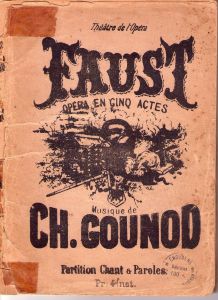
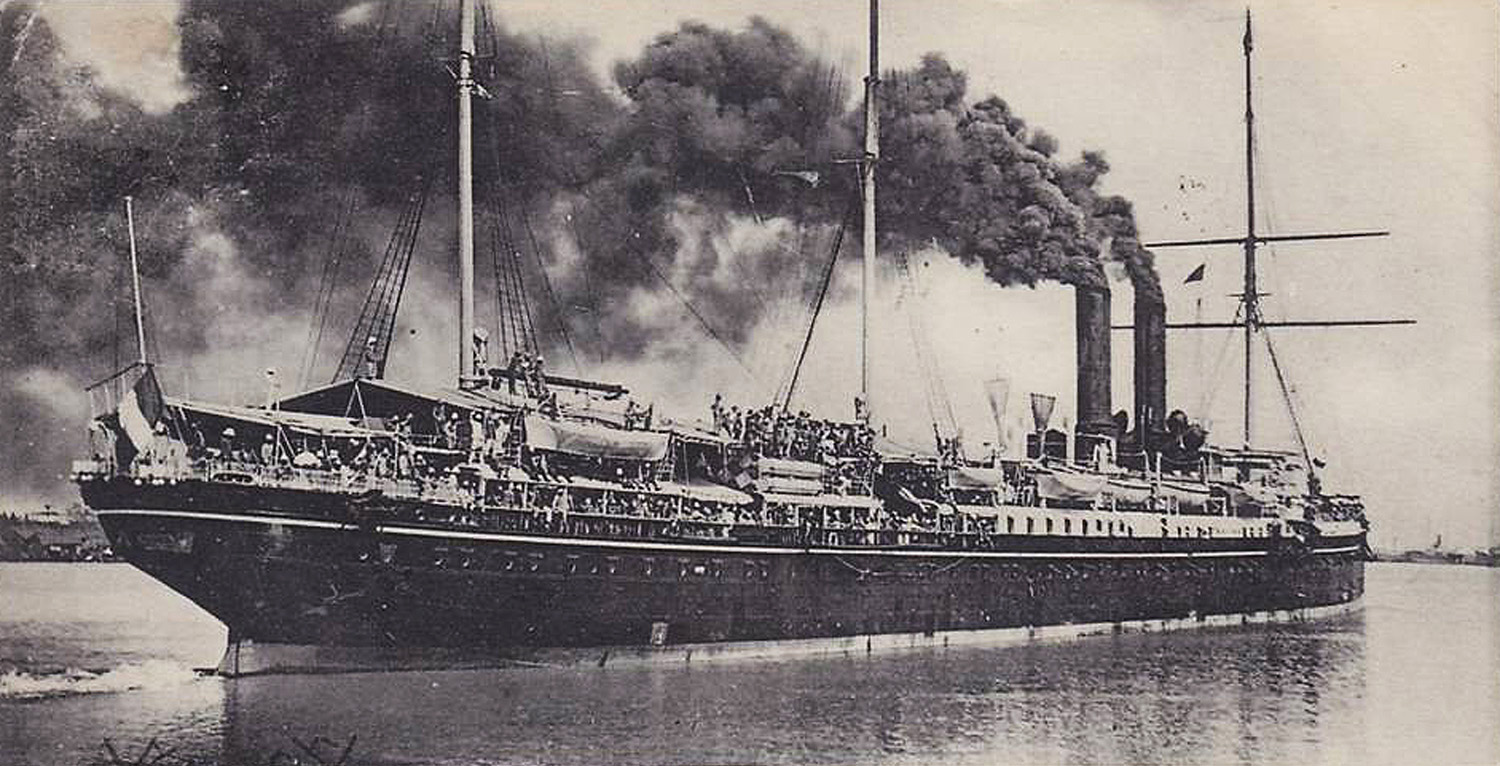
Finally, the big day arrives. The boat is signalled from the Cap; it enters the river and heads towards Nha-Be. Immediately, all of Saigon’s high society gets dressed up and invades the pier of the Messageries maritimes. After negotiating the last loop of the river, the great courier ship advances majestically into port and wastes no time docking. As soon as the gangway is in place, it is immediately stormed by the crowd, which eagerly spreads itself onto the deck. The impact of all those waxed moustaches and starched collars and cuffs is naturally lost in the crowd and many of our hungry socialites are inevitably obliged to return home empty-handed, with only the platonic satisfaction of having witnessed the arrival of their idols. However, most of them are content, and for good reason, in this special sport where many are called but few are chosen. Then calm returns, as theatre lovers bravely begin to study their scores and all Saigon awaits the minor intrigues which inevitably attend the presence of thespians. Some days later, the Theatre solemnly opens its doors to serve the gathering crowd of attentive spectators. Once more, we are treated to that venerable masterpiece of Gounod, the inevitable Faust, which every year is featured mercilessly in our opening programme. Saigon’s theatre season has begun, and that’s it for the next six months.

$_57

The score of Gounod’s Faust

The Saigon public have a reputation for being connoisseurs, and they are therefore very difficult to satisfy. In fact, among the self-appointed art critics, there are some who have never attended any theatrical performances other than those of Landerneau or Pont-à-Mousson. But no matter; it is fashionable to be a connoisseur and each tries to be one, judging with equal severity the débuts of the unfortunate artists and the efforts of their director. Many circumstances, however, argue in their favour. For example, the almost insurmountable difficulties of recruitment for performances in the Far East and the consequent lack of homogeneity of the troupe; not to mention the rigours of a climate which constantly threatens the artists’ health and often attacks their vocal cords; and finally, the excessive labour imposed on them to rehearse a programme which changes every day.

There is, in fact, a remedy for this state of affairs, and I would like to suggest it to the honourable committee which is entrusted with the organisation of our annual theatre programme. In my humble opinion, it would be wise to cease the performance of cumbersome operas with full orchestral accompaniment which require special staging and a standard of performances that only our Music Academy is able to achieve. Instead, the offerings should be limited to some light comedies and comic operettas whose spirit and quality is so exclusively French. I know that my proposal will make our excellent amateur critics leap with indignation, and I can’t offer any cure for that: however, on their return to France, they can at least console themselves by attending performances in Landerneau or Pont-à-Mousson.

AP3674-Despierres (1)

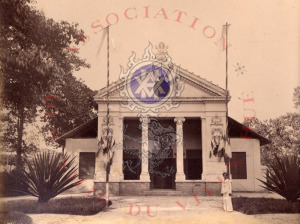
The former Saigon Municipal Theatre (Association des Amis du Vieux Huế)

Our new Theatre, opened on 15 January 1900 on the occasion of the visit by Prince Waldemar of Denmark, is undoubtedly a very beautiful monument, worthy in every respect of our beautiful Saigon. It has, moreover, even excited the jealousy of the incomparable Hanoi; and that says it all.

But I would be ungrateful if I didn’t also mention our former theatre, so small and so simply decorated, yet so cosy and intimate, surrounded by lawns and shaded by large trees. There, we saw no “dressing to impress,” no show of luxury; we attended without any fuss, as if we were attending a family gathering, and we always came out happy. All the old Saigonnais, myself and my contemporaries, certainly regretted the loss of this lovely theatre in its corner of greenery. But we must, it seems, march with progress, using a catchphrase like that of the seller of the first boxes of sardines in Nantes: “Always for the better.”

Like a Parisian boulevard, the rue Catinat has had its characters who have lived a little of its life, and whose absence is noted and regretted.

273_001

Rue de Bangkok, Saigon

A good example is the former official who became the landlord of several large buildings and could invariably be found perched at the corner of rue de Lagrandière. His thick crop of white hair, cut in the style of Titus, served as a contrast to his amiable ruddy face, a sign of good living. Always smiling, he would sit and watch the passers by, and for him, each was a friend to whom he extended his hand.

Then, in the vicinity of the Grand Hôtel Continental, at all hours of the day and night, we could once find a character with an opulent black beard and a booming voice with a touch of a Gironde accent which resounded across the square. He knew everything about Saigon the day after he arrived, and all Saigon knew and loved him.

And there too once went a perky little man, trotting daintily along boulevard Charner [Nguyễn Huệ] with a triumphant waxed moustache. That was our “king of automobiles.”

Personnel of the Director of the Arsenal, 1875

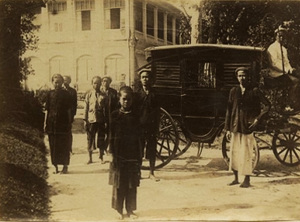
A carriage crew waiting outside the Marine Arsenal

Also operating in this area of the city was one of the friendliest people in our legal office. Dressed elegantly in his light jacket, he would stride along the street with his nose in the air, like the ogre in Tom Thumb, sniffing the fresh and fragrant scent of…. female flesh. Yes, he was out hunting, and you would always find his prey just a few steps in front of him.

Today, the judiciary is still represented in the rue Catinat by a friendly group which we call familiarly “the Fifth Chamber,” whose members wander along the pavement with slow, rhythmic steps, chatting about the interests of their clients. Happily when I pass them today I don’t have to count the missing, as they are still numerous in this country where the dead go quickly.

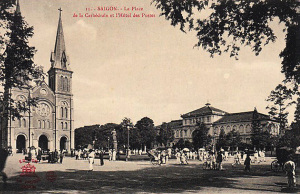
From the rue d’Espagne [Lê Thánh Tôn] to the place de la Cathédrale, the rue Catinat climbs between two rows of government buildings, on which it would be pointless to dwell. The same must be said for the Cathedral, which similarly deserves little attention. Completed in 1880, it replaced the modest little wooden chapel that once stood on the present site of one wing of the Christian Brothers’ Institution Taberd. It is therefore one of the oldest monuments in modern Saigon, but it is certainly not one of the best – its inelegant mass is enhanced only by its two front towers.

5803338464_313ee84d83 SAIGON - clocher en construction_ chaffaudage en bambou 1902_O

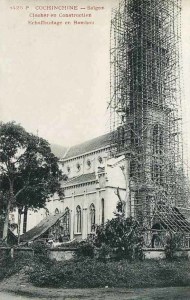
The bell tower of the Huyện Sỹ Church under construction in 1905

I much prefer the pretty little church [Huyện Sỹ Church] which was built next to the high road to Cholon, according to plans drawn up by an artist in a cassock, and with the posthumous piastres of an old Annamite Crésus in search of absolution.

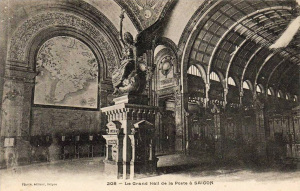
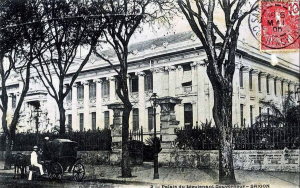
In the same way, I prefer the elegant Hôtel des Postes, which was built a few years ago in the immediate vicinity of the Cathedral. I followed with great interest the various phases of its installation, and have even contributed, in a very small way, to its interior decor. But I see you are smiling in disbelief, so let me explain….

The Indochina Postal Administration was placed under the direction of a great man, an outstanding public servant who remains etched on the memory of all who knew him. Hard on himself, he was also hard on others, but his spirit of high equity and impeccable righteousness, the extent of his technical knowledge and his tireless work ethic made him the model department head, a man for whom no detail could be left unattended. And it is to him that the colony owes the organisation of its admirable telegraph network.

Today only old Cochinchinois can still remember the tenacity and energy with which he carried out this gigantic work. His epic battles with the elephants of Annam, who took pleasure in shaking and demolishing the telegraph poles, are also legendary in Saigon. He left us knowing that if all had not loved him, he had at least forced everyone to hold him in high esteem. And is not this the highest praise that a public servant can hope for?

247_001

Saigon Cathedral and Post Office

I had, in fact, quite frankly sympathised with him in the early days of my arrival in Cochinchina, and out of this shared sympathy was born a strong friendship marked by frequent meetings. I also never forget our Sunday walks along the paths of suburban Saigon: with such a guide, a veritable walking encyclopaedia, each of these walks was for me a lesson of the most captivating interest.

One can expect that the construction and development of a new building to house his Postal Service would not leave our man indifferent, and indeed, it provided him with a unique opportunity to apply his infinite skills and energy. As soon as dawn broke, he was everywhere, keeping an eye on everything, sometimes emerging from the basement of the Post Office like a cricket coming out of his hole, sometimes appearing like a genie of the Bastille on the roof ridge of the building.

One morning, I found him perched high on scaffolding which had been erected in the vast central hall, brush in hand, exerting his topographic talents on one of the large maps which decorated the walls. “Climb up here to help me,” he shouted from his perch. I happily climbed up the bamboo ladder, and, installing myself next to him. immediately set to work, marking with strong artistic design the exact location of the good town of Chau-Doc, “capital of mosquitoes.”

Hotel de postes inside

The interior of Saigon Post Office

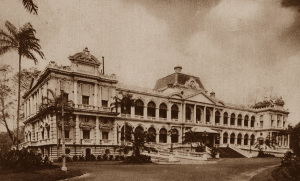
Behind the Cathedral, a wide boulevard stretches the entire length of the plateau from the Botanical Gardens up to rue MacMahon [Nam Kỳ Khởi Nghĩa]. Baptised with the gracious name of His Majesty King Norodom of Cambodia, this beautiful avenue, lined with tamarind trees, provides access to the Palace of the Government General. This imposing monument, the elegant proportions of which harmonise perfectly with the greenery around it, stands in the middle of a large park full of old trees which extend their high foliage into the adjacent Jardin de la Ville (City Park).

For over 30 years, the Palace of the Government General has been home to the high functionaries to whom the government of the Third Republic successively entrusted the fate of the colony – first the Governors of our Cochinchina, and then, after the consommation of the beneficent Union of Indochina, to the Governors General of Indochina, on those occasions when they visited their southern capital. When I landed in Saigon, the palace was looked after by an energetic and shrewd administrator, one of those men of whom one can say, with reason, “he’s a real character,” and who leave in the countries they are called to direct an indelible mark of their passage.

Norodom Palace again A i

The Palace of the Government General

We had to appear before this terrible man the day after our arrival; and I beg you to believe that, as we climbed the steps of the side porch which led into his office, my colleagues and I felt very uncertain indeed. I could, but dare not, use a much more intimate and forceful expression which would describe more accurately the intense feeling of fear which gripped us.

When we were introduced to him, I must admit that our initial reception was rather cold. “What are you doing here?” cried the ogre as soon as we crossed the threshold of his office. “I have not asked for you, neither do I have any use for you.” Then, seeing our discomfited expression, he suddenly calmed down and explained that the Collège des stagiaires was about to be abolished and that we had unfortunately arrived in the middle of a complete administrative reorganisation.

We took our leave of him on these good words, especially happy that our meeting had finished. In fact, it was this short interview which decided my colonial career; a few months later, without having otherwise been consulted, I traded my junior professional officer’s stripe for a deputy judge’s hat. Later, I learned to understand and appreciate the “beneficent coarseness” with which we had been greeted; and then I realised that his apparent rudeness hid true goodness and loving concern.

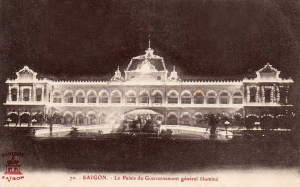
SAIGON - Le Palais du Gouvernement général illuminé

The Palace of the Government General illuminated for a ball

Many years have passed since the colonial adventures of my youth, and over time I have become an old and disillusioned magistrate who is surprised and intimidated by little. Yet even today, when I enter the former office of the ogre in the Palace of the Government General, I still feel a disagreeable frisson creeping across my skin.

On major public holidays such as 14 July or the first day of New Year, or when some prominent person honours our city with his presence, the Palace is decorated to the peak of its dome with illuminations. The doors of its reception rooms are opened wide and all Saigon dances breathlessly until dawn, while lovers of the Queen of Spades crowd around the gaming tables. These balls, known as “ouverts,” are particularly interesting, and it is prudent on such occasions to delay as long as possible the opening of the buffet … and the boxes of cigars.

Our Governor of Cochinchina, dispossessed of his palace, had to seek asylum in a large building located on rue de Lagrandière which was originally designed as a commercial museum, and for the construction of which the architect was inspired by the Munich Pinacothèque. Although it was only a poor copy, costly adjustments made it habitable, and it would, in fact, look good too, if the great caryatids flanking the entrance porch did not so miserably disfigure the façade they claim to decorate.

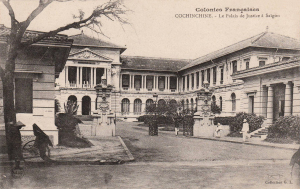
101 Palais de Justice

Alfred Foulhoux’s Palais de Justice (1885)

The Judicial Service is housed nearby, on the corner of rue Mac-Mahon [Nam Kỳ Khởi Nghĩa]. It is very comfortably installed in the Palais de justice, and it may be said that the sober architecture of that building and the perfect harmony of its proportions may be among the most beautiful sights of Saigon. During my early days in the colony, the premises of this important government office, which then existed in its infancy, were infinitely more modest.

The Tribunal once occupied the former Hôtel de la gendarmerie (Police Station). As for the Court of Appeal, it was encamped, after a fashion, in the stores of the Service local on rue Thu-Duc [Đông Du], while the French Chamber held solemn audience in a long hangar which can be admired even today on rue Taberd [Nguyễn Du], near the place de la Cathédrale. The magistrates there had, at short notice, replaced the horses of the gendarmes. The staff of the Attorney General’s Office had been assigned the other wing of these decommissioned stables. It was simple and tasteful. It was here that I was initiated, in around 1882, in the subtleties of native criminal procedure and the mysteries of the modified Penal Code.

Among my new friends was a cheerful fellow, as sharp as a monkey and even more bohemian than clever. Among his eccentric hobbies, he kept some of the most bizarre animals, and he had in his menagerie a cute little honey bear which became the frequent guest of the Prosecution, despite the opposition of the Attorney General, who then had an office in the same building.

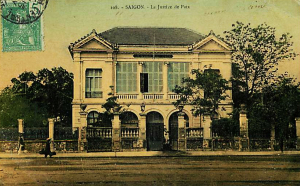
151_001

The Justice de Paix

In fact, the Attorney General only honoured us with infrequent visits because he he trusted us, and this confidence was well placed. However, those rare visits, which this excellent man knew how to endow with a very intimate and familial charm, had a serious drawback for us, as they usually coincided with the time we had designated our “cocktail hour” at the nearby café de l’Europe. So we devised a means of guaranteeing the tranquility of these extra-judicial drinking sessions.

Every day, a little before cocktail hour, I was dispatched under any pretext, in my capacity as leading man of the team, to the office of the Attorney General, who always greeted me with his most benevolent smile, and inquired with bonhomie about our health and our work. My reply was of course that all was excellent; but then I would make a discreet allusion to the presence in the building of the honey bear. “What?” the irascible little man would cry, brandishing a huge paper cutter, “He’s brought that dirty beast into the building again?”

That was enough, and it only remained for me to retire with the consciousness of duty done. Upon my return to the Prosecution, the indictments were lightly abandoned, the dossiers quickly rolled up, and our merry band, marching in English style, rushed down to the café de l’Europe where those pernicious cocktails awaited us, covered in snowy ice.

1882

Cafes on the Saigon riverfront

Since I’ve already recounted several old memories, let me just mention one more which dates from the same period and relates to the same subject.

One fine morning, probably taking advantage of the absence of the bear, our mentor arrived in our midst. By the merest chance, he found most of us installed in our rightful places, and painstakingly plunged his nose into the voluminous files which were piled up around us. Only one of the desks remained unoccupied, and for good reason. Its owner, big Robert, had just begun doing exercises, suspended on one of the horizontal iron bars high above the room, and was, at the moment of the Attorney General’s entrance, engaged in some skilful acrobatic manoeuvres.

The arrival of our unexpected visitor caught him by surprise, so big Robert sat above us silently and unnoticed, with his legs dangling down, while we strove to account for his absence. The chief went away satisfied, big Robert nimbly left his uncomfortable perch, and we welcomed his descent with a loud ovation. Thus ended one of the happiest incidents in the life of the colonial Prosecution service.

And what may surprise you most, dear reader, is that our work was no worse for it.

Sadly, most of the actors in these innocent little scenes have long since descended into the grave, and now I live alone with my memories.

To read part 3 of this serialisation, click here

Tim Doling is the author of the guidebook Exploring Saigon-Chợ Lớn – Vanishing heritage of Hồ Chí Minh City (Nhà Xuất Bản Thế Giới, Hà Nội, 2019)

A full index of all Tim’s blog articles since November 2013 is now available here.

Join the Facebook group pages Saigon-Chợ Lớn Then & Now to see historic photographs juxtaposed with new ones taken in the same locations, and Đài Quan sát Di sản Sài Gòn – Saigon Heritage Observatory for up-to-date information on conservation issues in Saigon and Chợ Lớn.
Saigon and Cho Lon – The Impressions of Colonial Lawyer George Durrwell in 1910, Part 1

845_001

George Dürrwell spent nearly three decades working for the Cochinchina legal service. His 1911 memoirs, Ma chère Cochinchine, trente années d’impressions et de souvenirs, février 1881-1910 (My Dear Cochinchina, 30 years of impressions and memories, February 1881-1910) afford us a fascinating picture of life in early 20th century Saigon and Chợ Lớn. This is Part 1 of a three-part excerpt from the book.

Saigon has been described as the “Pearl of the Orient,”and all of those who have had the good fortune to live there or to visit the city – except, perhaps, for one or two Tonkinese chauvinists – are agreed that it deserves this graceful designation without any reservation. It is also the true capital of our French Indochina: a commercial capital with an admirable maritime location; a historic capital, to recall the happy expression once used by Governor General Beau, “to glorify our dear city and the unforgettable memories that its name alone evokes;” and finally a political capital, simply by birthright.

KHA NHOI - Plantation de Cocotiers et Habitation de Colon

After arriving by ship at the Messageries maritimes wharf, early travellers passed through Khánh Hội en route for Saigon

The first impression on arrival in Saigon is not, in fact, the most engaging. After following the meandering path of the river, and contemplating for several hours its melancholy shores bordered by endless flat and monotonous rice fields, the traveller reaches, after a passage of 24 days, the pier of the Messageries maritimes.

There, in both sight and smell, he feels the perfectly unpleasant sensation of approaching a slum. For in front of him, right next to the dusty and often muddy road which leads to the old bridge across the arroyo Chinois [Eiffel’s Pont des Messageries maritimes], he encounters a shapeless mass of decrepit and lamentably rickety huts which emerge from pools of stagnant water, forming an ugly and unsightly view unworthy of the great city of which Khanh-Hoi is the suburb.

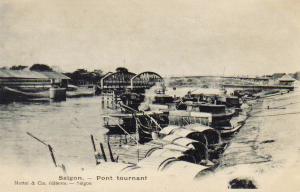
In fact, there is now a second bridge, known as the Pont tournant (Swing Bridge), over which passengers may travel to reach Saigon without passing through this ghetto, but it swings very badly. Some even claim that it doesn’t work at all; but those are grumpy and biased people who deserve no credit.

Pont tournant

The joint road-rail swing bridge, opened in 1908

I can say, indeed, that I saw it open at least once, at a practical time which permitted the free movement of the public. But as the saying goes, “One swallow doesn’t make a summer.” This unfortunate bridge has thus acquired, from the beginning of its existence, a true local celebrity; and the rivers of ink that have been spilled talking about it are certainly more tumultuous than the waves of dirty water which agitate the river over which it was thrown.

But let’s hasten to flee this smelly suburb, taking either one or the other bridge over the arroyo which still separates us from the city. For when we reach Saigon, everything changes.

One of the most brilliant writers of our colonial literature, Myriam Harry, devoted several graceful lines to Saigon in one of her evocative novels:

Saïgon - Haut de la Rue Catinat

The upper end of rue Catinat

“Ah! what a pretty city Saigon is! We don’t know why we love it, perhaps for its space, perhaps for its somnolence, or perhaps because of its tide of greenery, which swallows up its square white houses with their resemblance to small Greek temples.”

All this is perfectly true; it is certain that Saigon displays an indefinable charm and exercises a strange fascination on all those who visit it, on all those whose hearts it captures, and its evergreen trees certainly play a large part in this. Nevertheless, there is a disturbing question here, because those very trees which line our city streets are currently under threat. The idea of cutting down trees was raised for the first time by a friendly doctor involved in public affairs, who lost something like an arm or a foot or a finger – I don’t know what exactly – and because of this he imagined that he needed to cut down everything around him. He chose the trees of rue Catinat for his first attempt at field surgery, and it is to him, dear reader, that you owe the excessive sunlight which now beats down onto that street near its junction with the rue Lagrandière.

Saigon - Angle de la rue Catinat et rue La Grandière

The junction of rue Catinat and rue de Lagrandière

All of our poor trees would have been cut down if this ruthless lumberjack had not fallen victim to the unforgiving climate of our Cochinchina. However, he left behind a legion of devout followers; and, following the example of the empire of Lilliput, where civil war almost broke out between its citizens, Saigon today is still divided between those who advocate an almost complete slaughter of our treelined avenues, and others who argue for simple and hygienic pruning. I agree without hesitation with the latter. In the name of the beauty of the Saigon which we all cherish equally, I say this: cleanse our sewers; make clean water available in abundance; fill that home of microbes, the Boresse Swamp; but please, leave our “Pearl” its green adornment!

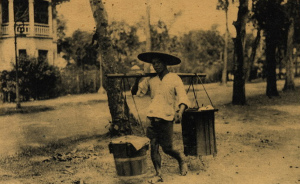
677_001 (1)

A merchant walking along the streets of Saigon in the early 20th century

There are, of course, vandals in all latitudes; and it’s nothing short of a miracle that the giant plane trees and ancient elms which line the incomparable allée des Alyscamps in Arles escaped, most recently, the axes of the tree killers.

Anyway, we will use the cool shade of the trees, which for the moment we are still allowed to enjoy, to wander together through the streets of the city – a city in which for me, every house brings to mind a memory, good or bad, sad or happy. Alas, sometimes those memories are very sad! For it was on the threshold of one of those houses, many years ago, that I left on a journey from which there would be no return. This was the journey I chose as my path through life, one which has left me alone with my infinite despair. Such memories bind one inextricably to the places which evoke them.

And as your “cicerone,” I will try as hard as possible to be the least “Joanne” guide possible [a reference to the Hachette travel guidebooks written by Adolphe Joanne].

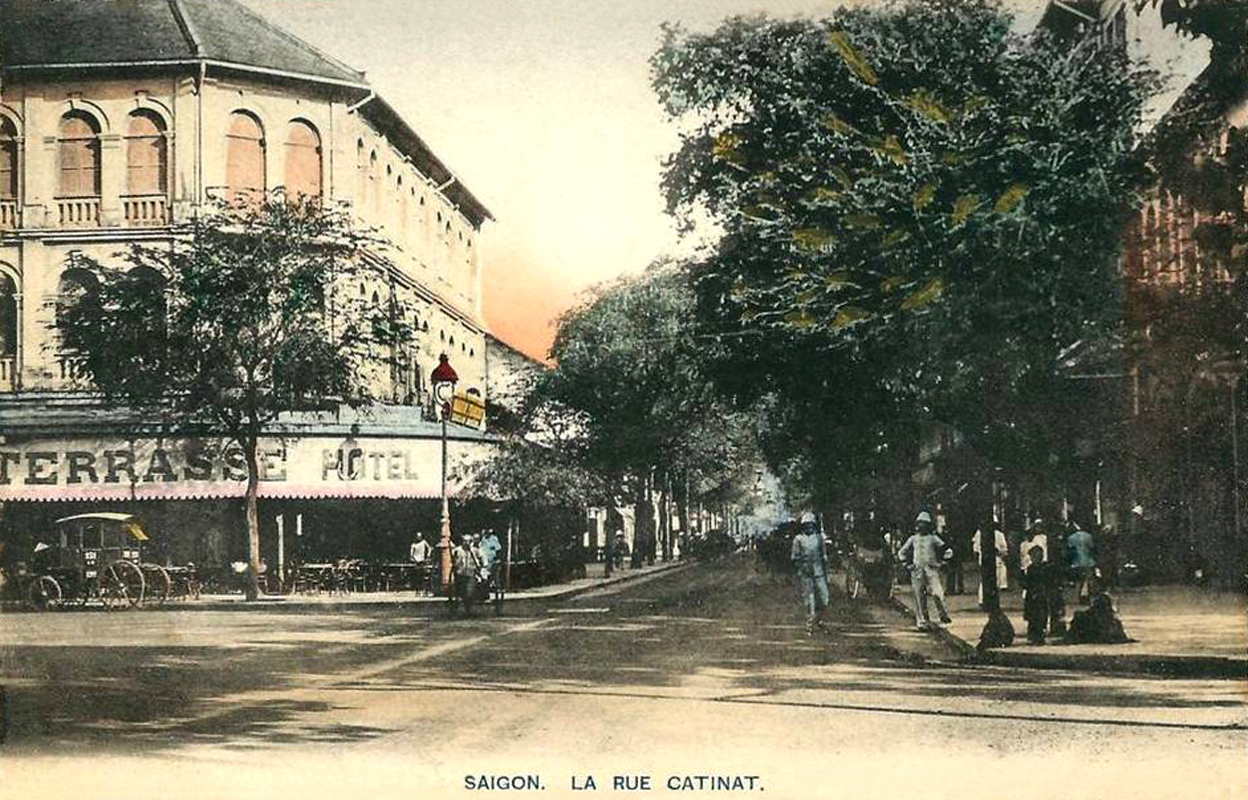
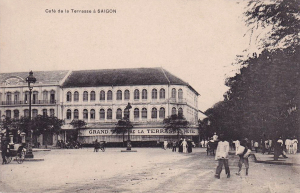
SAIGON - Café de la Terrasse

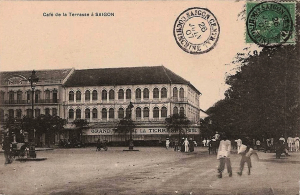
The Café de la Terrasse on Theatre Square

First of all, let’s give honour where honour is due. Just as Marseille has its Canebière, so Saigon has its rue Catinat [Đồng Khởi], which it shows off justly and with great pride. It is, indeed, unique.

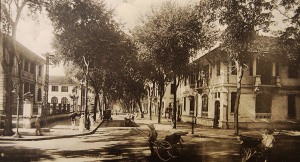
From the quai Francis Garnier [Tôn Đức Thắng], which by right of occupation would be more accurately be called the quai des Messageries fluviales (River couriers quay), up to the plateau that forms the place de la Cathédrale, lies a route of over a kilometre. Shaded by a double line of tamarind and mango trees, this road rises gently and in recent years the heavy traffic which fills it has made it too small for current needs.

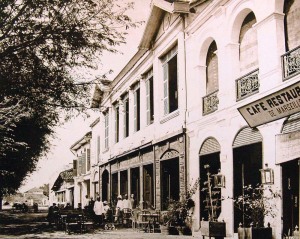
The houses that line the rue Catinat, taken in isolation, have for the most part no special qualities: some are old buildings which date from the time of the conquest, while others are of more recent construction. Most simply have a beautiful appearance and nothing more.

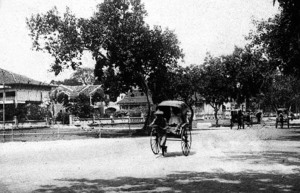
5837886229_a4b98ece31_o

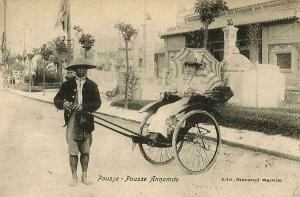
A pousse-pousse makes its way through the tree-lined streets of Saigon

Yet all of them, bathed by the rays of our Cochinchina sun, create an intimate and welcoming cheerfulness, like a group of large family homes which seduce irresistibly. This is true of some women’s faces: itemise their features individually and you will sometimes find them unsightly; but bring them together and they will often form a harmonious whole which charms more than accepted notions of beauty.

The lower part of the rue Catinat, which stretches as far as rue d’Espagne [Lê Thánh Tôn], is occupied by European and Asian traders, while the upper part is reserved for government offices. We will travel quickly from the one section to the other, stopping en route at the exquisite place du Théâtre, which I can describe unreservedly as a real gem.

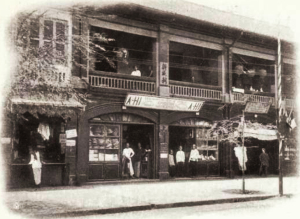
17 Boutique Chinois

A Chinese shop on rue Catinat

All of the most varied branches of our metropolitan commerce are widely represented on the lower end of rue Catinat: gold and jewelry shops, large, well-stocked bazaars, coquettish millinery shops, comfortable hair salons, bookstores stacked with the latest Parisian novels, pharmacies with gleaming and carefully labelled jars…. nothing is missing, you can buy everything here at moderate prices. But it is undoubtedly the grocery stores which take first place in this animated corner of the city; and this is an area of business in which the good Chinese pose a formidable competition to the French, I must tell you, moreover, that the honourable profession of the grocer is much more complicated here than it is in Europe, as it requires a more complete and varied practical knowledge.

4828655229_52c375bf67_o

Chinese merchants on rue Catinat

An amiable comic ditty that my good friend S sometimes hums in private, between the pear and cheese, proclaims in its chorus that:

In the business
Of the grocer
It is necessary to sell candles.

However, our Saigon grocers are not content just to add the commerce of the candle to that of selling cans of conserves and other colonial products. They sell a bit of everything, from pith helmets to saddles, manufactured everywhere from Paris to Nuremberg. There’s truly something for everyone.

Grocery stores which have expanded their activities in this way are described generously as “magasins généraux d’alimentation” (general provisions stores); they are more chic and more expensive than the rest.

274_001

One of the original Chinese compartment buildings on rue Catinat

Chinese small industry and commerce has effectively taken over the lower end of the rue Catinat, and this deserves our attention.

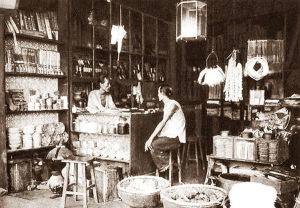
Here, first of all, picturesquely located in dilapidated old compartments which in this central area form the last vestiges of the old town, one may find a confederation of Chinese tailors whose workshops open directly onto the pavement. Every morning, their brave workers come and sit down, shirtless, in front of the benches upon which their daily work piles up. They don’t leave until nightfall, and it’s wonderful to see their nimble hands stir in a tireless toil, measuring, trimming, cutting and recutting, running their needles through fabric. For them there is no unemployment, no weekly rest, and especially no irritating discussion of the “three-shift” system: only the ritual celebrations of Tết interrupt their ardent working lives for a statutory fortnight’s holiday. And as you may know, it is from such good Chinese manufacturers that come, signed A-Tac or A-Hon, the colonial suits that help us dress so elegantly.

Marchand de sourbets

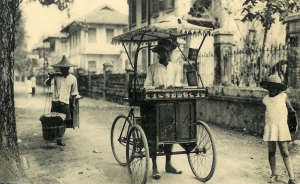
An ice-cream merchant on the streets of Saigon in the early 20th century

The meticulous precision work required by industry of clockmaking and jewelry also naturally appeals to the patient and industrious Chinese artisans, who have also cornered the market in this area. Shops in which rather dated clocks rub shoulders with a whole assortment of native jewelry are also numerous in the rue Catinat.

Further along, furniture makers and basket weavers obligingly spread out their masterpieces of dubious elegance – but beware of termites!

Along the lower end of rue Catinat there have survived a few Chinoiserie and Japonerie merchants which the customs tariffs have not yet reduced to bankruptcy. Once they were many, but now they are a dying breed. I recall many years ago the shop of a very large, paunchy man who combined his official duties as an interpreter in the Immigration Department with a Chinese antiques business. There, by browsing carefully and paying well, one could acquire some very beautiful artefacts.

Chettyar

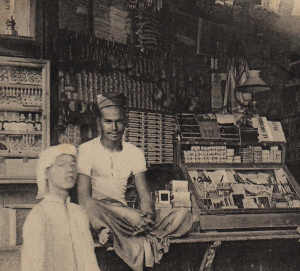
A Chettyar merchant in Saigon

But amongst the hectic scenes of daily life that play out all along rue Catinat, the most interesting are those surrounding the small money changers and tobacconists shops which line the left sidewalk. Around a dozen of these little shops stand side by side, opening directly onto the street. On the threshold of each, set tirelessly in the legendary pose of the artisan at work, stands a son of our French India, boss of his narrow house, proudly exhibiting his wares to passers by, including packs of cigarettes or tobacco of Algerian origin, fine Manila cigars, Japanese matchboxes and wooden pipes. Some of these tobacco shops also have attached to them small haberdasheries selling articles which are specifically intended for military customers.

I have not yet spoken about Saigon’s cafés. So, in order not to give the lie to the reputation of French colonisers, I will say that Saigon certainly has no shortage of them. Many of these, establishments of the second order, are grouped at the bottom end of the old rue Nationale [Hai Bà Trưng] in the neighbourhood of the naval port, which provides them with a guaranteed clientele. But it’s near the theatre that one may find most of the more up-market cafes. These are vast, well-appointed facilities, with large terraces which spill out onto the sidewalk, cluttering them up with a casualness which is very colonial.

Grand Hotel De La Rotonde

The Café of the Grand Hôtel de la Rotonde in the early 20th century

It’s here, at the “green hour,” that the Saigonnais come to rendezvous after the oppressive heat of the day has subsided, escaping from their desks and offices, eager to breathe the “good air” and enjoy the relative cool of the evening. Incidentally, I recall that in one of those vague early accounts of the Far East penned back in the 1870s by one of a special category of travel writer known today as the “pantouflards” (couch potatoes), it was written that Saigon was a city of idlers who spent their days and nights in taverns getting drunk on strong liquor such as absinthe. It’s time to do proper justice to this assessment by describing it as both inaccurate as malicious. They do not drink more in Saigon than they do in France, and consumption of absinthe is certainly more moderate here than it is in other French dependencies. In any case, the harsh climate we experience, ruthless to alcoholics and opium smokers, obviates against excesses of this nature. Let us therefore no longer make such rash judgments. We have a duty to recognise that in a city where one lives mainly an outdoor life, where it is necessary to escape the heat of the office or the solitary home, institutions of this nature have an undeniable practical utility.

IMAGE 7

André Pancrazi’s Café de la Musique on rue Catinat in the early 20th century

In my case, I can only make a single complaint against the café, and that relates to the incessant noise created by their concert orchestras, which have transformed this exclusive location of Saigon into a true outpost of the Point-du-Jour. You like violins? You’ll find them everywhere on the rue Catinat, from 6pm until curfew, their bows darting back and forth enthusiastically. Where music is concerned, I admit that I’m only a vulgar layman. But for many months in my little hermitage on the rue Blancsubé [Phạm Ngọc Thạch] – a neighbourhood of music lovers – I had to suffer the piano playing of a very amiable boy who sat down at his piano in the late morning and didn’t get up from it until nightfall. He carried on playing endless scales on this horrible instrument, interrupted only by his appalling rendition of “Salut, demeure, chaste et pure” from Gounod’s Faust. His dragging interpretation of the high note which marks the penultimate syllable of this air left a throbbing and painful impression in my eardrums which still lingers today. It almost drove me mad, and had it done so, that would have been very unfortunate for my family.

So let’s waste no more time being grumpy about the cafés of the rue Catinat with their blaring music and continue to the place du Théâtre.

To read part 2 of this serialization, click here

To read part 3 of this serialization, click here

Tim Doling is the author of the guidebook Exploring Saigon-Chợ Lớn – Vanishing heritage of Hồ Chí Minh City (Nhà Xuất Bản Thế Giới, Hà Nội, 2019)

A full index of all Tim’s blog articles since November 2013 is now available here.

Join the Facebook group pages Saigon-Chợ Lớn Then & Now to see historic photographs juxtaposed with new ones taken in the same locations, and Đài Quan sát Di sản Sài Gòn – Saigon Heritage Observatory for up-to-date information on conservation issues in Saigon and Chợ Lớn.
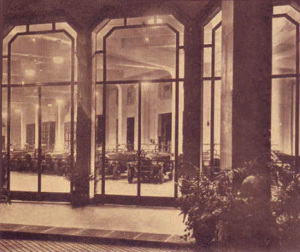
2014 – A Watershed Year for Saigon’s Built Heritage?

IMAGE 3

The Saigon Tax Trade Centre at 135 Nguyễn Huệ

This article was published previously in Saigoneer http://saigoneer.com

In the future, 2014 may be remembered as a watershed year in which a popular urban conservation movement emerged to champion the cause of Hồ Chí Minh City’s fast-disappearing built heritage.

The year 2014 began, just as 2013 had ended, with the destruction of a further batch of Hồ Chí Minh City’s colonial-era heritage buildings to make way for new developments.

DSC04606

The old Ogliastro warehouse at 132 Bến Vân Đồn in District 4, rebuilt in early 2014

These included 213 Đồng Khởi, 200 Lý Chính Thắng, the last Naval Artillery building at 3A Tôn Đức Thắng, and the old Ogliastro warehouse at 132 Bến Vân Đồn in District 4.

Early in the year the public also learned, through various press articles, the fate of other surviving colonial-era heritage buildings located on so-called “gold land” sites, including 59-61 Lý Tự Trọng, the Catinat Building at 26 Lý Tự Trọng, Bót Catinat at 164 Đồng Khởi, and the Nguyễn Văn Của Imprimerie de l’Union building at 49-57 Nguyễn Du.

However, perhaps what 2014 will be remembered for most is not the continued destruction of old buildings, but rather the growing realisation of local people that old Saigon – once described as the “Pearl of the Orient” – was fast disappearing under the wrecking ball of modernisation. And it was this growing awareness which led, during the course of the year, to the emergence of a community-led urban heritage conservation movement.

IMAGE 1

213 Đồng Khởi, demolished in March-June 2014

Public opposition to the fast-paced redevelopment of historic buildings first became apparent in the press coverage which followed the announcement that a new 14-storey City Administration Centre would be built immediately behind the Hồ Chí Minh City People’s Committee building. To make way for the new building, the plan involved the demolition of the art deco office and apartment block at 213 Đồng Khởi (1929) – a building which as recently as 2011 had been earmarked for repair and preservation – along with its neighbour, the former Secrétariat général du gouvernement building (c 1888) at 59-61 Lý Tự Trọng.

Then in March 2014, just as the wreckers began their work on 213 Đồng Khởi, the Vietnamese press gave extensive column space to an alarming report presented to an urban heritage conservation seminar organised by the Hồ Chí Minh Institute of Development Studies (HIDS) and the Hồ Chí Minh City Urban Development Management Support Centre (PADDI). According to this report, of the 377 colonial villas in Districts 1 and 3 which had been catalogued in 1993, more than 56% had been demolished, degraded or significantly altered by 2013.

View from Rex Tax Trade Centre June 2012 i

Another view of the Saigon Tax Trade Centre

However, it was the revelation in September 2014 of a long-planned scheme to demolish the Saigon Tax Trade Centre and replace it with a 43-storey tower block which really got the embryonic conservation movement into gear.

Though heavily modified since its glory days as the up-market Grands Magasins Charner (1924) and no longer the city’s most successful department store, the Saigon Tax Trade Centre building enjoyed iconic status and was greatly loved by many local people. Little more than a week after the announcement, a group comprising architects, academics and other concerned citizens had been formed under the leadership of Mr Phùng Anh Tuấn, the Honorary Consul of Finland in Hồ Chí Minh City, to raise concerns about the redevelopment plan and propose alternative solutions. An online petition was subsequently drawn up, requesting the Hồ Chí Minh City People’s Committee to preserve elements of the old building as part of the new development. Shortly before Christmas, responding positively to the recommendations of this group, the People’s Committee announced its agreement to a proposal by the Director of Planning and Architecture that the main lobby of the Tax Trade Centre with its priceless mosaic staircase, along with design features of the building’s exterior façade, should be preserved and incorporated into the new building.

IMAGE 2

The Catinat Building at 26 Lý Tự Trọng

In December 2014, building upon the momentum of its successful Saigon Tax Trade Centre campaign, the “Tax Team” relaunched itself as the “Saigon Heritage Observatory.” On its Facebook group page, the group declares its stated aims to be: (i) working with a range of partners to encourage and assist in the protection and restoration of historic buildings and streetscapes; (ii) promoting the important role played by the historic environment in economic and social development; (iii) providing a platform for the dissemination of information on best practice in urban conservation management; and (iv) monitoring and raising public awareness about the condition of buildings and streetscapes in danger of damage or destruction.

In 2015, the Saigon Heritage Observatory group plans to launch a unique open data heritage mapping project which will permit members of the public owning GPS-equipped cameras and smartphones to participate in the protection of the city’s heritage by uploading images of old buildings onto a website. These images will automatically be inserted in their correct locations on a Google map of the city, and website moderators will then add relevant details of each building, including date of construction, architect, historical data, architectural/artistic value, current condition and status.

IMAGE 5

The Saigon Heritage Observatory was set up in December 2014

It is envisaged that the project will become the basis for the development of a comprehensive inventory of colonial-era heritage buildings, something which does not currently exist in Hồ Chí Minh City. In future, the open data heritage mapping project can be used by the Vietnamese authorities and the general public, both as a tool for extending legal protection to selected heritage buildings, and as a means of improving people’s awareness of their cultural significance. It is believed that this will be the first instance of “crowdsourcing” techniques being harnessed in order to protect a city’s endangered built heritage.

Considerable challenges face the conservation lobby here in Hồ Chí Minh City. In the absence of any type of protection, the great majority of the city’s colonial buildings can still be modified or demolished at any time with impunity. While those located on the so-called “gold land” prime sites remain at the greatest risk of destruction, many others may yet be lost before statutory protection measures can be drawn up to save them.

However, the new group believes strongly in the power of community advocacy and remains upbeat about its efforts to protect and preserve what remains of Hồ Chí Minh City’s rich architectural legacy for future generations to enjoy.

Tim Doling is the author of the guidebook Exploring Saigon-Chợ Lớn – Vanishing heritage of Hồ Chí Minh City (Nhà Xuất Bản Thế Giới, Hà Nội, 2019)

A full index of all Tim’s blog articles since November 2013 is now available here.

Join the Facebook group pages Saigon-Chợ Lớn Then & Now to see historic photographs juxtaposed with new ones taken in the same locations, and Đài Quan sát Di sản Sài Gòn – Saigon Heritage Observatory for up-to-date information on conservation issues in Saigon and Chợ Lớn.
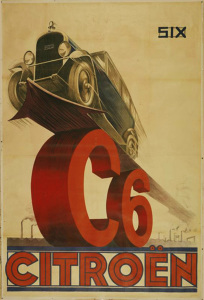
Date with the Wrecking Ball – Vietnam Railways Building, 136 Ham Nghi, 1914

IMAGE 1

The Vietnam Railways building pictured in 2014

This article was published previously in Saigoneer http://saigoneer.com

Featured in 2014 as a Saigoneer “Building of the Week,” the 100-year-old Vietnam Railways Building at 136 Hàm Nghi is yet another of Hồ Chí Minh City’s historic buildings threatened with destruction. Let’s take another look at its long history.

IMAGE 2

An early 20th century image of the Chemins de fer de l’Indochine (CFI) building with the Halles centrales in the background

When construction of the southernmost section of the Transindochinois (North-South) railway line got under way in 1904, it was envisaged that the existing terminus of the Saigon-Mỹ Tho line at the riverside end of rue de Canton (modern Hàm Nghi boulevard) would serve both lines. However, when the first northbound trains began operating, the colonial authorities realised that a larger station was required.

In 1910, a scheme was drawn up to reroute both railway lines as they entered the city centre, building a larger Sài Gòn Railway Station in reclaimed swamp land to the west and demolishing an old locomotive depot to free up land for the construction of a new central market and spacious city square.

A colonial-era taxi rank outside the CFI building

The project was beset by delays, but the Halles centrales (now Bến Thành Market) finally opened in March 1914, and the second railway station in September 1915.

As part of this scheme, the government railway company Chemins de fer de l’Indochine (CFI) built itself an imposing new southern region railway headquarters on the square, right opposite the station entrance. It was inaugurated in 1914, a full year before the opening of the new railway station. Each level of the ornate three-storey building incorporated a spacious outer corridor which shielded the offices from the heat of the external walls.

IMAGE 6

A 1960s shot of the building when it was the headquarters of Hỏa xa Việt Nam (HXVN)

In May 1952, when CFI officially became the Việt Nam Department of Railways (Sở Hỏa xa Việt Nam, HXVN), the railway building became its southern branch headquarters. Just three years later, HXVN became the southern rail operating company, responsible to the South Vietnamese Ministry of Public Works and Transport.

During the 1960s, the railway headquarters acquired a certain notoriety after the sidewalk outside the building was turned into a place of execution.

Since 1975, the building has functioned as the Hồ Chí Minh City branch office of Vietnam Railways. However, a 2013 article in the online Báo Giao Thông (Transport Newspaper) – since removed from access – indicated that as part of a co-operation agreement with Kinh Đô Land, the site was earmarked for redevelopment as offices and serviced apartments.

UPDATE: In August 2019, it was announced that the Hồ Chí Minh City People’s Committe had requested Vietnam Railways to transfer the building to the city government, with a view to its restoration and conservation, but that Vietnam Railways had refused, arguing that it need the building for its own operations.

At the time of writing, therefore, the threat to the future of this historic building remains as serious as ever.

“Saigon, October 1945 – Sở Hỏa Xa” by John Florea, and the same building today, now the Southern headquarters of Vietnam Railways (Tổng công ty Đường sắt Việt Nam) at 136 Hàm Nghi

Tim Doling is the author of the guidebook Exploring Saigon-Chợ Lớn – Vanishing Heritage of Hồ Chí Minh City (Nhà Xuất Bản Thế Giới, Hà Nội, 2019).

Tim Doling is also the author of The Railways and Tramways of Việt Nam (White Lotus Press, Bangkok, 2012) and gives talks on Việt Nam railway history to visiting groups.

A full index of all Tim’s blog articles since November 2013 is now available here.

Join the Facebook group pages Saigon-Chợ Lớn Then & Now to see historic photographs juxtaposed with new ones taken in the same locations, Đài Quan sát Di sản Sài Gòn – Saigon Heritage Observatory for up-to-date information on conservation issues in Saigon and Chợ Lớn, and Rail Thing – Railways and Tramways of Việt Nam for more information about Việt Nam’s railway history and all the latest news from Vietnam Railways.

Date with the Wrecking Ball – Former Imprimerie de l’Union Building, 49-57 Nguyen Du, c 1920

IMAGE 1

The Nguyen Van Cua Imprimerie de l’Union building at 49-57 Nguyễn Du

This article was published previously in Saigoneer http://saigoneer.com

Located close to the Saigon Post Office, the unassuming two-storey white shophouse building at 49-57 Nguyễn Du was once the headquarters of one of the most successful colonial-era printing companies.

In the early days of the colony, the Cochinchina administration set up its own government printing works to handle the publication of all official French government publications, including the Annuaire de Cochinchine Française and the Annuaire de l’Indo-Chine française.

1891

The Imprimerie coloniale, established in 1867 on the site of today’s Intercontinental Hotel, as indicated on a map of 1891

Established in 1867 on the site of today’s Intercontinental Hotel and run by a high-ranking government administrator, this institution was initially named the Imprimerie impériale, but later went by the alternative names of Imprimerie nationale or Imprimerie coloniale.

However, following the replacement of the early Admiral-Governors by a civil administration in 1879, the printing market was opened up to competition from private companies, leaving the poorly-funded Imprimerie nationale unable to compete effectively. It eventually closed in 1904.

According to a report in the Moniteur de la papeterie française et de l’industrie du papier of 15 January 1904, “The Printing Office of Cochinchina has been abolished. The equipment was old, worn, and required replacement; the Governor recognised that the private printing companies were sufficient, so he decided to close the Imprimerie nationale in order to save public money, while arranging for the fair dismissal of staff.”

In subsequent years, both public and private books and documents were printed by a variety of independent printing companies, including the Imprimerie Saigonnaise, the Imprimerie Commerciale Ménard et Rey and its later offshoot the Imprimerie Rey, Curiol et Cie, the Imprimerie nouvelle A Portail and the Imprimerie Moderne.

IMAGE 3

In the 1920s, the Imprimerie de l’Union printed the Lục Tỉnh Tân Văn newspaper

However, by the 1920s, one of the best-known and most successful of Saigon’s printing enterprises was Nguyễn Văn Của’s Imprimerie de l’Union, based initially at 13 and later at 57 rue Lucien Mossard (modern Nguyễn Du street). It printed the newspapers L’Écho annamite: Organe de défense des intérêts franco-annamites, L’Eveil économique de l’Indochine and later L’Ere nouvelle: Organe bi-hebdomadaire du Parti travailliste annamite, along with journals such as Pháp Viện Báo: Revue judiciaire franco-annamite and a wide range of Cochinchina, Saigon municipal and provincial government publications. The company also took over the printing of Lục Tỉnh Tân Văn (“Six Provinces News,” founded 1907), one of the earliest newspapers to use the Vietnamese quốc ngữ script.

Regarded as one of the leading Vietnamese intellectuals of his day, proprietor Nguyễn Văn Của acquired French citizenship, was elected as a Colonial Councillor and could frequently be found mixing amongst the high society of Cochinchina. He also became the owner of a 288-hectare plantation in Long Thành, Biên Hòa, and an active member of the Association des planteurs de caoutchouc de l’Indochine (Indochina Rubber Planters’ Association).

In 1925, Của was elected president of the committee tasked with raising funds for the statue of Pétrus Trương Vĩnh Ký and succeeded in raising 90,000 Francs to pay for the construction and installation of the monument. Significantly, when it was formally installed in 1928 behind the Cathedral, it was Của himself who delivered the eulogy.

Nguyễn Văn Của was also an active member of the Société des Études Indochinoises, and in 1927 the Société made him the president of the subscription committee they had set up to raise funds for the purchase of naval pharmacist Dr Victor-Thomas Holbé’s Asiatic art collection.

IMAGE 2

The words “Nguyen Van Cua” and “Imprimerie de l’Union” are still visible on the upper façade of the building

Của’s fundraising skills and extensive network of contacts ensured that Holbé’s priceless art works became the core collection of the new Musée Blanchard de la Brosse (opened in 1929), now the Hồ Chí Minh City History Museum.

Của’s eldest son Nguyễn Văn Xuân also became a naturalised French citizen, attending the prestigious Collège Chasseloup Laubat Laubat (now the Lê Quý Đôn Secondary School) and later embarking on a successful career in the French army, rising to the rank of lieutenant-colonel.

When he died in May 1941, Nguyễn Văn Của was given a grand funeral which was attended by many of the colony’s great and good. A few days later, in a long article in the Écho annamite newspaper, the President of the Chamber of Agriculture J Mariani gave a long eulogy describing Của as “a fine example of a self-made man” and “a model partisan of the Franco-Annamite union.”

The Nguyen Van Cua Imprimerie de l’Union building is a two-storey building which originally incorporated commercial spaces at ground floor level and family accommodation above. It has survived intact until the present day, with the words “Nguyen Van Cua” and “Imprimerie de l’Union” still visible on its upper façade,  but it is now in very poor condition. Sadly, it stands on the so-called “Gold Land” block enclosed by Đồng Khởi, Lý Tự Trọng, Nguyễn Du and Hai Bà Trưng streets, which, according to newspaper reports, will soon be redeveloped to accommodate “services, culture, luxury hotels, finance offices and exhibition areas.”

Nguyễn Văn Của, family photograph courtesy of his great-great grandson M Jean Xuan Chevalier

Tim Doling is the author of the guidebook Exploring Saigon-Chợ Lớn – Vanishing heritage of Hồ Chí Minh City (Nhà Xuất Bản Thế Giới, Hà Nội, 2019)

A full index of all Tim’s blog articles since November 2013 is now available here.

Join the Facebook group pages Saigon-Chợ Lớn Then & Now to see historic photographs juxtaposed with new ones taken in the same locations, and Đài Quan sát Di sản Sài Gòn – Saigon Heritage Observatory for up-to-date information on conservation issues in Saigon and Chợ Lớn.
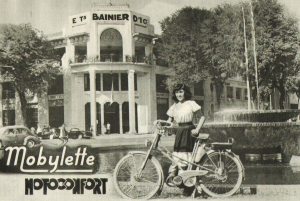
Icons of Old Saigon – Andre Pancrazi’s Cafe de la Musique and Grand Hotel des Nations

Both images

The Café de la Musique and the Grand Hôtel des Nations

This article was published previously in Saigoneer http://saigoneer.com

One of many French settlers of Corsican descent who made names for themselves in colonial Saigon, André Pancrazi is remembered as the proprietor of two old Saigon icons – the Café de la Musique and the Grand Hôtel des Nations.

Since André Pancrazi does not appear in the colonial records as a hotelier and restaurateur until 1900, little is known about his earlier business activities.

1889

An 1889 advertisement for the Hôtel and Café de la Musique, then under the management of Madame Hermann

However, it seems that he was one of several Pancrazi siblings who settled in Saigon in the late 19th century, including Antoine (who became his business partner), François (a clerk in the Saigon Immigration Service) and Bonaventure (a colonial administrator in Long Xuyên).

The “Hôtel and Café de la Musique” at 4 place Francis Garnier [modern Lam Sơn square] – with which Pancrazi’s name is forever associated – was originally opened in the mid 1880s by a businesswoman named Madame Hermann. During her 1888 visit to Saigon, wealthy French widow Louise Bourbonnaud was advised by one of her fellow travellers to stay at this establishment, but she chose instead to take a room at the more famous Hôtel de l’Univers.

Cafe de la Musique A i

A view of the Café de la Musique from rue Catinat (modern Đồng Khởi street)

By the late 1890s, one Lucien Chêne briefly appears as the café’s proprietor, but in 1900 the business was acquired by André Pancrazi.

By this time, the Café de la Musique was one of the city’s most popular café-restaurants, but its hotel facilities were very limited, so in 1900-1901 Pancrazi commissioned the construction of the 65-room Grand Hôtel des Nations at 70 boulevard Charner, at the other end of the same city block. After the new hotel opened, the old hotel rooms above the Café de la Musique became the hotel annex.

SAIGON 1910s - Perspective de l'Hôtel de Ville et Hôtel des Nations

Saigon: a view of boulevard Bonnard and the Grand Hôtel des Nations

Sadly, no descriptions of the hotel’s facilities have survived. However, it seems that the “fine dining” offered at the “Grande Terrasse” restaurant of the Hôtel des Nations was appreciated by Saigon’s gourmands. In his Excursion en Annam of 1905, G. Le Roy Liberge commented that the hotels in Saigon were so uninviting that he preferred to rent a room – and to take all his meals at the “Restaurant Pancrazi.”

In 1913, André Pancrazi was awarded the Chevalier de la Legion d’honneur for his services to the city, and from that date onwards he also appears in the colonial records as a Municipal Councillor.

Solirene 2

After 1922, the old Café de la Musique building was taken over by the Pharmacie principale L. Solirène

André Pancrazi remained a figure of importance in colonial Saigon’s hospitality industry for nearly two decades, but in 1919 he sold both the Café de la Musique and the Grand Hôtel des Nations, and soon afterwards he left Saigon. The records remain silent about the reasons for his departure.

By 1922, the Café de la Musique building had been taken over by the Pharmacie principale L. Solirène, which advertised itself as “the former Maison Holbé et Renoux, the oldest and most important pharmacy in the Far East, founded in 1865.”

Grand Hotel des Nations

A 1929 advertisement for the “Ancienne Maison Pancrazi”

After Pancrazi’s departure, the Grand Hôtel des Nations continued in operation under the management of a M. de Fourcauld, but such was Pancrazi’s reputation that throughout the 1920s its advertising continued to describe the hotel as the “Ancienne Maison Pancrazi.” Indeed, Henri Danguy, in his Nouveau Visage de la Cochinchine of 1929, commented that one never called this establishment the “Grand Hôtel des Nations” – it would always be the “Hôtel Pancrazi.”

The Grand Hôtel des Nations survived on its original site until the early 1950s, when the building was demolished to make way for the six-storey Liên Seng complex. A new Grand Hôtel des Nations subsequently reopened in that building and survived until the early 1970s.

Cafe de la Musique

Another view of the Café de la Musique from rue Catinat (modern Đồng Khởi street)

Saïgon - Hôtel des Nations

A view of the Grand Hôtel des Nations from place Francis Garnier (Lam Sơn Square)

4585354383_0bba386702_o

The “Grande Terrasse” restaurant of the Grand Hôtel des Nations

card00280_fr

The original Grand Hôtel des Nations was demolished in the early 1950s to make way for the six-storey Liên Seng complex, but a new Grand Hôtel des Nations subsequently reopened in that building

Tim Doling is the author of the guidebook Exploring Saigon-Chợ Lớn – Vanishing heritage of Hồ Chí Minh City (Nhà Xuất Bản Thế Giới, Hà Nội, 2019)

A full index of all Tim’s blog articles since November 2013 is now available here.

Join the Facebook group pages Saigon-Chợ Lớn Then & Now to see historic photographs juxtaposed with new ones taken in the same locations, and Đài Quan sát Di sản Sài Gòn – Saigon Heritage Observatory for up-to-date information on conservation issues in Saigon and Chợ Lớn.
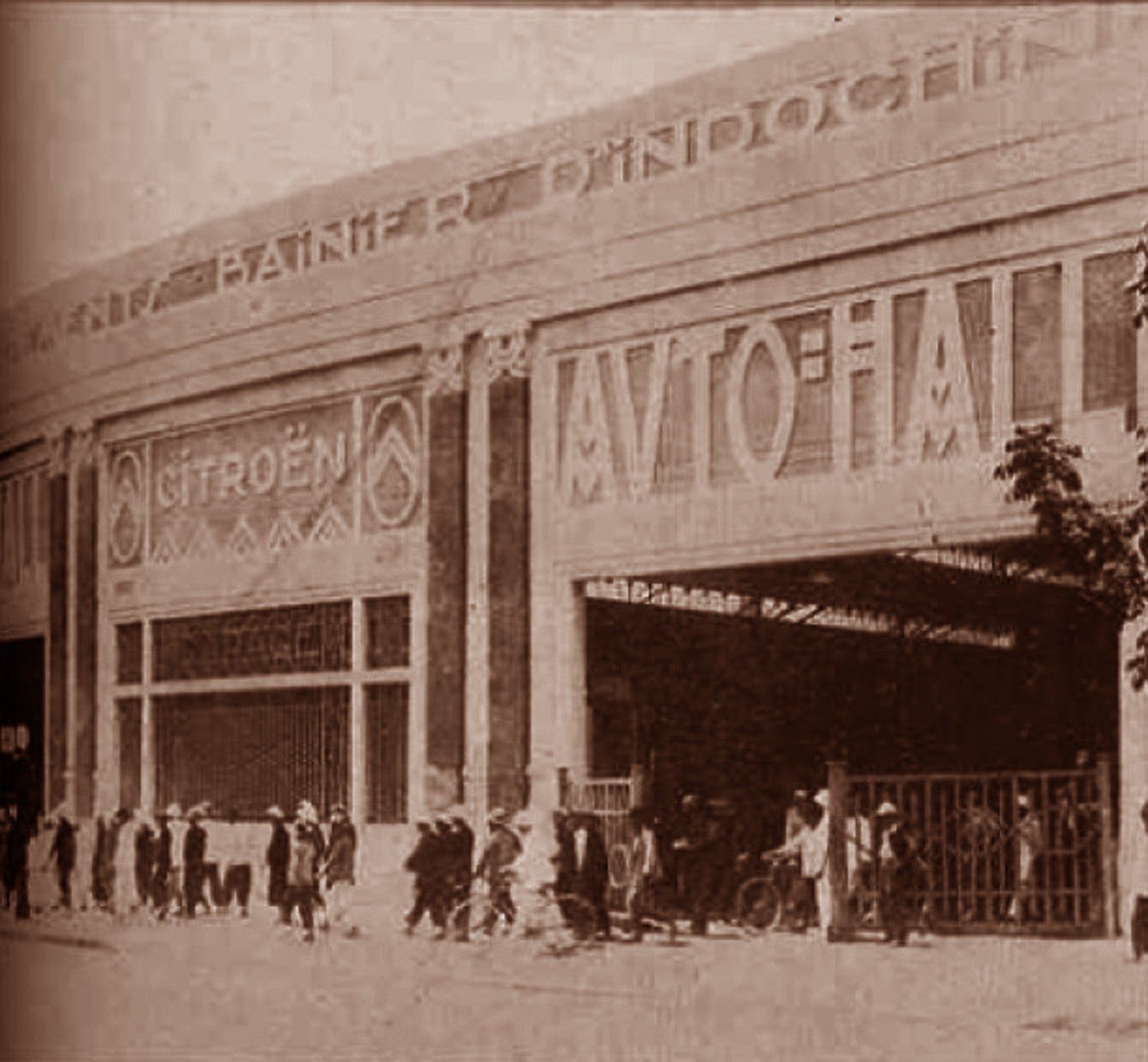
Saigon Through the Eyes of Early Travellers – A Maufroid in 1912

Polynesian

The Messageries maritimes vessel M V Polynésian, pictured in 1914

In early 1912, A Maufroid visited Cochinchina as part of a six-month tour of the Far East. This is an English translation of the chapter entitled “Saigon” from his 1913 book De Java au Japon par l’Indochine, la Chine et la Corée (From Java to Japan via Indochina, China and Korea).

Yesterday afternoon, the Polynésian passed close to high mountains that we first took to be part of the coast of Cochinchina. In fact, they were the islands of Poulo Condor, huge rocks rising from the sea which France turned into a place of exile for the indigenous criminals of Indochina.

MM

A view of the Messageries maritimes wharf in Saigon

By this morning we were in calm waters. The boat moved slowly up the Saigon River. The countryside was very flat and very green. Along the banks, we saw mangrove bushes at the foot of unknown shrubs, and beyond them the rice fields. The greenery, the plain, the light mist over the water which caught the first light from the rising sun, all was reminiscent of Holland.
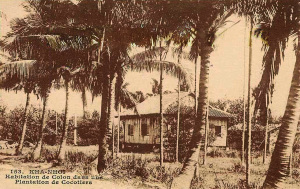
At 9am, the Polynésian docked at a wooden pier, where around 20 colons dressed in white were waiting for friends from France.

A river of moderate breadth, a smattering of officials meeting colleagues or greeting superiors, the very small amount of activity in a port containing just five or six ships – all of this seemed quite modest when you compare it with the great English ports of Colombo and Singapore. On the horizon there were no factory chimneys, and close to the wharf one could see only clusters of low houses, customs halls and courier offices. It gave the impression of a small, sleepy provincial town.

1910

A Saigon pousse pousse in 1910

Two pousse-pousse – that’s the name given to the rickshaw in this French territory – carried me and my luggage to the Hôtel Continental, the most recently established hostelry here in Saigon.

In fact, this name “pousse-pousse” (which can be abbreviated simply to “pousse,” meaning push) is only really justified in Pondicherry, where the driver really does push a small carriage ahead of him. Here, as in Ceylon, Singapore and elsewhere throughout the Far East, the vehicle is pulled, not pushed.

Unlike the Dutch, our Indochina compatriots do not regard this mode of locomotion as being incompatible with human dignity. The pousse-pousse abounds in Saigon, and its exaggerated number has had the effect of reducing the price of journeys to one of incredible modesty. For just 10 cents (5 French sous – the piastre of 100 cents is worth about 2.50 Francs) you can buy yourself an average-length journey.

Lt Gov Palace angle view i

The Lieutenant Governor’s Palace

People rarely walk in the streets. The soldiers themselves spend their time going from barracks to café and from café to barracks and they enjoy prices which are lower than those which civilians have to pay.

Besides, at certain hours of the day it’s so hot that walking is almost impossible for the European, while the “man-horse” – the pousse-pousse driver – runs like a deer, his back cooked by the sun and his skin dripping with sweat.

Saigon boasts of being the most beautiful city in the Far East. This may be true, if by “beautiful” we mean a city which is built to measure and intersected by broad avenues which cross each other at right angles. But for tourists seeking original buildings, or even just the coolness of shadows in the sweltering 32° heat, perhaps the old eastern cities with their bizarre and irregular houses have more to offer.

Gambetta A i

Gambetta, dressed for Arctic weather

Some of the city’s monuments are very elegant: the Palace of the Lieutenant Governor of Cochinchina on rue Lagrandière; the Post Office; Cathedral square, beautifully landscaped to combat the excessive temperature of the country; and especially the Palace of the Governor General, located at the end of boulevard Norodom, the wide verandahs of which are very well suited to the climate.

One may say the same of a statue which seems almost to menace the Governor General’s official residence with his vehement gestures: a bronze Gambetta, who struggles under a thick coat, like a North Pole explorer. The natives, who sweat all year topless, gaze with amazement at his incomprehensible clothing.

The Saïgonnais would have been unhappy if, over the past few years, they had not built a wondrous theatre. This building stands in the heart of Saigon, a square surrounded by cafés, where rue Catinat, that great artery of the city, joins boulevard Bonnard.

Square du Theatre i

The Saigon Theatre on place Francis Garnier

It cost nearly four million Francs to build, and each year the Municipal Council awards its Director a further subvention of 125,000 Francs, to which is added a tidy sum for artists’ travel.

Along with the cafés which surround it, the Saigon Theatre is the great preoccupation of the Saïgonnais. However, if you take account of the fact that, of its 50,000 inhabitants, Saigon has about 4,000-5000 Europeans capable of savouring comic operas and vaudeville, you will no doubt understand that the evening entertainments laid on here for the colons place a rather heavy burden on the local budget.

Saigon has the appearance of a quiet prefectural town in France which revolves around the lives of its garrison and officials. During the daytime, its spacious boulevards, roasted by the sun, become veritable desert steppes. Each functionary scribbles away all day in an office – unless he chooses to sleep while waiting for the cocktail hour. Then, at about five o’clock, everyone wakes up; the pavement cafés of the rue Catinat fill up with customers; and Theatre square is perfumed with the scent of absinthe. This is truly the magic hour! By this time, the temperature has become more bearable. Friends gather to talk politics while watching the promenaders pass by.

159_001

French colons doing the “tour de l’Inspection” by automobile

And how they pass by! An endless stream of people travelling by pousse-pousse, carriage, automobile; in fact, one might say especially by automobile. The motor car, in hot countries, has become a very explainable success. Its speed generates a violent current of fresh air, compared with which the faint breath of the electric fan or the archaic punkah is simply a caress without energy. Here, those who own motor cars may take a tour to the Inspection de Gia-Dinh, along a beautiful road where the powdery dust turns their white suits pink.

After dinner, even more people arrive at the cafés where the orchestras play. Then, during intervals in the performance at the Saigon Theatre, members of the audience come outside and spread themselves all over the square, sitting down at café tables to enjoy iced drinks with grandly dressed ladies.

As soon as a customer is sufficiently refreshed and gets up from his chair in the Café de la Terrasse, the Café de la Musique or the Continental Terrace, up to 20 pousse-pousse drivers immediately gather round him expectantly.

Caravelle Hôtel and Café de la Terrasse 2

The Grand Café de la Terrasse

As for these pousse-pousse drivers harnessed to their tiny carts, one wonders, seeing their heavy buns of black hair, their effeminate faces, their amphoral hips, whether they are men or women. But these are certainly men … of a somewhat frightening mentality.

When you call a pousse-pousse to go home, the driver will run for just ten seconds before turning to ask “Congaï, Mossié, congaï?” And you answer: No! To the hotel! And make it quick!

And so, the driver once more begins to run. But then, after another 30 metres, he slows and again puts his insidious question. A second refusal, this time even more categorical.

Finally, a little further on, he will amend his offer by asking: “Boy, Mossié, boy?”

I did not attend any performance by the visiting theatre troupe in Saigon. Yet the posters were enticing. The astute director had warned families of character about the particularly frivolous nature of the show.

Café de la Musique 1

The Café de la Musique

If this theatre didn’t help me to pass my evenings in Saigon, its presence was not, however, completely without use. As I strolled around the square during one intermission, admiring the grandly-dressed audience members who came outside to breathe the cool air, I was recognised by a lady with whom I had travelled on a steamship two years earlier. Madame P introduced me to her husband, who was kind enough to invite me to dinner the next day and then placed his automobile at my disposal for several refreshing promenades.

It was thus that I went one morning by motor car to Cholon. While Saigon is the bourgeois city, the town of administrators, theatre and cafés, Cholon is the city of business.

Cholon is exclusively Chinese, and has three times the population of Saigon. It is here that the trade in rice, tea, ceramics and various other commodities is concentrated entirely in the hands of the “Heavenly Ones.”

4722780231_3c4b14ef4a_o

Chinese workers in Chợ Lớn

The city is located five kilometres from Saigon on the arroyo Chinois [Bến Nghé creek]. This river is crowded with junks which are packed tightly against each other alongside rows of rice husking factories.

What I said about Singapore is equally true for Cholon: it is a Chinese colony ruled by Europeans. In the streets, one sees exactly the same spectacle as in Singapore; vertical banners with their golden characters on a black background, and paper lanterns carrying the owners’ names on their flanks.

In the shops – for indeed, most of the houses are shops – the Chinese go about their business wearing only shiny black pants; now that their hair has been cut short [the compulsory pigtail was abolished in China in 1911 following the overthrow of the Qing dynasty], we may see the spot on their necks from where their pigtails were recently excised.

6965684816_5abed51437_b

A pagoda in Chợ Lớn

A Chinese employee of Mr P who accompanied me showed me around a few pagodas, which were all very much alike. Their walls were decorated with human and animal figures and flowers made from glazed ceramics, while their angled roof ridges featured dragons with gaping mouths and sharp tongues darting from under slender moustaches. Inside, carved and gilded wooden panels celebrated the names of generous donors. In front of the Buddha statues burned incense sticks, placed in pots filled with ash. The fragrant jostick spirals hanging from the ceilings added their sandalwood fragrance to the scent of the incense sticks.

The Chinese in Cholon include some notorious millionaires. In order to flaunt his wealth, one of them, named Taï-Maïen, had the idea of building a villa which was almost an exact copy of the Palace of the Lieutenant Governor of Cochinchina.

L0055713 Cochin China [Vietnam].

The Plain of Tombs

Behind the shopping streets, located on swampy land alongside the canals, are scattered huts made from bamboo and leaves inhabited by Chinese people of low status. One day, by dint of cunning and economy, some of these people may come to compete in luxury with Mr Taï-Maïen. And if they do, in order to humiliate their compatriot, they will be forced to go one step further by building a copy of the great Palace of the Governor General!

We returned via the Plain of Tombs. A very sad place located in grey countryside covered in tufts of straw, with blackened, sunken gravestones everywhere.

On this side of the city, much of the land is covered in rice fields. Further east, in the direction of Thu-Dau-Mot, many rich Saïgonnais have recently set up rubber plantations, the fruits of which we will be able to appreciate in several years time.

Mộ Bá Đa Lộc ở Lăng Cha Cả

The tomb of the Bishop of Adran, Monsignor Pigneau de Béhaine

Between the Plain of Tombs and the Inspection de Gia-Dinh, I stopped for a moment before the tomb of the Bishop of Adran, Monsignor Pigneau de Béhaine. In the 18th century, the Bishop of Adran was the adviser and friend of Gia Long, Emperor of Annam. In 1787, through his mediation, the Asian sovereign concluded an advantageous treaty for France.

In his old age, Monsignor Pigneau de Béhaine retired to this place, occupying himself by cultivating a small garden. On his death in 1799, he was buried here, and Gia Long raised in his memory an Annamite-style mausoleum, on which one is surprised to see decoration which juxtaposes the Christian cross with Chinese characters and imaginary monsters!

Seeing the tomb of Monsignor Pigneau de Béhaine reminded me of my own country. In fact, I know several families from his birthplace, the village of Thiérache, to where, I think, I must one day carry some stories about the great prelate who served France so well in far-away Asia.

5709430224_6cea73cff4 SAGON - Un Changeur_O

Chettyar money changers in Saigon

While I was in Singapore, I visited an entire neighborhood of Hindu workers, which was not surprising to see in an English colony. In the streets of Saigon we encounter Indian people of a different aspect; these are the Chettyars, who go about naked to the waist, their energetic faces lit by cruel eyes.

The Chettyars are Saigon’s most formidable usurers. They are widely hated in the colony, where they exploit the vices of gamblers and bon viveurs. Anyone who borrows money has reason to use their services. In a country where the normal interest rate in prime mortgage investments is around 8-10%, the Chettyars serve those who do not measure their spending in accordance with their budgetary resources. With such customers, I’m told that some Chettyars demand up to 45% interest on their loans!

“They are a plague!” say many colons. But I say that the plague is not the Chettyars, it is rather the mentality of the borrowers who come to them to pay off gambling debts that no one is obliged to contract, or to pay for disproportionate amounts of luxury which too many French are getting used here as a result of their inexcusable snobbery.

Tim Doling is the author of the guidebook Exploring Saigon-Chợ Lớn – Vanishing heritage of Hồ Chí Minh City (Nhà Xuất Bản Thế Giới, Hà Nội, 2019)

A full index of all Tim’s blog articles since November 2013 is now available here.

Join the Facebook group pages Saigon-Chợ Lớn Then & Now to see historic photographs juxtaposed with new ones taken in the same locations, and Đài Quan sát Di sản Sài Gòn – Saigon Heritage Observatory for up-to-date information on conservation issues in Saigon and Chợ Lớn.