“The Old Annamite Citadels of Cochinchina” by Ung Hoe, 1926

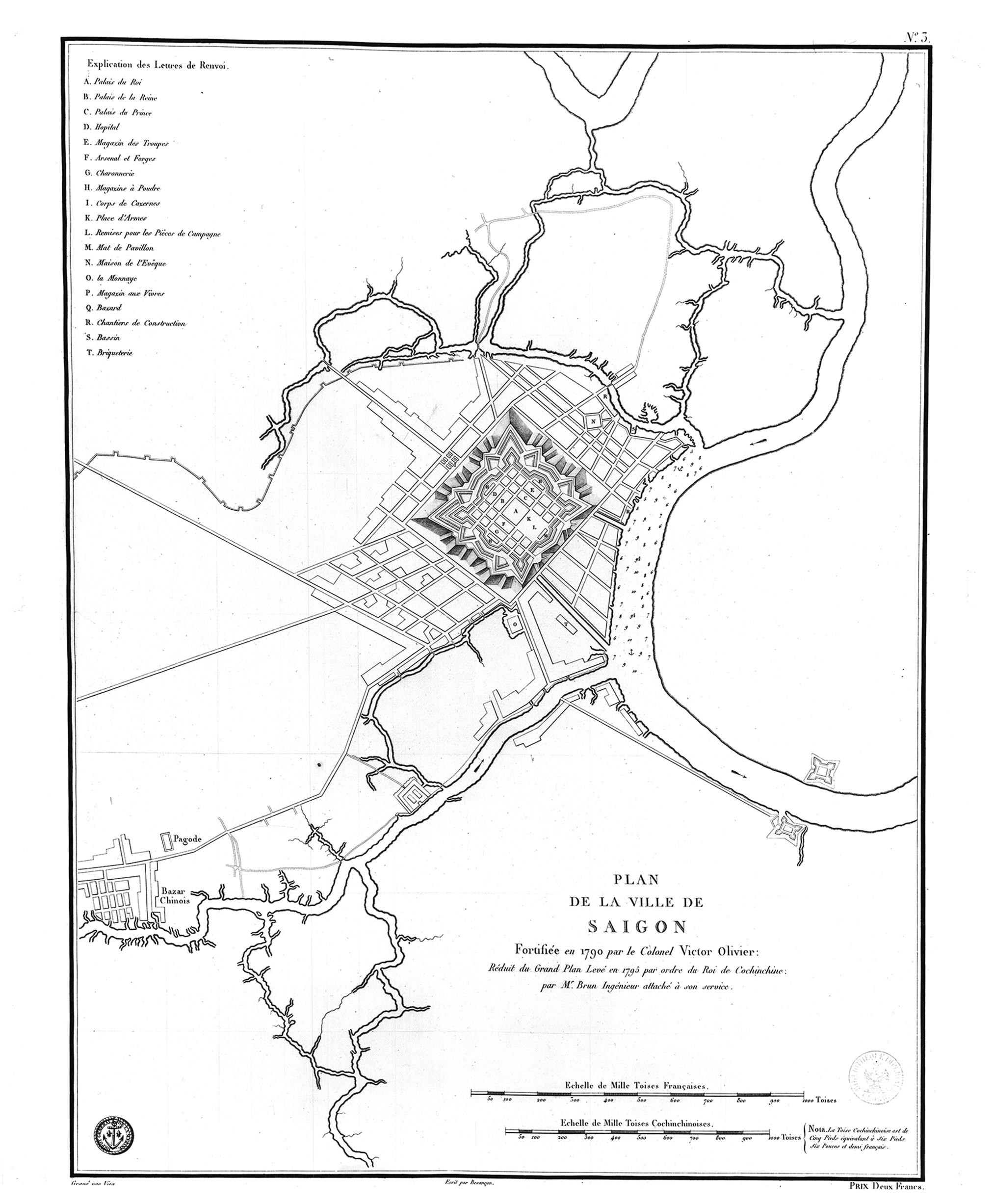
Plan of the City of Saigon, fortified in 1790 by Colonel Victor Olivier, reduced from the Great Plan drawn in 1795 by the order of the King of Cochinchina by M. Brun, Engineer in his service

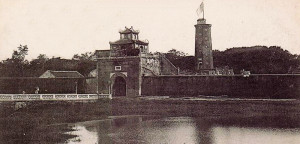
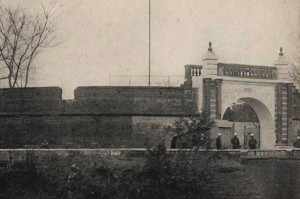
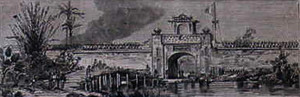
As the foundations for the Catinat Building were being laid in January 1926, large sections of bastion wall from the first Gia Định Citadel of 1790 were uncovered. On 8 February 1926, the Écho annamite newspaper published this fascinating article by Vietnamese scholar Ung-Hue on the history of Vauban military architecture in Cochinchina.

Since the discovery of the remains of the citadel built in Saigon according to the Vauban system by French officers in the service of Gia-Long, there has been much interest in the fortifications of this nature which were built in Cochinchina.

345_001Undoubtedly, the Bulletin des Amis du Vieux Hué, edited by R. P. Cadière, has made a valuable contribution to the history of our country. But so far it has not published any study on the Annamite armies or on the military arts of Annam. However, as Napoléon III once said, “The history of peoples is largely the history of its armies.”

While waiting for the Association des Amis du Vieux Hué, or perhaps even the Société des Etudes indochinoises de Saigon, to take responsibility for undertaking this work as part of their ongoing studies of Indochinese archaeology, history and philology, I think it may be interesting to gather together some information on the ancient “Vauban” citadels which were built in Cochinchina by French officers in the service of Gia-Long, or by their Annamite imitators.

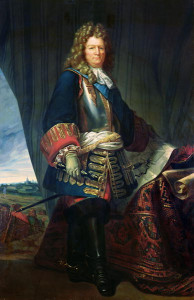
Let’s recall first of all that King Louis XIV’s military engineer Sébastien Le Prestre de Vauban (1633-1707) perfected the methods of fortification developed by his predecessors; and that, better than any of them, he knew how to adapt his citadels to the terrain in which they were built. Also, although one speaks generally of three Vauban “systems,” most textbooks admit that the illustrious engineer never strengthened two fortresses in the same manner, and that it was his successors who invented this threefold classification simply to facilitate its teaching.

Sébastien Le Prestre de Vauban, Seigneur de Vauban and later Marquis de Vauban (1633-1707)

Vauban also made improvements in the methods of attacking a citadel, developing his famous “parallel trench” system to ensure the decisive superiority of attackers over defenders. It was in order to make a citadel able to resist the maximum onslaught that he constantly studied methods of attack and then modified the fortifications accordingly. It was he who pioneered using the topography of the land when locating a fortress, and who carefully positioned the outer and inner walls, projecting bastions and lines of half-moon batteries, hiding his citadels behind massive fortifications and making them practically invulnerable.

The publication of plans and drawings of the Vauban citadels constructed in Cochinchina have, from a historical and military point of view, an importance of the first order. There no doubt exist many documents of this nature in the Directorate of Artillery and the Saigon Cadastre (Land Registry) Service. For example, I reported in a previous article on the plan of the Saigon citadel built by Olivier and Lebrun, which came from the collection of M. Bouchot.

That plan, which is now kept at the Cadastre, is a copy in reduction of a drawing found by M. Pont, former head of that service. It is a work in which the name of the draftsman has unfortunately been omitted. A second copy was presented by M. Pont to the Société des Etudes indochinoises when he was president of that society; it is probably this copy which was reproduced by George Dürrwell in his book Ma chère Cochinchine, trente années d’impressions et de souvenirs, février 1881-1910 with the following caption: “Map of the City of Saigon, fortified in 1790 by Colonel Victor Olivier, reduced from the Great Plan drawn in 1795 by the order of the King of Cochinchina by M. Brun, Engineer in his service.”

112_001Apart from this plan, there also exist drawings of five other Annamite citadels or fortified works built in Vauban style. These are the fortresses of Bien-Hoa, Ben-Ca, Phuoc-Tan, Long-Thanh and Tan-Uyen. They were executed to 1:2000 scale in 1854 by Marine Infantry Lieutenant Cullard and signed by Corporal Maquard.

No monument “à la Vauban” was built in Can-Tho. After the occupation of Bien-Hoa, Gia-Dinh, Dinh-Tuong (the former name of the province of My-Tho) and Vinh-Long by French troops, a mandarin of An-Giang (Chau-Doc) was ordered by the Court of Hue to build two store-fortresses (bao) in order to keep the precious objects of the provinces safely and also to store food for contingencies. Thus, two bao were erected, one in the village of Long-Thanh (Sadec), under the name of Bao-Tien (forward store), and the other at village of Dinh-Hoa (Can-Tho) under the name of Bao-Hau (Rear store). These works were square-shaped buildings built from masonry, but today only barely-recognisable ruins remain. They served for some time as a refuge for troops and Annamite irregulars who resisted the French army.

792_001At Chau-Doc, in the village of Long-Son, canton of An-Thành, one may find the remains of an ancient citadel built in 1838. It had not yet been completed when a Cambodian revolt forced the officers of Minh-Mang to abandon it and flee to the capital of Chau-Doc, where they built a large redoubt, now destroyed. That citadel, defended to the north by the Rach Cai-Vung, was surrounded on its other sides by ditches 20m wide and 2.50m deep. Within what is left of the ancient walls, we may still see three platforms without any special character.

Located some distance from the village of Vinh-Lac, on the edge of the Ha-Tien Canal, we may also note the shapeless remains of an old earthen fort which was built in around 1820 to monitor the digging of the canal.

In Ha Tien itself, there are also traces of a citadel which was built, it seems, by Mac-Cuu; but the few sections of wall which remain are in such a state of decay that it is impossible to work out the shapes or indeed dimensions this citadel could have had.

The citadel of My-Tho (formerly Dinh-Tuong), like that of Saigon, was built in the reign of Gia-Long by Olivier and Lebrun. A plan was drawn up in 1873 by M. Pont, when he carried out a cadastral survey of that province.

521_001At Sadec, there exists the foundation of the old earthen fortress in the village of Long-Hung, at the mouth of the Rach Nuoc Xoay. The Nguyen-Trao-Thiet-Luc reports that Nguyen-Anh (later Gia Long) took refuge there during his war with the Tay-Son.

Two fortresses existed in Tay Ninh, that of Quang-Hoa in the village of Cam-Giang, and that of Bau-Don in the village of Phuoc-Thanh. The latter was located exactly at what is now km 63 on Route Coloniale No 1. Nothing now remains of either fortress, apart from some light remains which are now completely covered by high grass and forest.

The citadel of Vinh-Long was demolished in 1877.

The book Dai-Nam-Nhut-Thong-Chi or “General Description of the Great Annam,” written in Chinese characters, includes a plan of all the citadels built in the reign of Gia-Long by Olivier de Puymanel, who is better known under the names of “Ong Tin” or Colonel Olivier.

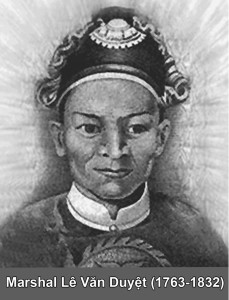
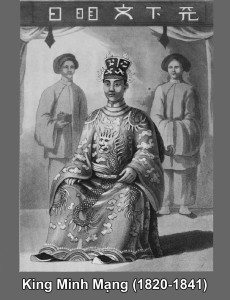
20The citadel of Saigon,  the ruins of which were discovered in January 1926, was destroyed following the revolt of Le-Van-Khoi, adopted son of Le-Van-Duyet, who had served as Viceroy of Cochinchina under Gia-Long and Minh-Mang.

J. Silvestre published the story of this revolt in the Annales de l’Ecole libre des Sciences politiques. Without adding anything to what we might call the “famous lines of history” surrounding the Great Eunuch, our former Director of Civil and Political Affairs gave us a more complete and finished picture of the story. His article contains many details for which we may look in vain in biographies of Le-Van-Duyet, and these details are of the kind which help us form a better idea of the character of both the men involved and the era in which they lived. J. Silvestre has borrowed mostly from the writings of contemporaries of Le-Van-Duyet. The judicious use he makes of these documents gives his story the advantage of dramatic colour, transporting the reader back to the early 19th century to experience the events he recounts. The passage dedicated to Le-Van-Khoi is particularly remarkable in this respect.

We know that after the death of Le-Van-Duyet in August 1832, Emperor Minh Mang ordered the governor of Saigon to pronounce, by posthumous judgment, on the conduct of Le-Van Duyet. From the beginning of this strange process, the entire family of the late Viceroy were arrested and incarcerated, on the pretext of questioning. Among them was Khoi, a Tonkinese of Muong ethnic descent. Involved in a rebellion and taken prisoner by the troops of Le-Van-Duyet after having put up a very brave fight, he had been saved from punishment by the Viceroy, who recognised his courage and uprightness. From that time onwards, Khoi attached himself to the fortunes of his benefactor, whom he followed in Saigon, eventually being promoted in 1832 to the grade of Lieutenant Colonel.

22Minh-Mang’s posthumous investigation into Le-Van-Duyet continued for some time. On the occasion of the Viceroy’s death anniversary, Khoi asked permission to go to his private home to celebrate the ritual ceremonies there. The chief justice agreed, placing him under the escort of several soldiers.

At this time, it was customary for people recruited for military service to be transferred from their own province to another, or for those condemned to exile outside their province to be conscripted into armies elsewhere. So it was that the soldiers charged to monitor Khoi were his countrymen who had been recruited from Tonkin, and they proved more than ready to support him. Khoi took the opportunity of the Viceroy’s death anniversary to gather his friends and other people loyal to the memory of Le-Van-Duyet and armed them. On the next night, they surprised and killed the main mandarins of Saigon.

With all of the Tonkinese soldiers rallying around their leader, many other people in Cochinchina embraced Le-Van-Khoi’s cause. From that moment, Khoi found himself master of Cochinchina. He set up a government, of which he became the leader with the title of Generalissimo. But the court of Hue quickly assembled an army to quell the insurgency; at the same time, it bought with money the betrayal of some rebel leaders, and suddenly Khoi found himself besieged in the Saigon citadel, awaiting the help he had requested from Bangkok.

At the end of 1833, the royal army began the siege of Saigon. The city was defended by about 2,000 soldiers. Early in 1834, the Siamese arrived and easily captured Ha-Tien and Chau-Doc. But they then disbanded and proceeded to plunder the country. Shamefully beaten by the Annamites, they hastened back across the border with their booty.

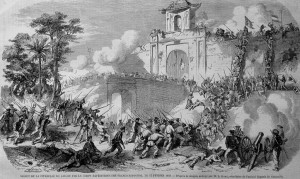
French capture Saigon in 1859 iThe siege of Saigon lasted until 1835. In the seventh month, the royal army made a supreme effort, For three days and three nights, Minh-Mang’s artillery bombarded the citadel. Then at 4am on the 10th, the firing suddenly stopped and a massive assault was launched from all sides.

Despite the desperate resistance of the besieged, the citadel was taken and its defenders were either killed or captured.

Order was restored in Cochinchina, permitting the case against Le-Van-Duyet to resume. His tomb was razed, and over the ruins was erected a pillar surrounded by chains, together with this contemptuous inscription: “Here lies the eunuch who resisted the law.”

The citadel of Saigon was destroyed and replaced by another one of smaller dimensions. It was that smaller citadel which was taken in 1858 by Admiral Rigault de Genouilly.

Ung Hue

Tim Doling is the author of the guidebook Exploring Saigon-Chợ Lớn – Vanishing heritage of Hồ Chí Minh City (Nhà Xuất Bản Thế Giới, Hà Nội, 2019)

A full index of all Tim’s blog articles since November 2013 is now available here.

Join the Facebook group pages Saigon-Chợ Lớn Then & Now to see historic photographs juxtaposed with new ones taken in the same locations, and Đài Quan sát Di sản Sài Gòn – Saigon Heritage Observatory for up-to-date information on conservation issues in Saigon and Chợ Lớn.

Icons of Old Saigon – The First Governor’s Palace, 1861

“La première résidence des Gouverneurs à Saigon” – an exterior view of the first governor’s palace, from the 1931 book Iconographie historique de l’Indochine française (1931) by Paul Boudet and André Masson

This article was published previously in Saigoneer

It’s often assumed that the Norodom Palace (1873) was the first colonial governor’s palace to be built in Saigon, but it was in fact preceded by a much humbler structure, the Hôtel des Amiraux-Gouverneurs.

For more than two years after the French conquest of Cochinchina in 1859, the early Admiral-Governors – Rigault de Genouilly, Jauréguiberry, Page and Charner – were billeted in temporary premises within the Naval Barracks next to the Saigon River.

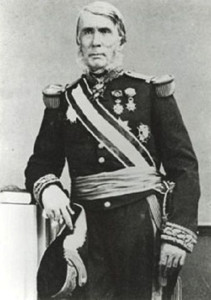
Admiral-Governor Louis Adolphe Bonard, 28 November 1861-23 April 1863

However, when Admiral-Governor Louis Adolphe Bonard took over in November 1861, a dedicated governor’s palace was deemed a priority and the Naval Engineering Corps was charged with building one.

Unfortunately at this time funds were still limited, so it was decided to build a temporary palace which could be replaced at a later date by a more permanent structure. In December 1861, a set of wooden buildings was imported in kit form from Singapore and assembled at the top end of the rue Catinat (Đồng Khởi), next to the place de l’Horloge (Clock Square, after the clock tower which stood at its centre), an area which was already home to several other colonial government offices.

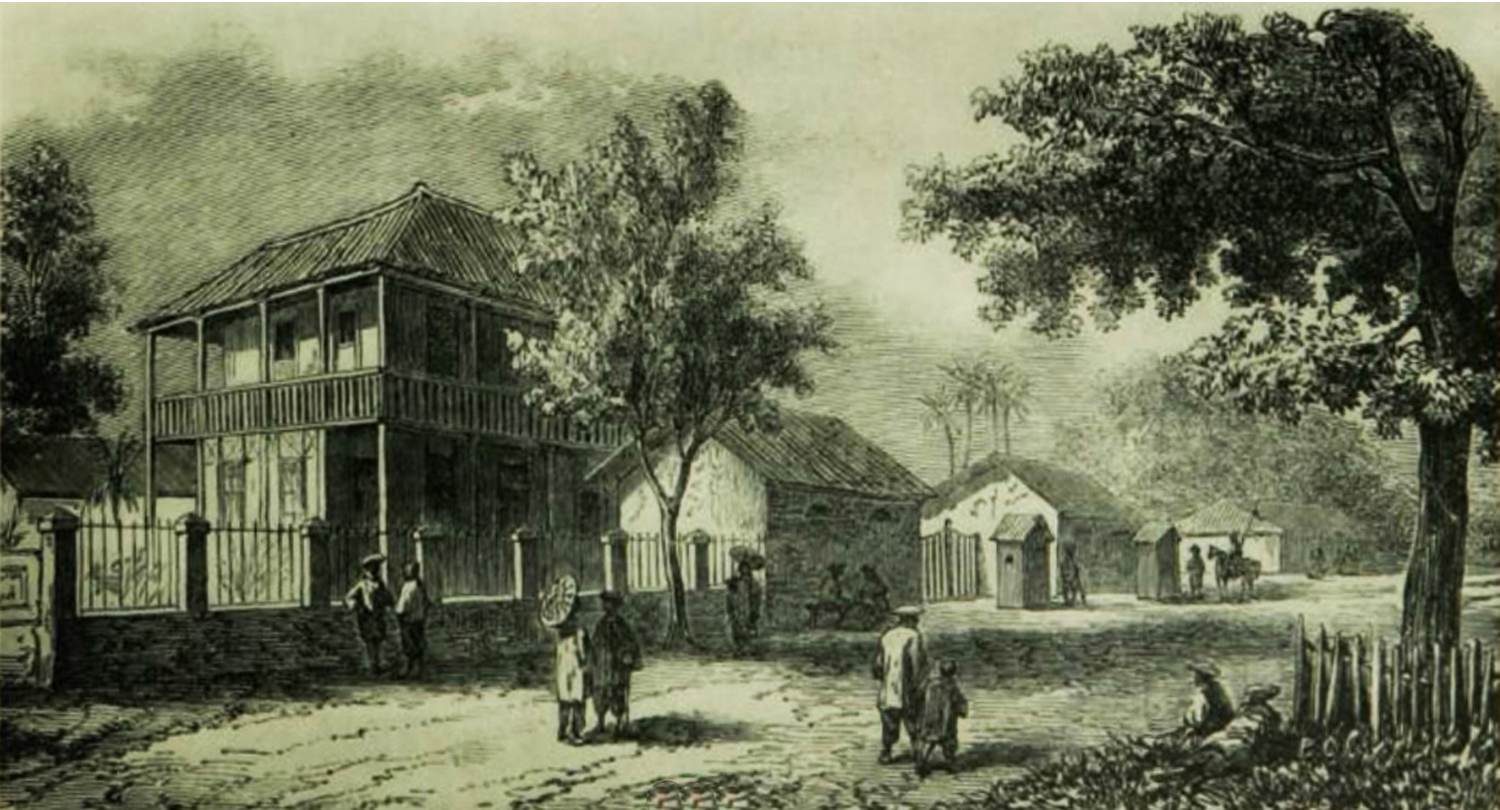
Standing on the site occupied today by the Trần Đại Nghĩa High School, this Hôtel des Amiraux-Gouverneurs incorporated a governor’s residence, offices and meeting rooms, a 600-seat salle de spectacles (events hall), a stable and a pig farm. Drawings of the building were published in the 1931 book Iconographie historique de l’Indochine française (1931) by Paul Boudet and André Masson.

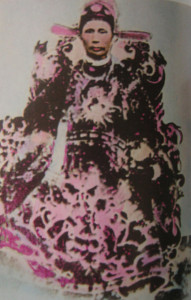
Phạm Phú Thứ, 1821-1882

Diplomat Phạm Phú Thứ, who accompanied royal mandarin Phan Thanh Giản to Saigon in 1863-1864, described the building as follows:

“The Governor’s palace comprises four buildings constructed in a line, each with nine compartments and eight doors.
The central compartment of the first building forms the main entrance. The four two-storey compartments on the west side of this building are the Governor’s apartments, while the four compartments on the east side form the offices.
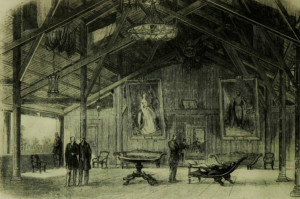
An intermediate structure connects the first building with the second building, where the reception or conference room may be found. On the west wall of this room are hung two large portraits: the one on the right is that of the Ung Ba Su (Emperor), the Head of the French State, while the other one on the left is that of Y Pha Ra Tri Xa (the Empress), the Queen. In between them is hung a small portrait of the son of the Head of the French State. On the east side, the sixth and seventh compartments form waiting rooms, while at the rear we may find the Salle de spectacles or music room.
This building, painted very beautifully, connects with the third building, where the dining room is located.”
(Bulletin des Amis du Vieux Hue, No 1-2, April-June 1919).

“La première résidence des Gouverneurs à Saigon” – portraits of the French Emperor and Empress inside the first governor’s palace, from the 1931 book Iconographie historique de l’Indochine française (1931) by Paul Boudet and André Masson

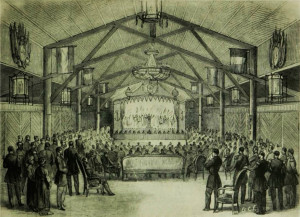
The Salle de spectacles of this first governor’s palace was used for a variety of functions, including the staging of performances by visiting theatre and music companies before the inauguration of the first Théâtre de Saïgon in 1872.

After the demolition in the early 1870s of the first wooden cathedral – the Église Sainte-Marie-Immaculée, which stood on the site of the modern Sun Wah Tower until it became infested by termites – the salle de spectacles was also pressed into service every Sunday as a makeshift church.

Despite Phạm Phú Thứ’s flattering description, the Hôtel des Amiraux-Gouverneurs was a very basic structure in a city which already had several large and impressive brick buildings. One in particular, the imposing Maison Wang-Tai on the Saigon riverfront – see Wang Tai and the Cochinchina Opium Monopoly – could be seen by everyone arriving in the city.

“La première résidence des Gouverneurs à Saigon” – the Salle de spectacles or events hall of the first governor’s palace, from the 1931 book Iconographie historique de l’Indochine française (1931) by Paul Boudet and André Masson

Indeed, it’s said to have been a source of great embarrassment to the French authorities that a Chinese businessman had such a splendid headquarters while the colonial Governor still resided in a wooden hut. That embarrassment is often advanced as a reason why so much money was spent in 1868-1873 on the spectacular new Palace of the Government (later the Norodom Palace, see Saigon’s Palais Norodom – A Palace Without Purpose), reportedly the most expensive civic building constructed in East Asia during the late 19th century.

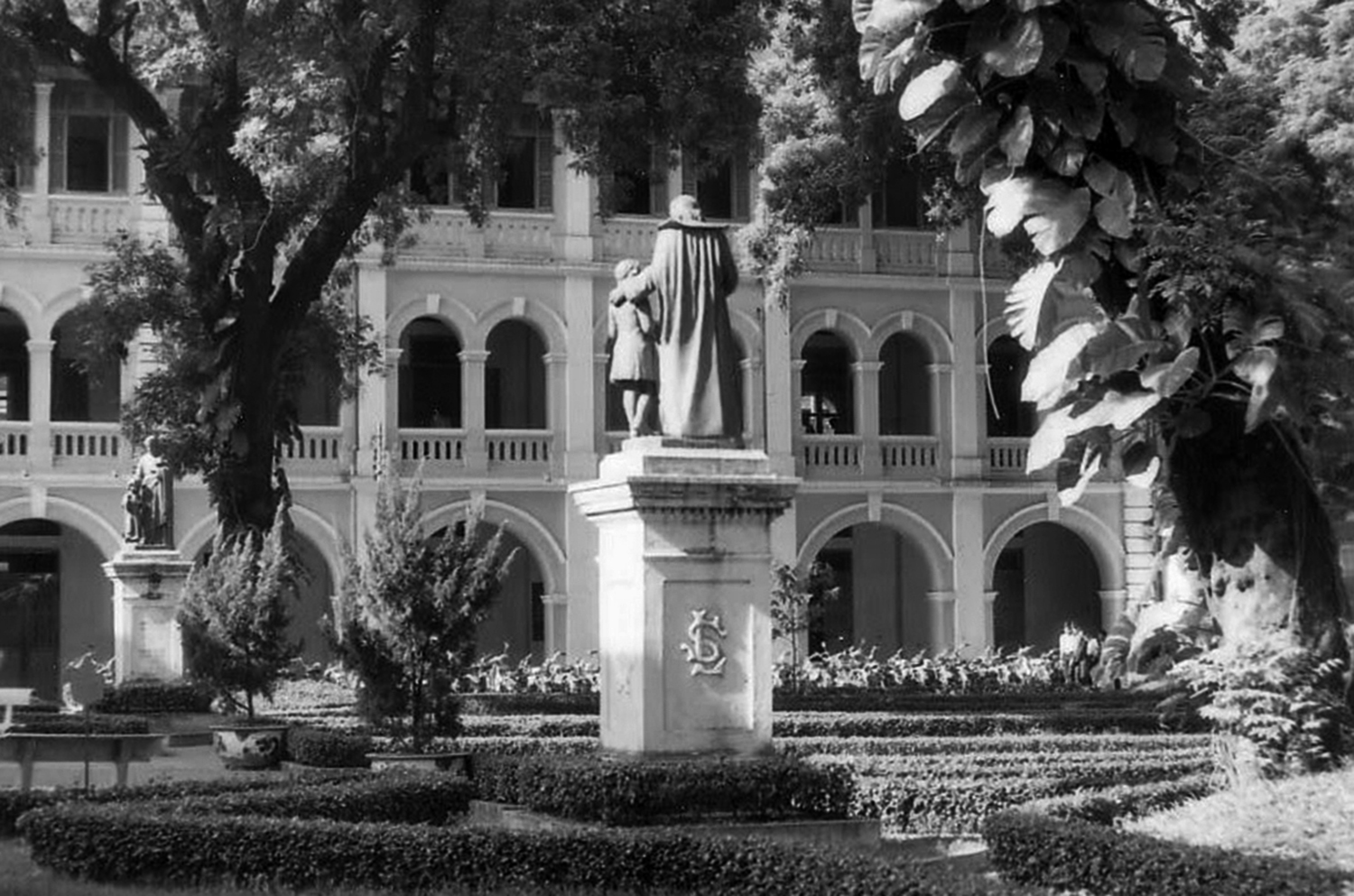
In 1873, after the colonial Governors had moved out, the old wooden palace buildings were given to the Société des Missions Étrangères de Paris (MEP) and Father Henri de Kerlan transformed them into a school named the Institution Taberd. The new school was taken over in the late 1880s by the Christian Brothers, who in 1890 had it reconstructed as the large three-storey colonial building which today houses the Trần Đại Nghĩa High School.

Clock Square and the Telegraphic Services Office in 1862

Built in 1890 by the Christian Brothers, the Tabert School, now the Trần Đại Nghĩa High School, stands on the site of the former Hôtel des Amiraux-Gouverneurs

Tim Doling is the author of the guidebook Exploring Saigon-Chợ Lớn – Vanishing heritage of Hồ Chí Minh City (Nhà Xuất Bản Thế Giới, Hà Nội, 2019)

A full index of all Tim’s blog articles since November 2013 is now available here.

Join the Facebook group pages Saigon-Chợ Lớn Then & Now to see historic photographs juxtaposed with new ones taken in the same locations, and Đài Quan sát Di sản Sài Gòn – Saigon Heritage Observatory for up-to-date information on conservation issues in Saigon and Chợ Lớn.

“A Tasty Stroll in Saigon,” L’Écho annamite newspaper, 18 April 1924

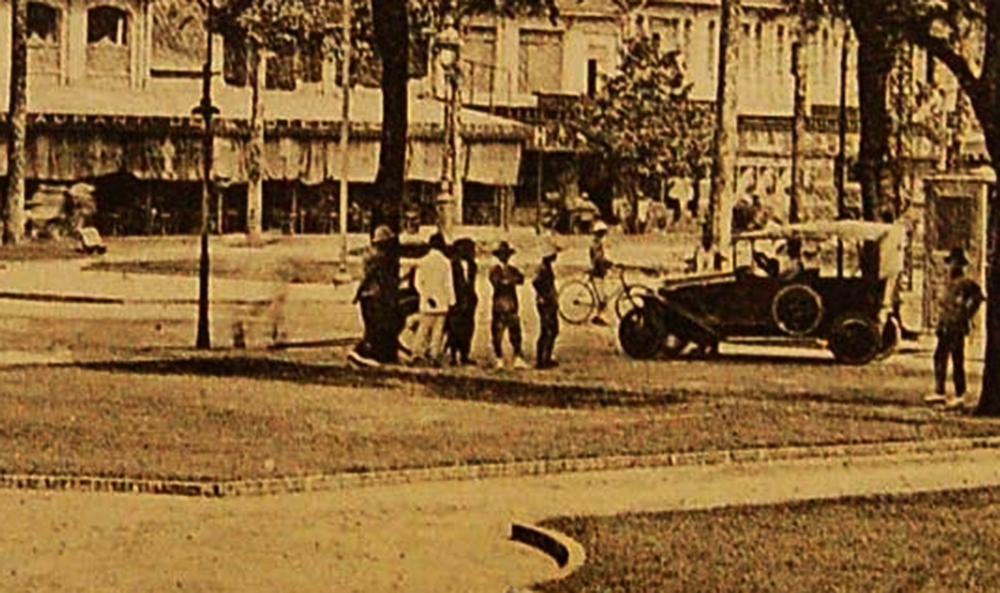
A central Saigon street scene in the mid 1920s

A brave nhà-quê named Pham-Van-Vang, aged 28 and originally from Binh-Luong-Trung, Go-Cong province, wanted to visit Saigon, which he had never seen and of which he had heard so many wonderful things.

So, on the 15th of last month, after selling in Cholon a cargo of paddy which had netted him 3,000 piastres, our man took the opportunity to take a “Grand Duke’s Tour” of the “Pearl of the Orient.”

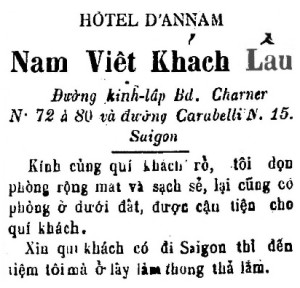
Newspaper advertising for the Nam-Viet-Khach-Lâu dormitory

While Vang went into raptures standing in front of the gleamingly lit stores of the rue Catinat, two individuals dressed in European style, named Muoi-Cho and Ba-Duoc, engaged him in conversation and offered to guide him around the capital.

Vang having accepted their services, they brought him to the annex of the Nam-Viet-Khach-Lâu [a Vietnamese person’s dormitory run by the Hotel d’Annam], where they rented a room in which they relieved our naïve country bumpkin of the sum of 500 piastres over a game of baccarat.

After this first exploit, the swindlers led their unwitting victim to the house of a Monsieur Maturin on the rue de Champagne [modern Lý Chính Tháng, District 3]. The master of the house proposed to his new “friend” that they take a walk to the Halles-centrales [Bến Thành Market], an invitation which Vang accepted with pleasure, considering himself honoured to keep company with such a kind ông-tây.

On the way, the two men stopped at a Chinese bistro, where they drank a toast to their mutual health and their new friendship. Maturin, citing urgent business, then asked Vang to return alone to his house on the rue de Champagne, promising that he would join him there.

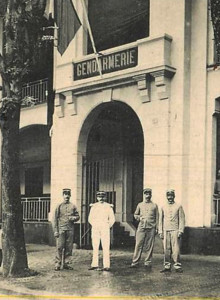
The Gendarmerie coloniale, Saigon

Arriving at Maturin’s house, the nhà-quê was surprised to find the European there already, together with Muoi-Cho, Ba-Duoc and a young métisse named Mademoiselle Vidal. Immediately, the quartet pounced on the naïve peasant, striking him repeatedly with a stick in order to rob him of his remaining 2,480 piastres.

Then, in an attempt to cover up what they had done, Maturin grabbed the unfortunate Vang by the collar and led him to a nearby police station, where he filed a complaint against him for trespass and attempted theft.

However, Maturin soon fell into his own trap. Known as the leader of a gang of thugs and repeatedly convicted for fraud, the disreputable character immediately aroused the suspicions of the sympathetic commissioner, Monsieur Chapuis. During the course of the very detailed investigation which followed, the guilt of Vang’s aggressors was firmly established.

Maturin was referred to the public prosecutor’s office. Mademoiselle Vidal was allowed out on bail, pending the outcome of the investigation.

As for his two native accomplices, they both fled and are now actively being sought by police.

Tim Doling is the author of the guidebook Exploring Saigon-Chợ Lớn – Vanishing heritage of Hồ Chí Minh City (Nhà Xuất Bản Thế Giới, Hà Nội, 2019)

A full index of all Tim’s blog articles since November 2013 is now available here.

Join the Facebook group pages Saigon-Chợ Lớn Then & Now to see historic photographs juxtaposed with new ones taken in the same locations, and Đài Quan sát Di sản Sài Gòn – Saigon Heritage Observatory for up-to-date information on conservation issues in Saigon and Chợ Lớn.

Saigon’s Famous Streets and Squares – Me Linh Square

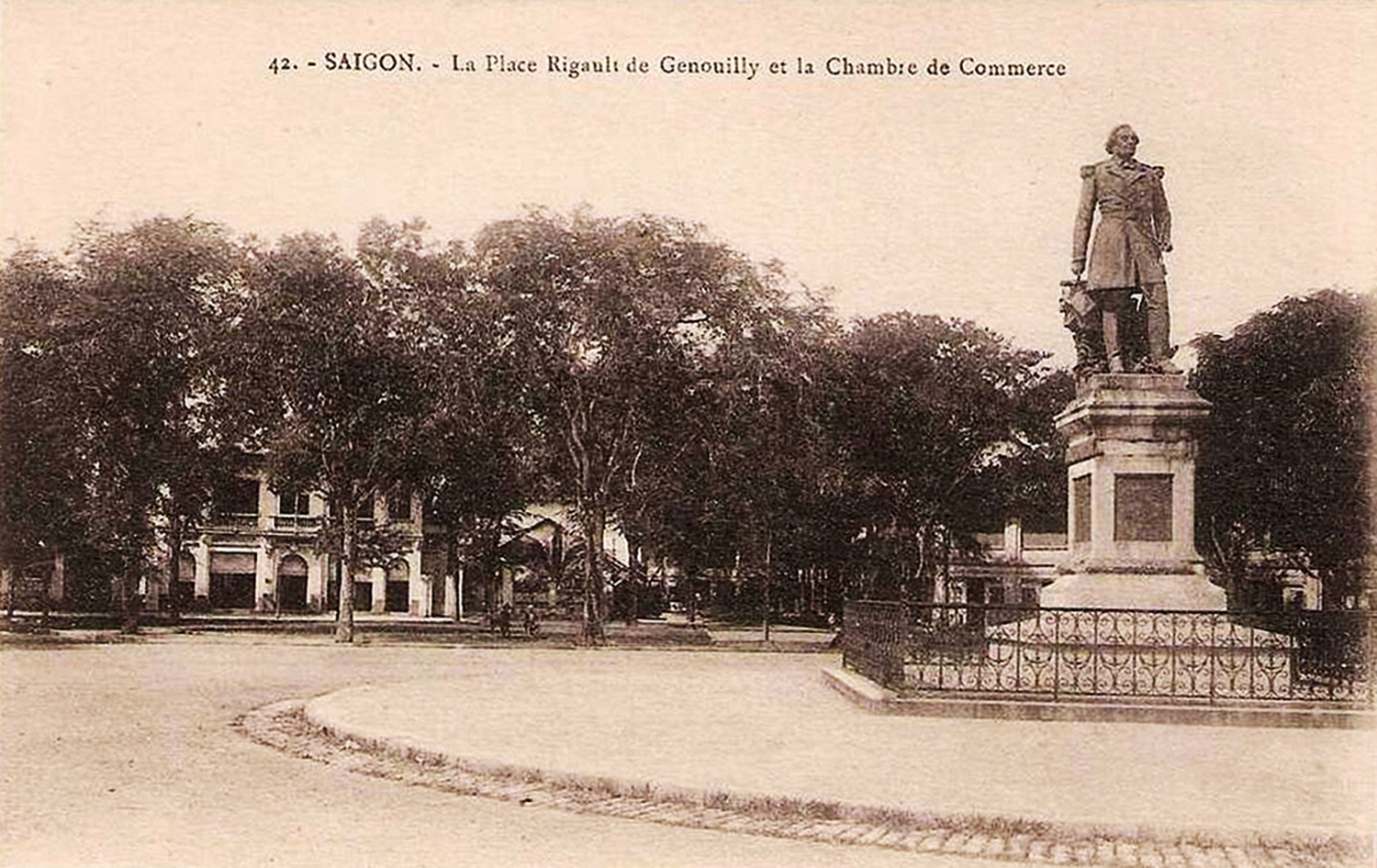
Saigon – Place Rigault de Genouilly and the Chamber of Commerce

This article was published previously in Saigoneer

The square known today as quảng trường Mê Linh has been home to five different monuments since its inception in the 1860s.

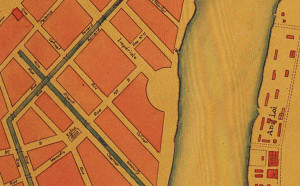
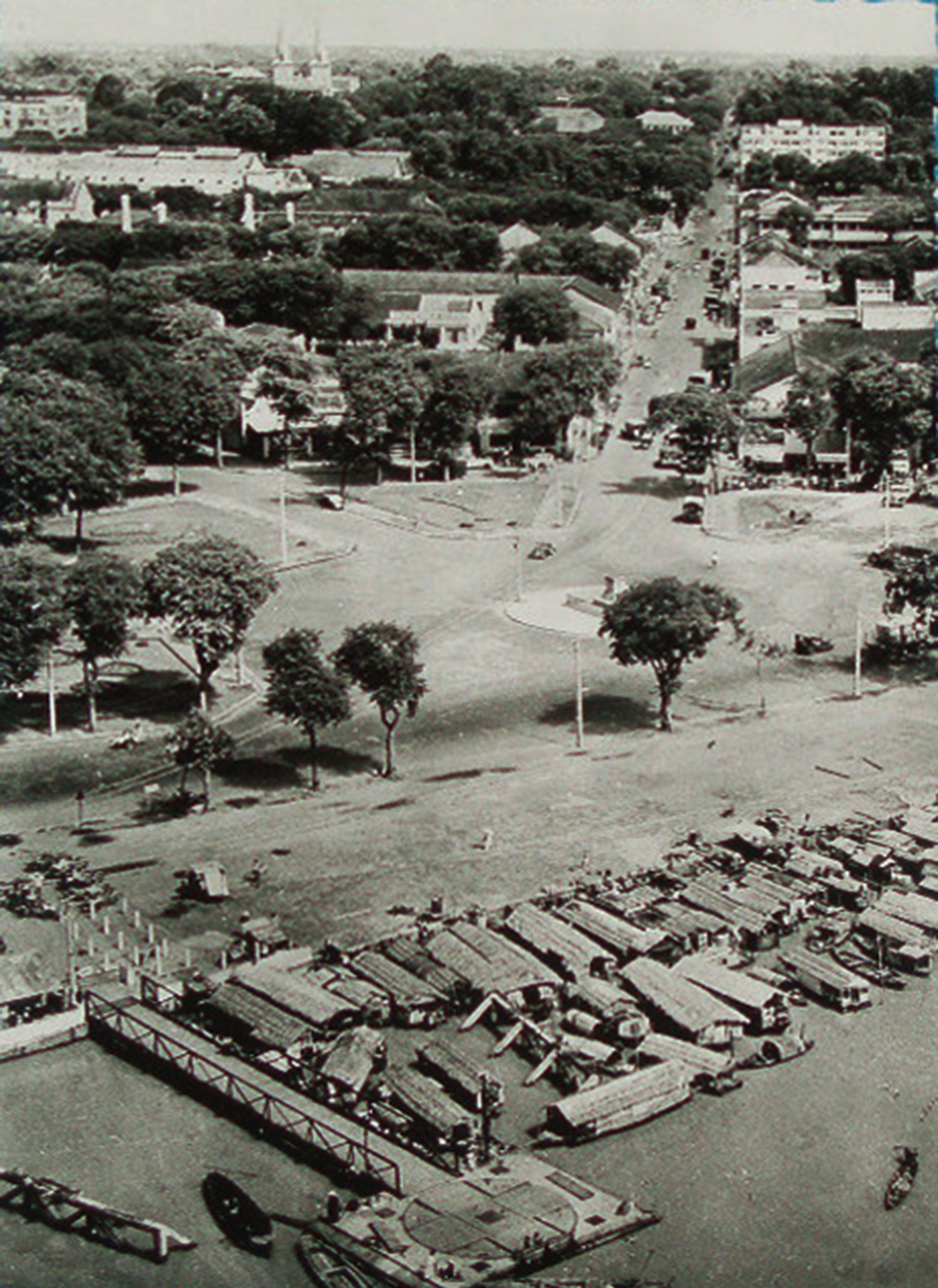
When it was first laid out in 1863 at the junction of rue Impériale (Hai Bà Trưng) and quai Napoléon (Tôn Đức Thắng), the square known today as Mê Linh square was designated the “Rond-point.” From the outset, it was seen to mark the southernmost point of the French Naval Port, which occupied a large area of land between the square and the shipyard.

The Rond-point marked on an 1865 map of Saigon

In 1866-1867, three other roads – rue Vannier (Ngô Đức Kế), rue Turc (Hồ Huấn Nghiệp) and rue de Thu-Dau-Mot (Thi Sách) were laid out to intersect the square. The rue de Yokohama (Phan Văn Đạt) followed soon after, completing the modern road layout.

In 1868, Charles Lemire (Annales des voyages, de la géographie, de l’histoire et de l’archéologie, 1869) described the Rond-point unflatteringly as “a big empty space which is currently being transformed into a roundabout, or perhaps a square, where some benches have been placed in anticipation.”

At the time of Lemire’s visit to Saigon, residents of the square included: the first Chambre de commerce and briefly also the Municipal Council, which shared a compound at No 11; and the Cercle des Officiers, which occupied a temporary building at No 8 until the completion of its permanent home in 1876. The Hôtel de l’Univers, which opened in 1872 as a two-storey building on rue Vannier, was subsequently extended to overlook the square, with entrances on both rue Vannier and rue Turc.

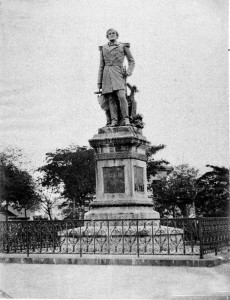
A close up of Alexandre Lequien’s statue of Admiral Rigault de Genouilly in the early 20th century

The first monument was set up on the square in 1875. Writing 13 years later, Louise Bourbonnaud (Les Indes et l’Extrême Orient, impressions de voyage d’une parisienne, 1892) described this monument as “a high pyramid in memory of Monsieur Navaillé, a prominent citizen who did much for the development of trade in Saigon and the colony.” She added that the cost of the monument was met by subscription.

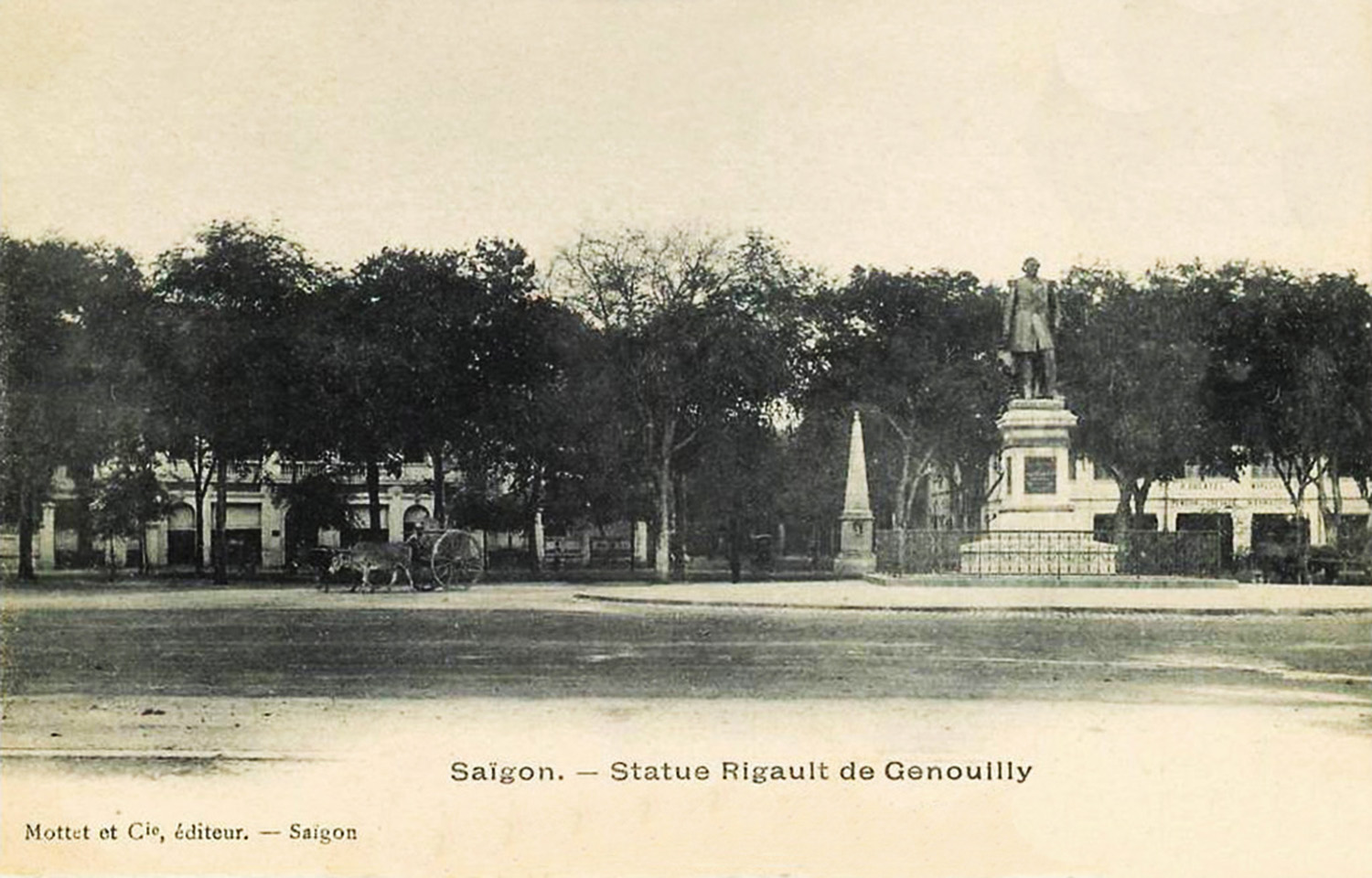
A second, larger monument was added in 1878, when a statue of Admiral Charles Rigault de Genouilly (1807-1873), created by sculptor Alexandre Victor Lequien (1822-1905), was erected in the centre of the square, again paid for by public subscription. Admiral Rigault de Genouilly had led the joint French and Spanish force during the opening phase of the Cochinchina campaign (1858-1861), and also became Cochinchina’s first Admiral-Governor.

In his 1911 memoirs, Ma chère Cochinchine, trente années d’impressions et de souvenirs, février 1881-1910, lawyer George Dürrwell described the unveiling of the statue as follows:

“The inauguration of the Rigault de Genouilly statue was the object of a great patriotic gathering to which the entire population of Saigon was invited. This was an occasion which lacked nothing in solemnity: the highest authorities of the colony praised the hero of the day in the most generous terms; land and sea troops marched in parade in front of him; a poet celebrated the Admiral in pompous Alexandrine verse; and the youth of local schools performed a cantata featuring the chorus: ‘Come, children of Annamite France, To the land of steam and electricity!’ And in those few happy words were summarised the whole of our future programme.”

The monument to Ernest Doudart de Lagrée, pictured in the early 20th century

Henceforth, the Rond-Point became known as the place Rigault-de-Genouilly, and the wharf opposite was christened the appontement Rigault-de-Genouilly or Rigault-de-Genouilly wharf.

At some point in the early 1890s, the Navaillé monument was removed, and in 1893 it was replaced by another pyramid-shaped memorial, this one dedicated to the memory of Ernest Doudart de Lagrée (1823-1868), leader of the French Mekong Expedition of 1866-1868. The adjacent rue de Yokohama was then renamed rue Doudart de Lagrée.

In the late 1880s, a large building was constructed on the south corner of the square adjoining the quayside to house the Commissariat de Police for the 1st Arrondissement (District 1). That building survived until the 1990s, when it was demolished to build the Renaissance Riverside Hotel.

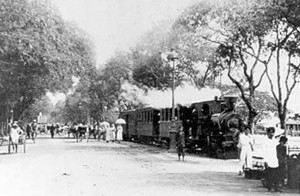
The place Rigault-de-Genouilly also became an important transport hub in 1891, when the terminus of the CFTI “Tramway de la route basse” (Low road tramway) steam tramway from Saigon to Chợ Lớn was installed on the quayside, right opposite the square. Four years later, this tramway line was extended eastward from the square and then northward through the city to Gò Vấp and Hóc Môn, transforming the place Rigault-de-Genouilly into a through-station.

The quayside opposite the square became the terminus of the CFTI “Low Road” steam tramway from Saigon to Chợ Lớn in 1891

With the advent of new electric trams in 1923, lines were rerouted through the city centre, but in the twilight years of the French colony, between 1948 and the closure of the tramway network in 1954, congestion in the city centre led once more to trams running along the quayside, through the square and up rue Paul Blanchy [Hai Bà Trưng street].

One of the square’s best-known later landmarks was the factory of Brasseries et glacières de l’Indochine (BGI) at 6 rue Paul Blanchy. This company was set up by Étienne Denis and Louis Palanque in 1927, after they had taken over Victor Larue’s Larue Frères Industriels-Glacières-Brasseries. The factory building, designed by Paul Veysseyre, survived until November 2015, when it was demolished to make way for a new tower block.

Following the departure of the French in 1955, the Rigault de Genouilly statue was removed. In the same year, the Republic of Việt Nam government renamed rue Paul Blanchy (the former rue Impériale) as Hai Bà Trưng (“Two Trưng Sisters”) street, in honour of siblings Trưng Trắc and Trưng Nhị who rebelled against Chinese rule in the 1st century CE, while the place Rigault-de-Genouilly itself was renamed Mê Linh square, after the sisters’ home prefecture. Nearby rue Cornulier-Lucinière (the former rue de Thu-Dau-Mot) was also renamed Thi Sách street, after Trưng Trắc’s husband General Thi Sách, whose murder by the Chinese drove the two sisters to revolt.

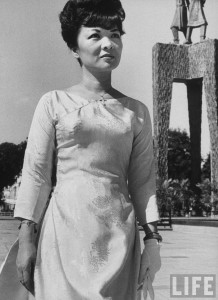
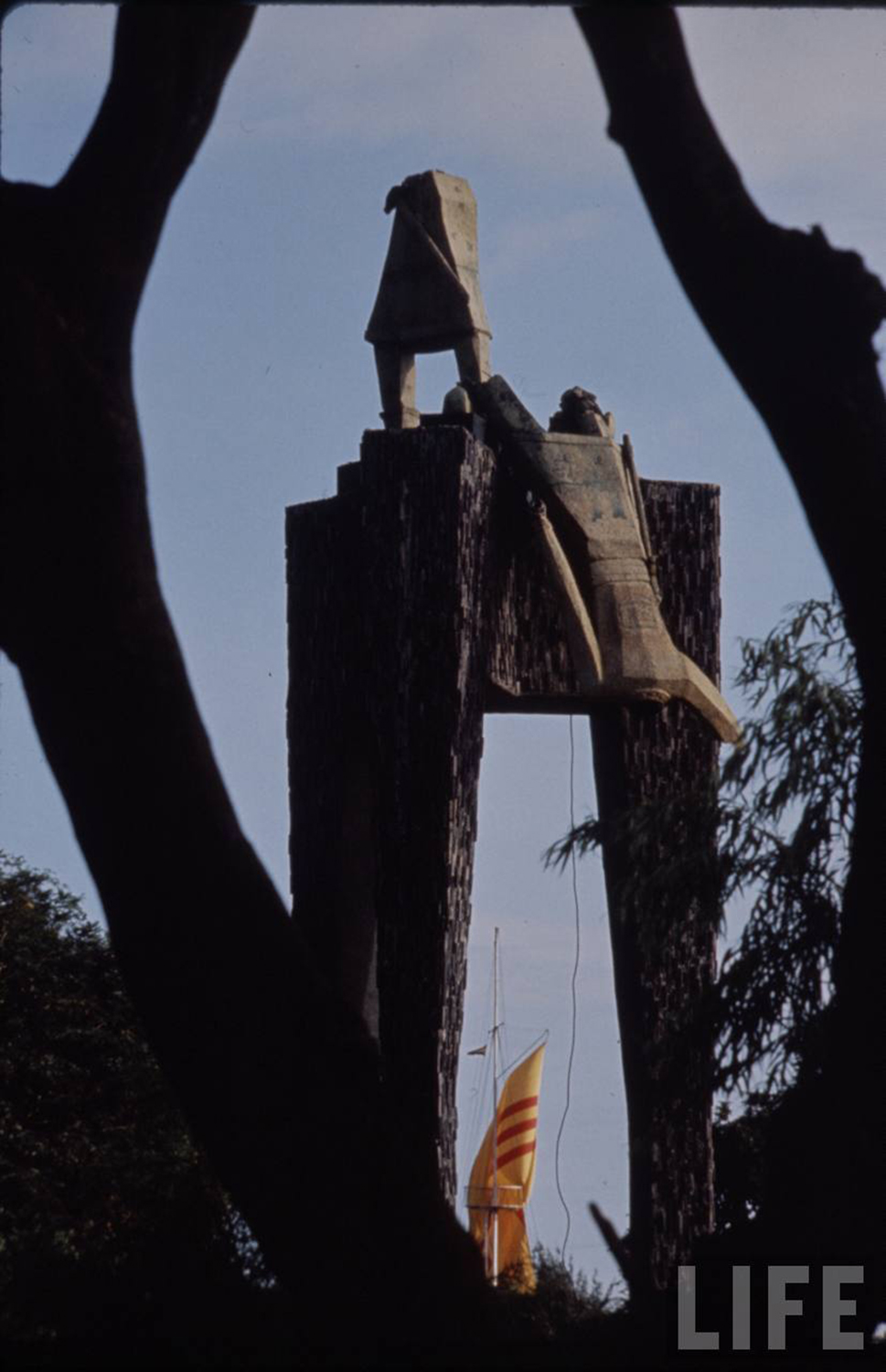
Madame Nhu posing in front of sculptor Nguyễn Văn Thế’s statue of the Trưng sisters (LIFE magazine image)

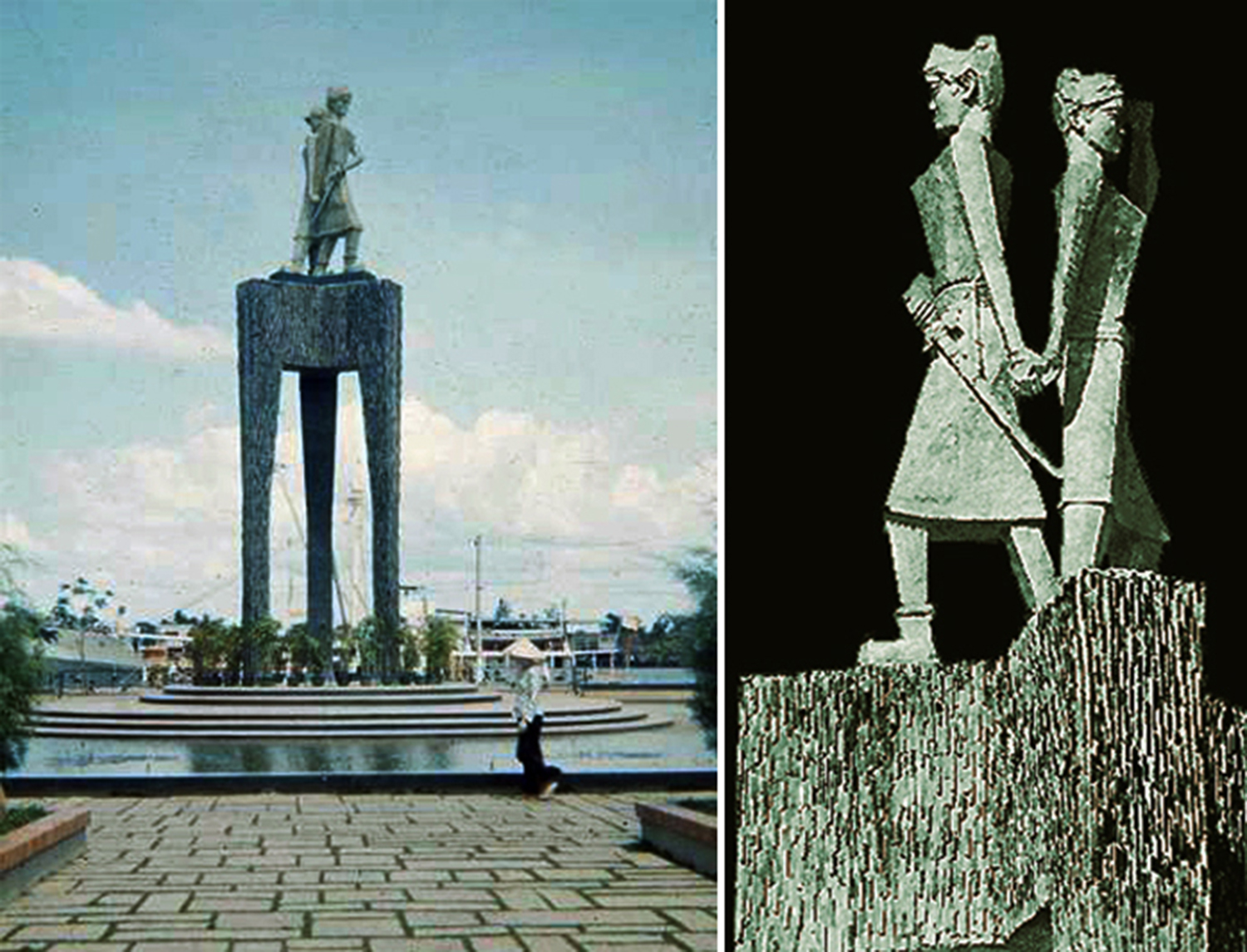
In March 1962, a lake was added and a statue of the Trưng sisters was ceremoniously installed at its centre. Created by sculptor Nguyễn Văn Thế, the statue depicted the two sisters on a large pedestal with three legs, each leg resembling the head of an elephant, the animal on which they are said to have ridden into battle.

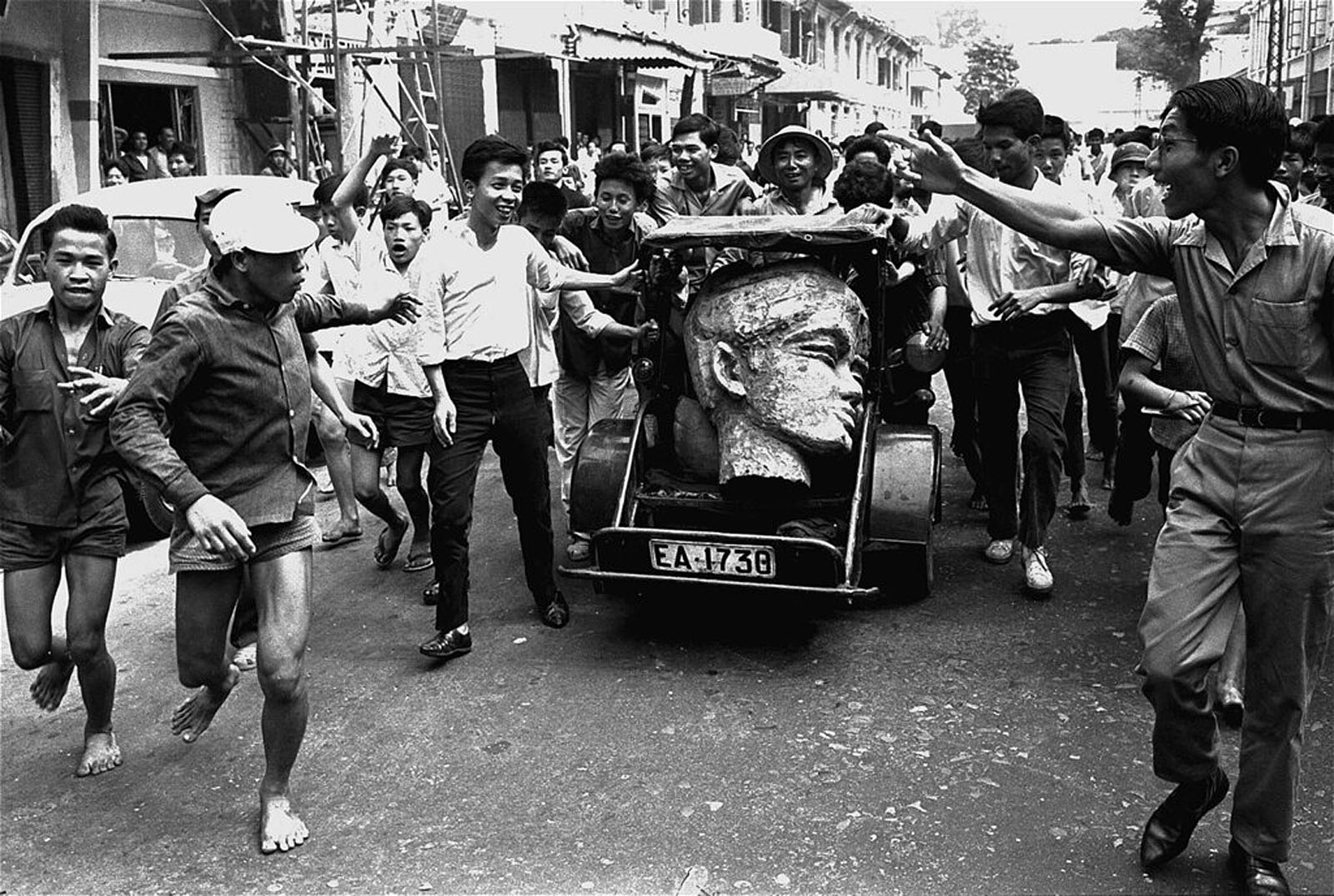
However, the statue had been commissioned by the unpopular Madame Nhu, wife of President Ngô Đình Diệm’s brother Ngô Đình Nhu and at that time (the president being unmarried) de facto “First Lady.” It was rumoured that Madame Nhu had insisted that the sculptor use her own facial features as the model for the faces of the two sisters, and consequently, after the overthrow and assassination of Diệm and Nhu in November 1963, jubilant anti-government rioters tore down the statue.

It was replaced in 1967 by the current statue of Trần Hưng Đạo, a national hero who inflicted three successive defeats on Mongol invaders in the late 13th century. In addition to being a great military leader, Trần Hưng Đạo also authored an important literary work known as Hịch tướng sĩ (“Officers’ Proclamation”) and two famous military treatises, Binh thư yếu lược (“Book of Military Tactics”) and Vạn kiếp tông bí truyền thư (“Vạn kiếp Esoteric Book”).

Saigon – Statue of Admiral Rigault de Genouilly

Charles Rigault de Genouilly (1807-1873)  by Photo Cremière

Electric tramway tracks may be seen in this mid 1950s image of Mê Linh Square

The 1962 Trưng sisters statue by sculptor Nguyễn Văn Thế

The Trưng sisters statue was destroyed in the wake of the November 1963 coup which overthrew President Ngô Đình Diệm (LIFE magazine image)

Saigon, 2 November 1963 – A Vietnamese crowd jeers as a peddicab driver carts the head of a demolished statue through the streets of Saigon, November 2, 1963, following the overthrow of the Diem regime. The monument was demolished by the crowd because of its resemblance to Mrs Ngô Đình Nhu, South Vietnam’s former first lady (AP Photo)

Tim Doling is the author of the guidebook Exploring Saigon-Chợ Lớn – Vanishing heritage of Hồ Chí Minh City (Nhà Xuất Bản Thế Giới, Hà Nội, 2019)

A full index of all Tim’s blog articles since November 2013 is now available here.

Join the Facebook group pages Saigon-Chợ Lớn Then & Now to see historic photographs juxtaposed with new ones taken in the same locations, and Đài Quan sát Di sản Sài Gòn – Saigon Heritage Observatory for up-to-date information on conservation issues in Saigon and Chợ Lớn.

“The Organisation of Tourism in Indochina,” from Maurice Rondet-Saint, Choses de l’Indochine contemporaine, 1916

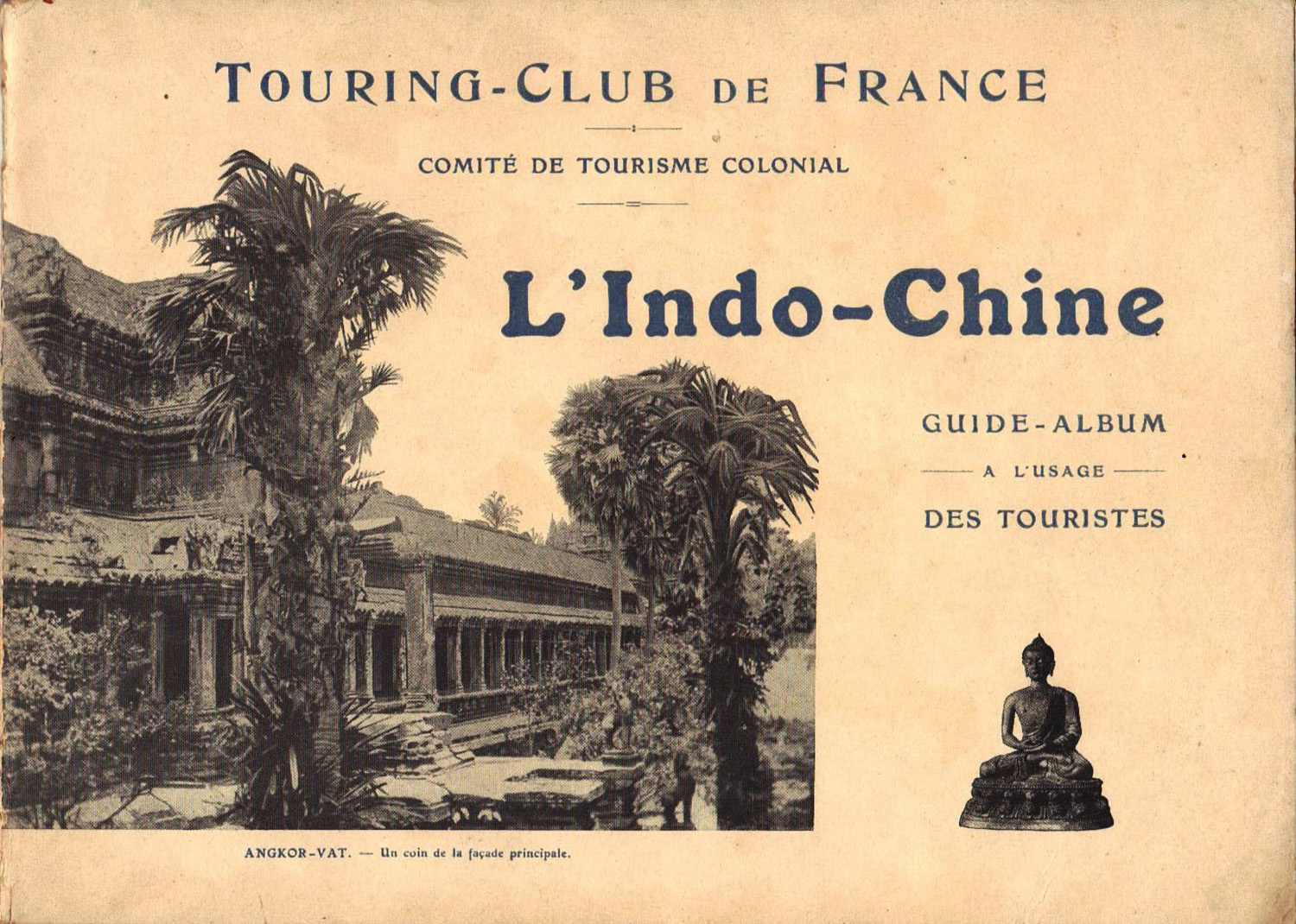
The Touring-Club de France Indo-Chine guidebook-album of 1913

Up to now, our colonial empire – Algeria and Tunisia excepted – has played a negligible role in the immense tourist movement which has already transformed many other parts of the world where it already represents an economic factor of primary importance.

This fact is especially striking in Indochina, where it takes on the character of a major economic deficiency.

Some clarifications are needed to support this assertion:

Indochina is located in a part of the world where the intensity of tourism is considerable. This is affirmed by the figures cited below, which are drawn from the most direct and reliable sources.
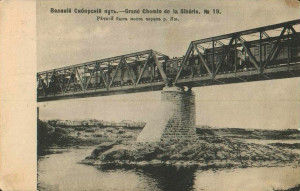
The Trans-Siberian railway line

By a quite explicable phenomenon which it is important to note first, the Trans-Siberian railway line, far from competing with the shipping companies and harming tourism in Southwest Asia, has on the contrary favoured it. Today we may say categorically that the new rail route has permitted travellers to the Far East to complete their tour of East Asia without the need to make a long and repetitive return journey by sea.

At present, Japan annually receives around 20,000 tourists; Java 8,000; and the Philippines 4,000.

To these figures one must add, to the number of people likely to be interested and attracted by Indochina, a portion of the 25,000 tourists who travel each year to India.

However, in the presence of this data, we experience some embarrassment to admit that the number of visitors received annually by Indochina in recent years has never exceeded 150!

That figure alone is enough to characterise the weakness of our efforts to date in the field which concerns us here; just as it shows the importance of developing a programme to rectify the situation.
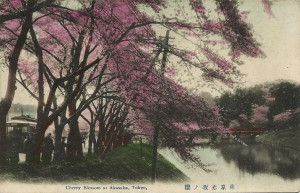
Cherry blossoms in Akasaka, Tokyo

Japan is a country whose charms and sights are famous, but they are unquestionably inferior to those of Indochina; neither can Java, where in reality there is a lot less to see than its well-established tourist publicity maintains, support a comparison with our colony.

The Philippines attract 4,000 tourists each year; these are exclusively American citizens who wish to know the new colony of their Union.

As for India, there we find a long established current of tourism, recruited from a global clientele for whom this trip has somehow become a “classic” one.

What is obvious is that, amidst this considerable tourist activity, the same participants must be counted more than once, because many of them obviously feature in the statistics of the several different countries they pass through during one overall excursion.

However, these same tourists gravitate around Indochina, passing near its coast, staying in Singapore and Hong Kong, without our colony experiencing any benefit from their presence.
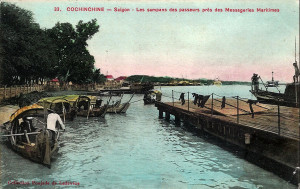
Sampans in Saigon harbour

The reason for this situation is not difficult to identify: it is simply that up to now, no-one, either in our colonial world or back home in the Metropole, has given any thought to the shocking contrast which exists in this respect between our possession and neighbouring countries; and as a consequence we are viewed with indifference and disregard by international tourists.

One can, however, affirm that no country possesses, grouped together in one land, as many architectural, artistic and natural wonders as our Indochina: wonders made even more remarkable by the fact that each of these wonders is unique in the world. Potentially, therefore, they accord in an absolute and very timely manner with the famous “Best in the world” category so dear to Americans, which justifies above all in their eyes the nature and value of a touristic attraction.

If our rivals in neighbouring countries have attained such remarkable results while our tourism industry is still in its infancy, this simply reflects the determination of those countries over many years to draw a practical and profitable advantage from the wealth factor represented by the tourism industry. For us, however, this was never a major concern; it took a very long time here – almost until the very last days preceding the Great War – for the potential value of tourism to be realised, and even now it remains largely neglected, while others at the door of our Asian Empire stage a wonderful party.
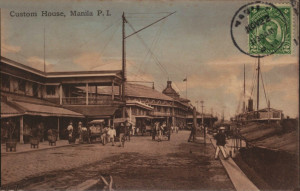
Manila Customs House, Philippines

The results obtained by our Asian neighbours in places like Japan, Java or the Philippines, are not the work of individuals alone. In these countries they have organised tourism rationally, somehow even scientifically; they knew how to transform this sector into a powerful state industry.

They have not only equipped their countries to receive an influx of foreign visitors, but also spent time studying how to attract them and get them to visit.

They have prepared beautifully produced publicity brochures, regularly updated and always in plentiful supply wherever they may be read by the prospective visitor.

Obviously some spending was required to put all this into action, but that spending was infinitely inferior in amount to the sum we might assume.

One searches in vain, on our side, for an equivalent initiative.
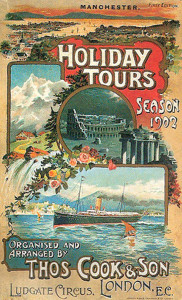
A Thomas Cook & Son poster from 1902

And if Indochina can only boast 150 visitors per annum beside the approximately 50,000 who trek through neighbouring countries, it is simply because, neither in France nor in the colony, have we ever taken the trouble to inform that potentially enormous market about the beauties our Asian domain can offer, nor to equip our colonies to receive the tourism movement thus set in motion.

A typical fact which I have personally observed demonstrates the validity of this assertion: one would search in vain for the smallest mention of Indochina on the itineraries of any of the multiple and important travel agencies which have houses around the world, such as Thomas Cook, or the large American firm Raymond and Whitcomb.

In the hall of the Banque de l’Indochine in Saigon, a stack of brochures is made available to the public. I once flipped through them, in idleness as much as curiosity, pending the completion of the banking transaction for which I came. They contained publicity, well understood elsewhere, in favour of destinations such as Chicago, Santa Fe, California. A publication of the Pacific Mail entreated globetrotters to visit Manila, Honolulu, Russia, Japan, China, Java and India. Not a word about our incomparable Indochina, even though all travellers to this region must pass near it in order to make these trips! It is completely ignored. Neither is there any further trace of the beautiful Indochina album, distributed free by the Touring-Club, which a few years back spent a large sum on this promotional item with support from the colony.
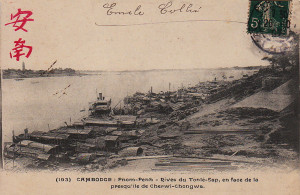
The banks of the Tonle-Sap river in Phnom Penh

I commented on this situation to a gentleman of the administration, who seemed so surprised that I considered it pointless continuing.

As long as Indochina remains outside the countries classified as centres of international tourism, tourists will not come. And while we fail to provide tourism publicity materials, our colonial domain will remain excluded from this movement.

An extremely vicious circle

It will serve us well, however, if we finally take full advantage of the wealth which our colonial action has assigned to us.

Moreover, one should not hide how far the general mentality in French colonial circles is alien to the most basic understanding of tourism as an economic factor. It’s as if the idea of an individual travelling for pleasure, without being forced to do so professionally, has not yet developed in the eyes of many colons. I can’t think without amusement of the number of times I have heard, from smart people, this Baroque thinking: “What? You travel for pleasure? Nothing obliges you to do so?” And my interlocutor looks at me with wide eyes, bewildered, as if to make sure I don’t have two heads, like the well known calf.
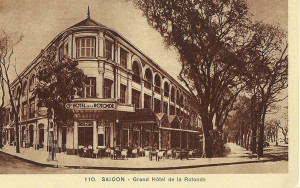
The Grand-Hôtel de la Rotonde, Saigon

In the Baron de Montesquieu’s great novel, it was commented: “Monsieur is Persian! How can one be Persian?” It seems that since that time not so much water has passed under the bridge as many people might claim.

On the day we decide to address practically and on a widespread scale the issue of exploiting tourism in Indochina, the first problem to deal with (except in a few places) will be that of the hotel industry.

Indeed, not only is the hotel industry the foundation for the tourist exploitation of a country, but its role is so important that it can, in certain cases – and examples of these are not lacking in other countries – have a material impact on tourist numbers.

In any plan to develop tourism for an entire country, the various hotel operations form a whole in which the diverse elements are interdependent. If one element is inadequately equipped, this inferiority affects the reputation of other elements in other parts of the country.

“This room is dirty,” said a tourist of my acquaintance to an Indochina hotel manager (an exception, I hasten to add). “So?…” replied the innkeeper without blinking. “Others slept well there, and they didn’t die!”
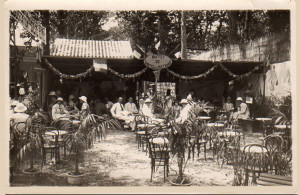
The outdoor restaurant of the Hôtel des Nations, Saigon

You will not accuse me of exaggeration if I assure you that this tourist had only one desire: to scuttle away without seeing any more of this place where the respect due to the visitor was conceived in so singular a way. After that experience, it is doubtful that he will become a hot propagandist for our Indochina!

Perhaps the best example is set by Corsica, a beautiful country just a stone’s throw from that part of Europe where, every year for several months, the great continental tourism movement is focused. Up to now, despite providing a few things properly from the point of view of the hotelier, we have been unable to profit from the great tourist movement which has become the fortune of the “Scented Isle.”

The beauty of Indochina

Indochina, as I have said, is a country which contains some of the world’s most wonderful and incomparable sights.

These, thanks to the efforts made in the last few years by the Touring-Club, are only now beginning to be recognised. It is not inappropriate to recall here their character and value:
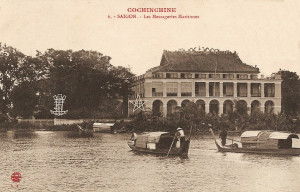
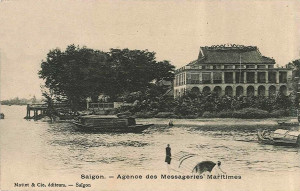
The Messageries-maritimes, Saigon

– Saigon, the beautiful city, centre of our influence in the Far East.

– Phnom Penh, with its palaces, its temples and its character.

– The vast region of Angkor, whose magnificent monuments constitute, in a full ensemble of art and majesty, a splendour the equivalent of which we would seek in vain elsewhere, even in India.

When I last went there, access to Angkor had been greatly facilitated by the extension of the Angkor-Siem Reap road as far as the Great Lake.

The current public automobile service may therefore, from this time, run directly between Angkor and the Great Lake.

A motorboat connects the destination of the automobile service with the anchorage for larger tourist vessels which ply the Great Lake.
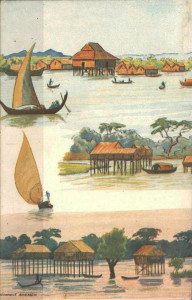
Fishermen’s huts on the Tonle Sap river

We have thus already come a very long way from the difficult conditions of the trip to the ruins described by Pierre Loti in his 1908 work Un pèlerin d’Angkor.

Then, for those whose time is not limited, there is Laos, which also includes many beautiful monuments, ranging from the grandeur of the rain forest to the splendid waterfalls of Khone. Laos, alone, would be worthy of attracting the elite of globetrotters worldwide.

There’s also Annam and its mountains, which unfold in front of the eyes of the visitors like unforgettable tableaux, whose character is accentuated by the presence of a diverse fauna found in few other countries.

The royal capital of Hue, with its tombs, serene majesty in a framework of high wooded hills, leaves an indelible memory for all those who have seen it; its curious Confucius Temple, the Pass of the Clouds, and the Marble Mountains complete in this part of our colony a rare set of tourism destinations.

Finally there is Halong Bay, a wonder of nature, unique in the world, and whose spectacle is overwhelming in its grandiose severity.

Haïphong, a fine maritime city which has emerged from the Delta marshes.

Hanoï, our northern capital, so interesting to visit, with its large indigenous agglomeration juxtaposed with a new and beautiful French city.
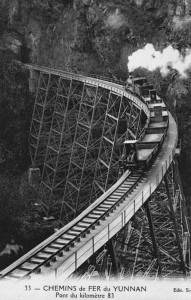
The pont en dentelles (“steel lace bridge”) at km 82 on the Lào Cai–Yunnan-fu line

The Yunnan Railway, finally, an extraordinary work, born of the imperial policy of a great nation such as ours, a masterpiece of the art of the engineer overcoming all difficulties. This also represents a tourist value of the highest order, as much by the impressive series of sites offered to the traveller all along this incredible railway line, as by the variety of countryside through which it passes, arriving after three days in the old Chinese city of Yunnan-Sen [Kunming], still mysterious, so full of character and curiosity.

Tourism organisation in Indochina

The current situation in the Far East, considered from the point of view which concerns us here, may be summed up thus: Indochina, however superior in its tourist attractions, finds itself excluded from the tourist movement in the presence of neighbouring countries which are inferior to her.

Hanoï could succeed quickly, at the price of a slight effort.

Angkor, already developed, may provide a model for the type of tourism organisation which should be established in places where the hospitality industry is not yet ready to meet needs.

As for means of transport, we certainly cannot yet claim perfection. However, tourist transportation exists here in such conditions that we can, with those in place at this hour and subject to some development of riverboat timetables, envisage the organisation of a comprehensive and quite satisfactory service.
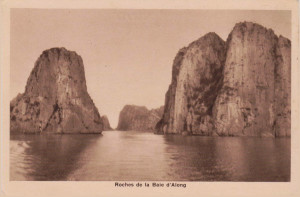
Rocks in Hạ Long Bay

In short, the primordial elements have been created; one only has to develop them, to extend them and especially to co-ordinate them, in order to arrive at the receiving capacity of a given coefficient of tourists.

This brings me to consider what limit one can foresee to the development of the tourist sector.

It is a mistake, in fact, to suppose that, when it comes to developing a country from the point of view of tourism, the same type of programme will be of interest throughout the entire country.

Such an error is twofold; First, because most of the time the costs exceed the advantage presented. Then in most cases, the time limit does not allow visitors to devote the necessary time to visit all of a country’s different regions.

Most often, the modern tourist does not stay long: at each stage of his trip, he sees the sights quickly; he rarely assigns more than one day to the same attraction; and on the following day he goes to see something else.

The specialists who remain for a long time at some particular location are the exception and therefore have no place in the general question under discussion here.
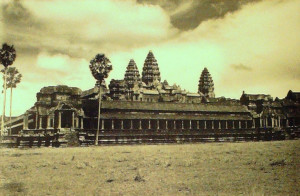
Angkor Wat

From the above, the conclusion emerges by itself: It’s a question of determining the areas of Indochina for conversion to tourism.

They are distributed as follows:

1. The Southern Region – 12 to 15 days
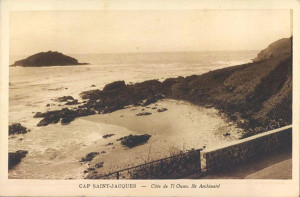
– A. Saigon and its environs; Cap Saint-Jacques, Trian Falls.
– B. Phnom Penh.
– C. Angkor and its surroundings.

2. The Central Region – 6 to 8 days
– A. Hue.
– B. The Tombs.
– C. Marble Mountains.

3. The Northern Region – 12 to 15 days
– A. Haïphong.
– B. Halong Bay.
– C. Hanoi.
– D. Yunnan Railway.
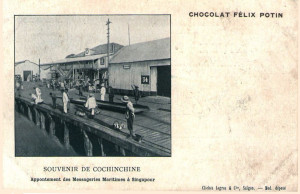
The Messageries-maritimes wharf in Singapore (Chocolat Félix-Potin)

So the complete journey through Indochina, made from one end to the other with planned connections so that there are no unnecessary stops, can be achieved in a period of 35 or 40 days. But this represents for most tourists a maximum availability of time.

To this period of time, we must also add the time required for crossings from Singapore to Saigon and from Haïphong to Hong Kong, an average of three to five days for each respectively.

Indochina, divided into three parts, does not offer equal interest from an intrinsically touristic perspective.

Indeed, one must admit that Saigon, located on the main Far East route, enjoying a renown as a pleasant stay and favoured by the fact of being the access point for Phnom Penh and Angkor, will be to a much greater extent the centre of attraction which a majority of tourists are content to visit, being unwilling or unable to venture further to the Centre and North of the colony.
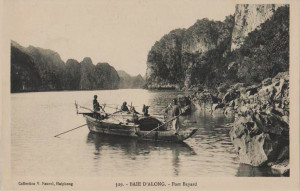
Fort Bayard, Hạ Long Bay

The Northern region gets its power of attraction from two spectacular sights: Halong Bay and the scenery alongside the Yunnan railway. One will soon be able to reach it from Hong Kong more easily, as maritime services will shortly be reorganised to meet the requirements of special traffic in accordance with the overall aim of tourism development.

As for the Central region, only those tourists who wish to “do” Indochina are likely to visit.

This means that the effort involved will not be the same in each of the above three regions. Therefore I will examine these areas successively, from the point of view of both accommodation and communications.

Southern Indochina

Saigon, thanks largely to the enlightened action of the Comité d’Initiative Sud-indochinois (South Indochina Tourism Committee), is already, we can affirm, in a state to respond to an influx of tourists, especially since this influx will be gradual and at the outset will not exceed the current possibilities.
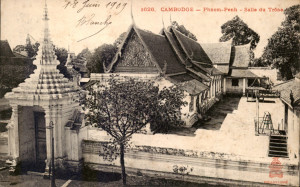
The Throne Room of the Royal Palace in Phnom Penh

In Phnom Penh, a considerable effort has already been made; however, the future of tourism in that city, contrary to what has quite inadvertently been done so far, will lie in developing the capital of Cambodia as a place where visitors stay en route from Saigon to the Angkor region, rather than as a destination in its own right.

In Angkor, finally, the bungalow established by the administration can satisfy every need, because it is designed according to the “pavilion system” which is applied without exception throughout Java.

This pavilion system consists of a central building which offers a range of common services – dining room, lounge, smoking room, etc – surrounded by chalets, all leaning against each other and each comprising one bedroom equipped with modern amenities and an adjoining shower room, plus a small covered terrace. This system has the overwhelming superiority of permitting the hospitality industry to extend its facilities economically, as and when the need arises, in contrast to building costly multi-storey hotel buildings as is generally done back home.
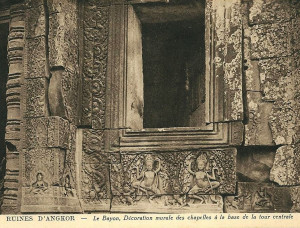
Detail from the wall of the central sanctuary of the Bayon temple

It is therefore fair to say, without pretending that we can achieve tomorrow what has been done in Java or even the Philippines, that in future South Indochina will be able to take a share of the already large number of visitors who arrive every year in the Far East; and that it is reasonable to work initially towards a figure of 1,000 visitors per season.

The means of communications in southern Indochina are very varied. Cochinchina and Cambodia are criss-crossed by a network of superb roads; the automobile is already represented there by more than 300 cars and by several public automobile services. River shipping services and railways may also, after a certain and easy development, respond easily to all the requirements of future tourist traffic.

Saigon is already connected by rail to My-Tho, and as such is the starting point for all river services to Phnom Penh and Angkor.

With some minor modifications to the current mode of operation, the flourishing Messageries-fluviales de Cochinchine riverboat company will possess all the means to ensure a satisfactory service, in accordance with the operating conditions of international tourism.
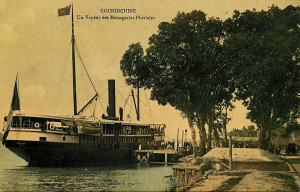
A riverboat of the Messageries-fluviales company

The tourist clientele in Indochina has so far been insignificant. One might even ask the Messageries-fluviales to create its own special department for tourism.

At the moment, riverboat tourism is enjoyed only by a few individuals and isolated groups – interesting visitors, certainly, but not yet the large numbers which in future could bring substantial economic benefits.

Only when the tourist influx becomes large enough to become a “case apart,” thereby guaranteeing a sufficient and regular number of tourists each season, will the company consider the establishment of a special service adapted to this new clientele, as has been done in many other places, including in Egypt, where the prosperity of the river tourism business is well known.

At that point, the needs of the clientele go beyond the requirements of ordinary traffic, necessitating the intervention of the government, since this is a private industry exploiting a particular market. On the other hand, the government should not impose any pricing hardship on the company which is providing the services. It should be for the firm concerned to examine, like any other trader or industrialist, the tariffs it must apply to customers of whatever category who use its services.
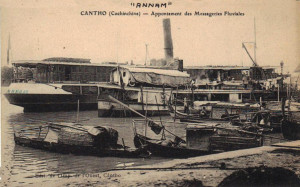
The Messageries-fluviales wharf in Cần Thơ

The same goes for the operation of hotels and bungalows, which can be built either by private initiative, or by the administration for rental to the hotel industry.

To quote an example, the operation of the Angkor bungalow is entrusted to the Messageries-fluviales company, but this does not prevent administrative intervention to ensure the provision of special staff, equipment and draft or pack animals, all elements that are charged to the administration. Indeed, instead of the bungalow being granted free to the operator to exploit, the latter is limited in its exploitation by a tight list of charges.

Another example may be taken from the Tourism Organisation of Java, an absolutely perfect organisation which I will describe in detail later. The official agency of Batavia-Veltevreden gives all foreign visitors to the large Dutch colony a free set of documents which are so well prepared, so complete, and so carefully planned, that a trip throughout the whole island is the thing easiest in the world, even for the traveller less familiar with great excursions.

It’s by a set of processes which are perfectly within our reach in Indochina, that Java has given birth to and developed the huge tourist industry it enjoys today.

Takeo temple

It is important to clarify a key point here:

We are in the presence of an international clientele which is accustomed to pay throughout the Far East fixed prices, very much higher than those charged in Indochina for tourist trips, like Angkor for example. It is therefore important that, in order to create a sense of value in the eyes of the foreign customers, these same higher prices are applied to Indochina.

This would of course be to the benefit of the colony and in the interest of the operators of the tourism industry. It would be absolutely illogical and damaging to our reputation if the commercial exploitation of tourism in Indochina did not represent the same coefficient of expenses for the traveller and legitimate benefits for the country than in any other tourist regions of Asia.

The foregoing reveals a new issue which has not thus far been considered.

The Marble Mountains in Tourane (Đà Nẵng)

The season in which visitors can make an excursion to Angkor, the main attraction of South Indochina, is relatively short: it varies, depending on the year, but generally lasts from October to March.

The Compagnie des Messageries-fluviales has recently mapped the navigation conditions of the Great Lake. The review, we are assured, has shown that some minor works could, without overspending significantly, increase the duration of the season beyond the current length of six months. This observation, of considerable interest, deserves to be considered further.

Central Indochina

Tourane and Hue are linked by a railway line whose route is very picturesque.

On the other hand, there exists between Tourane and the Marble Mountains a small tramway which operates one train per day in each direction. This tramway can easily be used to access the Marble Mountains, which are located just a few hundred metres from one of its stations. The construction of an access road over a short distance currently obstructed by sand will be enough to make this wonderful excursion easier for visitors.
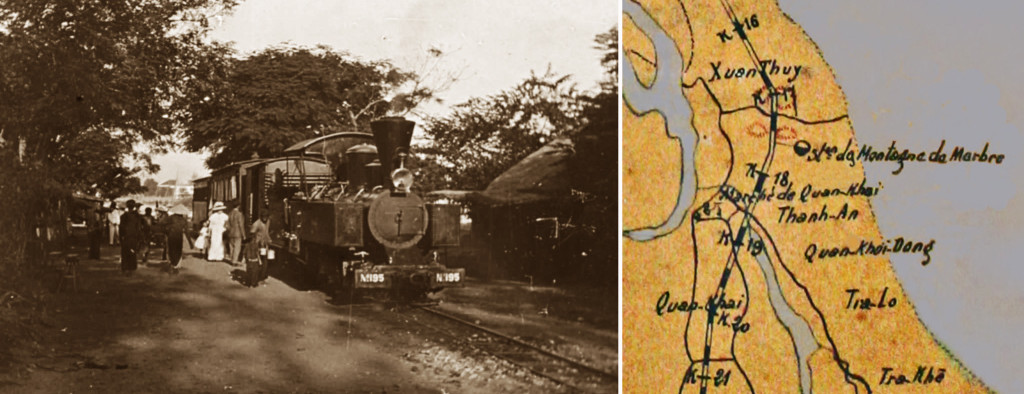
A steam tramway service waiting to depart from Tourane for Faifo/Hội An in 1906 (Fonds de l’Association des Amis du Vieux Hué), and a 1910 map showing the Marble Mountains tramway station between Tourane and Faifo

The Royal Tombs in Hue are accessible either by boat or by car. Good roads, passable by automobiles, connect many of them.

As for the hotel industry, this is perhaps sufficient, in Hue at least, for the current still very limited tourist numbers, but will need to be upgraded once tourism begins to develop.

It seems natural to consider, in this case, the possibility of administrative intervention, as previously mentioned.

Northern Indochina
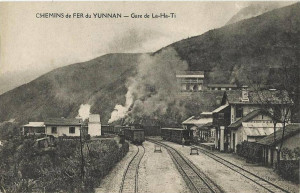
La-Ha-Ti station at km 70 on the Yunnan line

In the North, both Haïphong and Hanoï are already equipped with a hospitality industry which in future will be able to meet fully all the requirements of a large and “well paying” clientele.

Secondary but adequate hotels representing commendable private initiatives exist along the Yunnan railway at Lao-Kaï, Ami-Tcheou and Yunnan-Sen. Mobile buffets already operate on the trains.

Perhaps later, if tourist traffic justifies this addition, the Compagnie des chemins de fer de Yunnan may have to consider the introduction of sleeper carriages, like those used in India and America; the management told me that they were enthusiastic about this idea, which would make the five-day round trip from Haïphong to Yunnan-Sen and back much easier.

Regarding the visit to Halong Bay, the problem has been solved: the Frères Roque armaments firm now operates along the North Tonkin coast a world-class fleet of five steamships – the Emeraude, Perle, Saphir, Rubis and Onyx – all beautifully equipped and able to compete with any foreign ship of their class. Monsieur Roque is personally convinced of the value of the exploitation of Halong Bay. One finds in him a most absolute and most effective champion of tourism development.
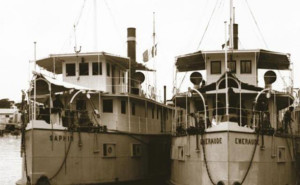
Two of the five ships built by the Frères Roque to transport pasengers and cargo between Hải Phòng and Hạ Long Bay

Northern Indochina also has a Syndicat d’Initiative (Tourist Office). This organisation has not yet begun to operate fully, but it seems to have the necessary elements to play an important role in the tourism sector.

I spoke earlier of the prices that could be applied to international tourists: I will complete this observation by another which relates just as well to the hospitality industry as to transport. The established price must correspond with the provision of adequate facilities and comfort.

In other words, it is essential to build on what exists in neighbouring countries, in order to be neither superior nor inferior to what one encounters there, to provide customer satisfaction and to help give Indochina tourism an economic value of primary importance.

Maritime services

Maritime navigation services, as they normally function to or from Indochina, are represented by:
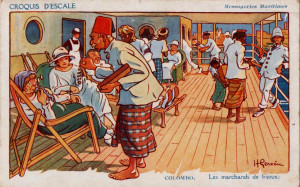
On board a Messageries-maritimes ship

A. – Compagnie des Messageries-maritimes

1. The “grand courrier” Far East line service from Marseille which stops at Saigon. This service, which operates every 14 days and continues on to China and Japan, should also stop at Tourane. The administration has already agreed that a Tourane stop would be useful and will impose this obligation on the company after the completion of the Vinh-Quan-Tri railway line. The plan is an excellent one, and we cannot but applaud.

The current stops are, from Marseille: Port-Saïd, Djibouti, Colombo, Singapore, Saïgon, Hong-Kong, Shanghaï, Kobe, Yokohama. Same stopovers on return.

2. The freighter which leaves Marseille on the 30th of every month and links Saigon with Haïphong and Tourane. Ports of call from Marseille: Port-Saïd, Suez, Colombo, Saigon, Tourane, Haïphong, Saïgon, Colombo, Djibouti, Suez, Port-Saïd, Marseille.

3. The coastal service which makes a series of intermediate stops between Saigon and Haïphong.

The Messageries-maritimes vessel André-Lebon arriving in Saigon

4. The Singapore-Saïgon service. This service operates every 14 days, alternating between a Messageries-maritimes “petit courrier” vessel and a British luxury cruise ship.

B. – Compagnie des Messageries-fluviales de Cochinchine

This company operates a twice-monthly Saigon-Bangkok service, in correspondence with the Messageries-maritimes “grand courrier” coming from France and continuing on to Japan.

C. – Compagnie des Chargeurs Réunis

This company operates a monthly service from Dunkerque, Le Havre, Pauillac, Marseille and Toulon (optional) to Saigon and Haïphong. Stopovers: Port-Saïd, Djibouti (optional), Colombo, Singapore, Saïgon, Tourane, Haïphong and back, except Djibouti. The Company is in talks with the state to make 13 journeys each year instead of 12.
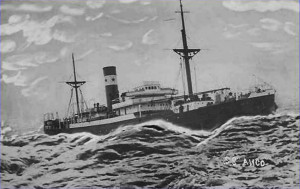
The Chargeurs Réunis cargo vessel Ango

The services of the Messageries-maritimes are well known and many will be aware of the significant improvements made recently by the company, notably the arrival of its new and beautiful ships the André-Lebon, the Paul-Lécat and the Sphinx, whose dimensions and luxurious interiors have caused a sensation throughout the Far East.

It’s also worth mentioning the excellent “Euphrates” class cargo ships of the Messageries-maritimes, as well as the “Admiral” class vessels of the Chargeurs Réunis, which have recently supplemented with the arrival of the Ango, the Bougainville, the Champlain and the Dupleix, all built with the latest equipment and representing the last word in luxury.

Even the Messageries-maritimes vessels which operate the coastal services are worthy of note. I personally have travelled on several of these vessels, so I can speak knowingly and say, without claiming perfection, which is not very common here, that these ships in general may be compared very favourably with their foreign counterparts which serve ports like Singapore and Java – I have mentioned the activity of their traffic from the standpoint of tourism – and operate along the Malay coast.
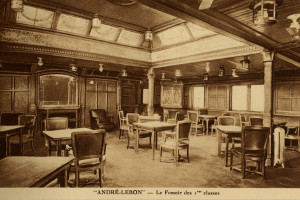
The first class smoking lounge of the Messageries-maritimes vessel André-Lebon

As for the Haïphong-Hong-Kong, Saïgon-Singapore and Saïgon-Bangkok lines, an improvement is without doubt desirable if they are to participate fully in the development of a strong tourism industry.

To conclude this survey of the Indochinese maritime services, I believe that the planned restoration of the discontinued Singapore-Batavia line as part of a new service from Hong-Kong to Haïphong, Saïgon, Singapore and Batavia will make a significant contribution, not only to the development of tourism, but also to growth of the economy in general.

The commercial organisation of tourism

The vast tourist movement enjoyed by several countries in the Far East was not only created by each country alone. It was sparked, channelled and organised by a number of powerful companies which excel in this type of industry.

The best known of these foreign firms are Thomas Cook and Sons, Raymond and Whitcomb, H W Dunning and EMS Hall Tours Company of San Francisco, to name but a few.
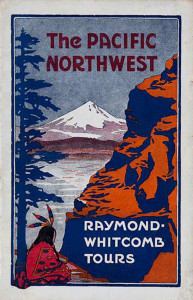
A Raymond & Whitcomb tours poster

In France, some very honourable houses also specialise in long deluxe excursions, though unfortunately the extent of their operations so far cannot be compared to those of their competitors in other countries.

It is these companies which control the world tourism sector, a colossal movement, whose importance only those who have observed it at first hand in different parts of the world can appreciate. It is on these companies that we will in future depend to direct to Indochina each year an as yet undetermined, but certainly considerable, number of tourists.

Contrary to what may be supposed by people who are poorly informed about these matters, we should not be focusing on France as a potential tourist market for Indochina. French tourists who decide to visit our Asian possessions will always remain a small minority, and a factor of almost zero in any economic report, the only real issue here. Instead, we must look to the wider milieux from which thousands of visitors to India, the Far East and the East Indies are drawn every year.

The companies which control the movement of tourists and could channel more visitors in our direction have not so far considered our colony seriously for two reasons:
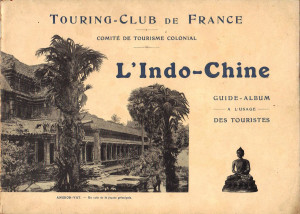
The Touring-Club de France Indo-Chine guidebook-album of 1913

The first is that they are unaware of its incomparable tourist beauty spots, simply because no serious publicity campaign has been launched overseas, apart from the efforts of the Touring-Club which were interrupted by the Great War.

The Touring-Club published a beautiful illustrated guidebook-album on Indochina. This 52-page publication, exquisitely designed, illustrated with numerous excellent photographs and incorporating both French and English text, was a work of which our great association should be very proud.

However, that publication represented more than just a guidebook: It was almost a luxury item, certainly far superior to anything published elsewhere in its genre.

Ultimately, that very superiority proved to be a drawback: the Touring-Club Indochina album-guide was large, luxurious and expensive, when a less elaborate publication would have done the job just as well.
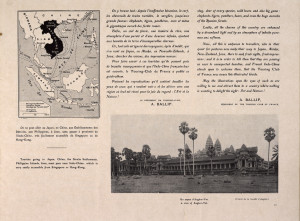
A page from the Touring-Club de France Indo-Chine guidebook-album of 1913

There is a very good way to persuade these firms to channel tourists to Indochina, and that is to invite them to send their agents on study tours which we will arrange for them in each of our three tourist regions.

After such study tours, we can be certain that the agents will return to their countries with the conviction that Indochina is an unrivalled destination ideally suited to those of their clients who have already travelled widely and are looking for something special, something different.

Moreover, these agents will be better qualified than anyone to establish points of comparison with other tourist countries of the East, the Far East and the East Indies; it is they who will formulate a general tourism management programme, placing Indochina at the level of other countries regularly frequented by their clientele.

It is also they who will control, subject to the implementation of such a programme, the number of tourists who can be sent each year to Indochina.
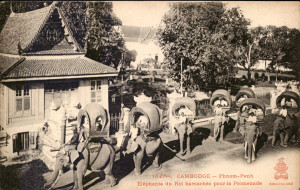
The King’s elephants on parade in Phnom Penh

In effect, the clientele of these powerful companies is, if I may use the expression, a true “market” of which the potential returns are known.

It’s thus by adopting a set of measures in agreement with the tourism providers that we can prepare the three regions of our colony, exploitable in the vein that we are studying here, to receive an expected number of new visitors.

These firms are also the commercial enterprises which, based on the current conditions of transport and hospitality, or by requesting certain changes that would improve the existing elements, will identify the tour packages which must be developed as new items for the tourist market. The firms will then sell these tour packages just as they currently sell tours to Japan, the Far East, or the Archipelago of East Indies. They have not done this so far with Indochina for the reasons that I have sought to determine above with the most precision and clarity as possible.

It would be desirable for the French tourism industry also to be involved in the study tours, which may be easily organised on site by an easy path to be deducted by the data above.
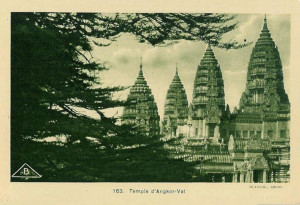
Another view of Angkor Wat

I have, understandably, some reluctance to speculate in advance what number of visitors we can hope for at the outset.

However, we already have a figure for the total number of tourists who currently travel near to Indochina and pass before its ports, without setting foot in it.

In the Far East, India, the East Indies, Java and the Philippines, we may find, as I said at the beginning of this work, a total of approximately 57,000 visitors each year. This clientele, formidable as it is, does not need to be enticed to the Far East: it’s already here. It is therefore a potential market in the region, waiting to be tapped. And if these visitors have not so far been brought to our East Asian Empire, it is, I repeat, due to the fact that no attempt has yet been made to publicise it, despite the fact that we are well aware of the considerable potential income they represent.

Would it be an exaggeration to predict that, out of so many thousands of free travellers, all eager to experience new artistic or natural wonders, we might from the outset attract a figure of 1,000 tourists per season?

The courtyard in front of King Tự Đức’s Tomb in Huế

I do not think that this is a utopian idea. And such a result would be considerable, when one considers the rapid growth of tourist which, by simple and inexpensive means, has been achieved in Java, a place relatively close to our Indochina yet significantly less endowed in major attractions.

And what opportunities will tourism offer to our indigenous arts and industries, which we so commendably seek to develop through other means? The arrival of foreign tourists could bring substantial profits to local businesses which currently serve only the needs of the sedentary population!

Here again, tourism must be seen as an economic element of primary importance, and one can only be surprised that it has not attracted more attention from us before now.

The coming of “grand tourisme” in Indochina will also have another consequence which should not be overlooked: it will encourage the conservation of sites like Halong Bay, that natural wonder which imprudent concessions have blighted with mines and quarries.
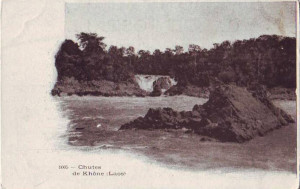
Khone Waterfalls in Laos

Furthermore, by involving the Sites and Monuments Committee of the Touring-Club in the development of heritage tourism, we may nurture respect for, and guarantee the preservation and restoration of, the architectural splendour contained in our Asian territories, thus giving to our subjects evidence of our concern and our respect for their history and religious traditions, to which they themselves attach so much importance.

In this form, no one could deny how tourism could benefit Indochina.

Publicity

I conclude this study on a rather mundane, but highly important subject: publicity.

This is indeed a crucial point. All of the countries which have made the exploitation of tourism a major economic objective have adopted a uniform mode of publicity which may be broken down into three parts:
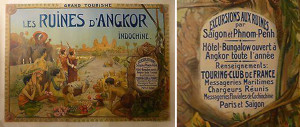
A poster promoting excursions to the temples of Angkor

1. Posters

2. Brochures

I will speak only of the latter, since the role of the first defines itself.

These must be of the model adopted by foreign tourist organisations worldwide: cheap booklets; easy to put in your pocket; reduced text; some photographs and precise information on hotels, transportation and prices, as I mentioned earlier.

This type of publication is common in Japan, America, Java, the Philippines, India and Malaysia.

It must be constantly offered to the public, and distributed in all crowded public places, including halls of travel agencies, hotels, banks and shipping companies.
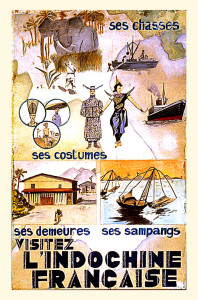
A later “Visit Indochina” poster

The permanence of this publicity is assured by a correspondent on the spot in each of the centres of interest, that is to say, in the great capitals of Europe and America: Colombo, Singapore, Batavia, Hong-Kong, Shanghai, Yokohama, Tokyo, San Francisco, Seattle-Tacoma and Vancouver.

3. Local publicity

This will be provided on site by the tourist offices:

a) Permanent tourist information offices must be set up in all of the main centres; at the present time they exist only in Saigon and Hanoi.

b) Local publicity will be provided in brochures, each focusing on different regions, as happily has already been done for some Indochina destinations.

Conclusion

Equipping Indochina to receive its share of the tourism which has hitherto by-passed it will, of course, incur a few expenses.

But if tourism is of general economic interest, it also represents a whole array of special interests.

So it is therefore the public authorities on one hand, and the interested parties on the other, which must bear the expense of developing it.
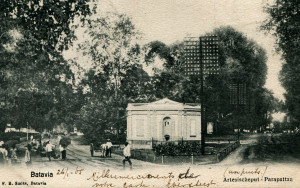
Colonial Batavia (Jakarta)

We can learn much from the way in which tourism programmes have been designed in Java, where one can find a very active tourism promotion agency.

The Dutch administration has established a Central Office for Tourism, with official government status.

For Indochina, it would be preferable, given the results it has already obtained, and the invaluable services it has already rendered, for the functions of a tourism promotion agency to be delegated to the Touring-Club. It could then set up a Tourism Office which, in constant communication with metropolitan agencies, as well as foreign tourism agencies, would take charge of both internal organisation and external programmes.

The cost of running such an office is likely to be no more than 50,000-60,000 francs per annum, based on the figures kindly provided to me in Batavia by the very distinguished director of the Netherlands Office. There, half of the running costs are provided by the shipping companies and railways, the hotel industry and other trade groups which benefit from tourism. The government then matches the funds gathered by these private initiatives.
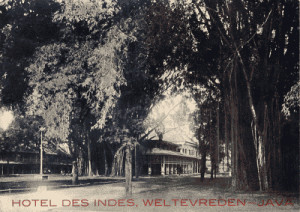
The Hotel des Indes, Batavia (Jakarta)

It is thanks to this system, and to the perfection of its organisation, that Java succeeded in increasing its number of tourist arrivals from 500 in the year before the war to the current figure of 8,000 per annum.

I will synthesise the results obtained from the Dutch colony by mentioning just these two examples which were selected from over one hundred:

Dutch ships serving Java are crowded to the point that seats are very hard to get, so when I came back from Batavia to Singapore, I had to rent an officer’s cabin, which is also a practice allowed on these boats.

And at the Hôtel des Indes at Batavia-Veltevreden, which five years ago was an establishment of secondary order, certainly much inferior to the main hotels in the two major cities of Indochina, has recently executed a two million dollar expansion programme …

One may take all this case as a moral tale and learn from it.

I will finish by pointing out that the Indochina administration regards the development of tourism as a great issue on which depends the prosperity and future of our great Asian colony.
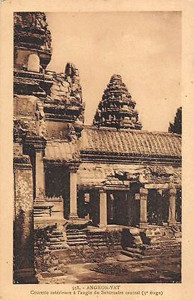
Another view of Angkor Wat

Several years ago, the Governor of Cochinchina and the Residents-superior of Annam, Cambodia, Laos and Tonkin made known to the president of the Touring-Club Committee, the late M Guillain, former Minister of Colonies, their approval of the terms of a report which had been presented to them on the organisation of tourism in Indochina. Similar communication was made to the Ministry of Colonies.

As for the positive feelings of the Governor General, M Albert Sarraut himself took the time to express in happy terms his support for tourism development in an address delivered to the meeting of the government council in Hue in 1913.

The acquiescence and the unanimous support of public authorities are now established and will remain for the future: it is a fact whose significance cannot be diminished.

Well combined and wisely co-ordinated, it is hoped that this bundle of efforts and goodwill will have the effect of finally endowing our East Asian Empire with the prosperity which can result from the organisation of large-scale international tourism.

Tim Doling is the author of the guidebook Exploring Hồ Chí Minh City (Nhà Xuất Bản Thế Giới, Hà Nội, 2014).

A full index of all Tim’s blog articles since November 2013 is now available here.

Join the Facebook group pages Saigon-Chợ Lớn Then & Now to see historic photographs juxtaposed with new ones taken in the same locations, and Đài Quan sát Di sản Sài Gòn – Saigon Heritage Observatory for up-to-date information on conservation issues in Saigon and Chợ Lớn.
Icons of Old Saigon – The Belt Canal (Canal de Ceinture), 1862

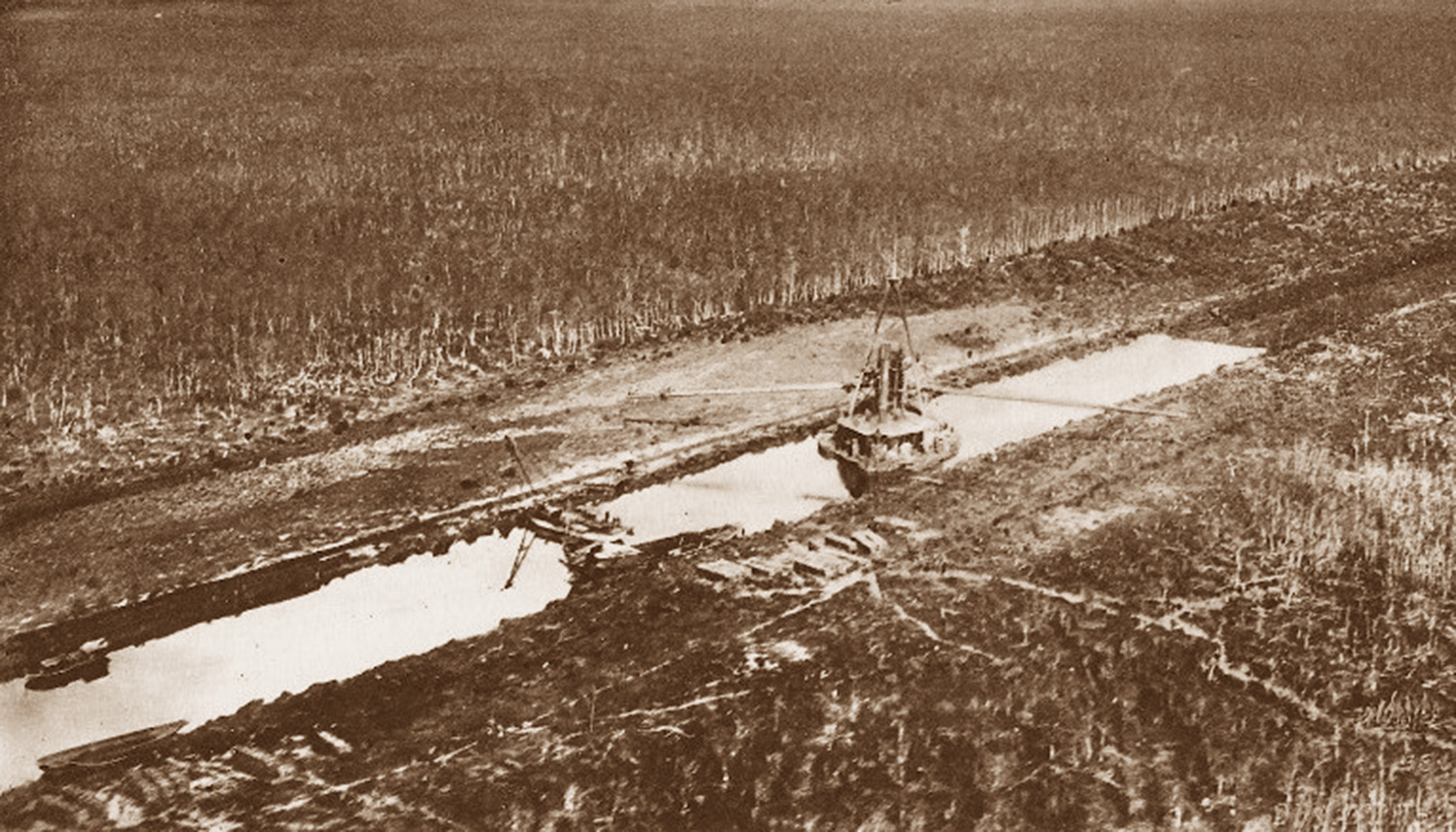
Canal construction in colonial Cochinchina

This article was published previously in Saigoneer

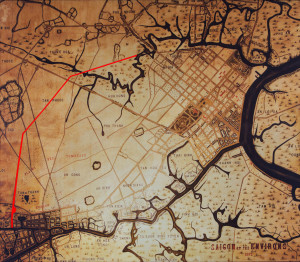
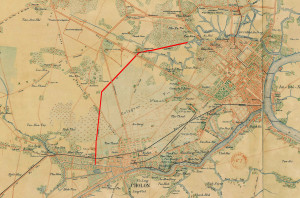
Commissioned in 1862 to facilitate French gunboat access around north and west Saigon, the Belt Canal was never completely navigable.

For more than a decade after the French conquest, the possibility of a major offensive by armies of the Nguyễn court in Huế remained a constant threat to the French authorities in Saigon.

A French gunboat

It was against this background in 1862 that the Cochinchina government drew up plans to dig a new Belt Canal (canal de Ceinture) linking the Lò Gốm creek in Chợ Lớn with the arroyo de l’Avalanche (Thị Nghè creek) in northern Saigon, thereby turning Saigon into an “island fortress” which could easily be patrolled by its gunboats.

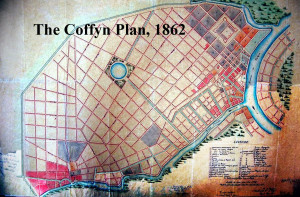
The idea of a Belt Canal was first elaborated in the abortive “Coffyn Plan” of May 1862, drawn up by Lieutenant Colonel Paul Coffyn, head of the Marine Engineering Corps Roads and Bridges Department, which sought to integrate Saigon and Chợ Lớn into a new “city of 500,000 souls,” designed in accordance with French specifications.

The Belt Canal was envisaged in the “Coffyn Plan” as part of a city-wide waterway network, based on Saigon’s existing inner-city canals and creeks (see The Lost Inner-City Waterways of Saigon and Cho Lon – Part 1: Saigon) and draining into a large central lake, which some scholars claim was a water management tool designed to tackle the problems of flooding.

The “Coffyn Plan” of 1862

However, for financial reasons, Coffyn’s grandiose vision was only partially realised. Hygiene subsequently demanded that the inner-city canals and creeks were filled from an early date, and the construction of a central lake was ultimately abandoned, along with whatever plans the French authorities had envisaged for flood control.

The only major elements of the 1862 Coffyn Plan to be implemented were the new road layout and the construction of the Belt Canal for use by French naval patrol vessels.

Both Paulin Vial (Les Premières années de la Cochinchine, colonie française, 1874) and Alfred Schreiner (Abrégé de l’histoire d’Annam, 1906) tell us that construction of the 6km Belt Canal began in November 1862, and that some 40,000 workers were recruited to dig the canal and at the same time build an adjacent defensive wall using the displaced earth.

The Belt Canal is marked in red on this 1892 Saigon map on the wall of the City Post Office

All of this work seems to have been complete by the time Captain M. Bigrel drew up the Carte Générale de la Cochinchine, Canton de Dương Hòa Trung 1872-1873 for Admiral Governor V. Dupré, “thus transforming the combined cities of Saigon and Cholon into an island of nearly 20 kilometres circumference” (Schreiner).

Although the Belt Canal was essentially new build, it seems that some existing waterways may have been repurposed to create it. For example, we know that as early as 1798, materials for repairing the Giác Lâm Pagoda had been conveyed from Chợ Lớn along a creek which resembled closely the lower section of the later Belt Canal. The temporary woodshed set up at at Hố Đất wharf next to this creek to store wood, brick and stone for the refurbishment was later transformed into the Giác Viên Pagoda, now at 161/35/20 Lạc Long Quân, Phường 3, Quận 11.

According to the Cochinchina government’s Notice historique, administrative et politique sur la ville de Saïgon (1917): “It was Admiral Bonard… who began the digging of the Belt Canal, which, however, was never completed.” Several scholars, including Saigon historian Vương Hồng Sển, cite this comment as evidence that the canal was never fully dug. However, numerous late 19th century maps – most notably the 1892 map of Saigon on the wall of the City Post Office – suggest otherwise.

The Belt Canal is also marked in red on this Saigon map of 1895

A more likely explanation is that, while the canal had been fully dug by the early 1870s, an imbalance of water levels precluded a continuous flow along its course. This is suggested by Schreiner’s comment that work on the Belt Canal “went ahead without prior levelling, and in the absence of a serious study of the water regime, so that it could never be used as planned.” As such, it may well have been completed and even partially navigable, but sections of it remained without water and French patrol vessels were thus never able to use it to travel all the way from the Lò Gốm to the Thị Nghè.

In any case, by the 1870s the threat of landward attack on Saigon had diminished considerably and there was no longer a need for a “fortress Saigon” surrounded by waterways, neither was there any reason for commercial traffic to use this partially functioning canal located in what was then a very remote part of the city. The almost total lack of information regarding its subsequent usage suggests that by the early 20th century the Belt Canal had simply been abandoned.

Tim Doling is the author of the guidebook Exploring Saigon-Chợ Lớn – Vanishing heritage of Hồ Chí Minh City (Nhà Xuất Bản Thế Giới, Hà Nội, 2019)

A full index of all Tim’s blog articles since November 2013 is now available here.

Join the Facebook group pages Saigon-Chợ Lớn Then & Now to see historic photographs juxtaposed with new ones taken in the same locations, and Đài Quan sát Di sản Sài Gòn – Saigon Heritage Observatory for up-to-date information on conservation issues in Saigon and Chợ Lớn.

Saigon-Cholon in 1868, by Charles Lemire

Saigon – next to the river

First published in the 1869 journal Annales des voyages, de la géographie, de l’histoire et de l’archéologie, edited by Victor-Adolphe Malte-Brun, Charles Lemire’s article “Coup d’oeil sur la Cochinchine Française et le Cambodge” gives us a fascinating portrait of Saigon-Chợ Lớn less than 10 years after the arrival of the French.

Cap Saint-Jacques and the journey up river to Saigon

We are now in sight of cap Saint-Jacques [Vũng Tàu], where a lighthouse was inaugurated on 15 August 1862.

Cap Saint-Jacques Lighthouse

That lighthouse is located on the south summit of a chain of rocky and forested mountains, which has 139 metres of elevation and the advantage not being shrouded in clouds like neighbouring peaks. It stands 8 metres high. The lighthouse is a first class installation. Its light is fixed, and it is visible 30 miles out to sea.

We will soon see the French flag floating over a fort which was built between the mountain and the sea. It’s the military post of cap Saint-Jacques, which is connected to the lighthouse by a road of three kilometres, dug into the same side of the mountain. It is a very picturesque road and practicable on horseback. The fort is controlled by a naval officer who monitors the coming and going of ships in the harbour below.

The semaphore system of the lighthouse is used to communicate with ships as they enter or exit Coconut Tree Bay (baie des Cocotiers). Dispatches and other communications are forwarded to the cap Saint-Jacques lighthouse by electric telegraph, and thence directly to Saigon.

Coconut Tree Bay is shaped like a horseshoe. In the background, standing out against a blue sky, are the graceful plumes of many coconut trees, from which it gets its name.

At one end of the bay stand the green wooded mountains of the cape, and on the other the massif of Gan-ray, flanked by a circular Annamite fort which we took and then abandoned. It is in this bay, amidst a smiling landscape, that we may find the cap Saint-Jacques fortress, next to which lies the telegraph office. The signal mast at the corner of the fort is not just a semaphore installation. It is used to indicate to pilots, by means of signals of local convention, which vessels are lying offshore, and to inform the captains of ships at anchor, as well as those making their way into the bay, when they are sent a telegraph communication. This latter signal flag consists of a white ball with horn supported by a white and blue flame. The colour of the ball varies according to the number of vessels present in the harbour. The bay of Gan-ray provides shelter from the monsoons, but it is used very little by shipping.

Baie des Cocotiers, Cap Saint-Jacques

Coconut Tree Bay is well sheltered from the northeast winds, and this is where the pilot boats are stationed. Chinese and Annamite junks and other commercial vessels also anchor here. The junk owners get their supply of wood in the nearby forests, and their water from the spring located between the cemetery and the foothills of the Gan-ray massif.

Chinese compradors and ship supplies merchants come and go between Coconut Tree Bay and Can-Gio.

The price of pilotage for ships of war is as follows:

Cap Saint-Jacques to Saïgon
– Steam ships 4 piastres
– Sailing ships 8 piastres per metre draft
Can-Gio to Saïgon
– Steam ships 3 piastres
– Sailing ships 8 piastres per metre draft

The price of pilotage for commercial ships is as follows:

Cap Saint-Jacques to Saïgon
– Steam ships 5 piastres
– Sailing ships 8 piastres per metre draft
Can-Gio to Saïgon
– Steam ships 4 piastres
– Sailing ships 8 piastres per metre draft

Road construction at Cap Saint-Jacques

That makes 3.33 piastres or 18.52 francs per French foot, and 3.05 piastres or 16.92 francs per English foot.

For vessels towed from Can-Gio to Saïgon, 5 piastres.

For sail pilotage from cap Saint-Jacques to Can-Gio, 2 piastres.

At night, the pilot schooners carry lights on their bows. As this harbour is open to the southwest winds, ships, junks and pilots shelter from the monsoon at Can-Gio, at the entrance to the Saigon River.

A floating beacon has been established at this location to indicate the route to ships at night time. Can-Gio village is situated 11 miles from cap Saint-Jacques. Here, shipowners may procure poultry, pork, fish and fruit. It is also from here that fish are shipped to Saigon and Cholon by fast boat. As for the tiny village of Coconut Tree Bay, it consists of around 20 fishermen huts and doesn’t have a proper market. A number of Chinese have opened stores here and they sell some food for consumption by Europeans.

In the “Valley of the Lilies,” a large area of marshland situated next to the cape, we may find sacred Pink Lotus flowers (Nelumbium speciosum) and hidden amongst the dunes, covered with thick foliage, we can also see beautiful gardens with coconut palms which provide the lighthouse with the oil it consumes. The plain next to it sustains farms which grow corn and potatoes, natural meadows, and beyond that woods with abundant deer, wild boar, peacocks, tigers and leopards.

Off the coast of Cap Saint-Jacques

A temperature cooled by the sea breeze and the fresh and crisp air of the forested mountains, along with the possibility of sea bathing on a fine sandy beach, make cap Saint-Jacques a sanitarium, a place of convalescence which is frequented in every season.

On the shore, in the shade of magnificent oil trees and slender palms, rises a pagoda of poor appearance, dedicated to the whale protector of the shipwrecked. It conserves the skeleton of one of those enormous cetaceans. The skeleton is covered piously with mats and topped with a large red star. Around this great debris, we may see several tombs containing the bones of small whales and porpoises.

Annamite and even Chinese sailors come here to do their prostrations to the accompaniment of gongs and firecrackers, hoping to secure a good wind and a favourable crossing. The Annamites claim that when they are shipwrecked, a whale or a dolphin will take them on its back and carry them safely to the shore. However, it is a fact that their junks are shaped like large fish. Eyes are painted on either side of the ship’s bows, and many vessels are also decorated with wooden appendages which mimic fins. Clinging to the hull of one of these vessels, upturned and being pushed by the tide towards land, it would be very easy to believe that you were being saved by a whale or a dolphin!

The sails of Annamite junks are triangular in shape and hang from the yard which is affixed to the main mast. The stays are made from rattan. The anchor is made of wood and consists of two connected parts, which makes it very durable. The flag is never fully hoisted and floats as if it were at half-mast. Junks usually have three masts which occupy less than half of the boat from the front and are aligned in order of size. Junks coming from Tonkin generally have square sails.

A Chinese freight barge

These junks cover considerable distances between Tonkin, Upper Cochinchina, Lower Cochinchina and Cambodia; the value of goods traded by them with Saigon alone amounts annually to over 13 million francs, and the number of junks coming in and out of Saigon every year exceeds ten thousand.

Arrival in Saigon

It has sometimes been argued that the location of Saigon, 60 nautical miles from the mouth of Donnai River, is a real obstacle to the prosperity of this port; that the delay thus caused to vessels which frequent it is a barrier to it becoming one of the great entrepots of the China seas and the commercial warehouse of these parts.

For these reasons, we will answer that ships using the China seas always pass the Poulo-Condor islands and often the cap Saint-Jacques lighthouse; that the electric telegraph established between that point and Saigon permits vessels in search of charter not to go up river unnecessarily; that almost all the rivers leading from that coastline come within reach of Saigon and are well-resourced in river boat as well as sea junk transportation; and that loading and unloading facilities and storage in Saigon are large and the port offers an excellent and safe anchorage in case of war.

Besides this, Saigon boasts the same benefits as many other ports of great importance located at the end of large rivers. Finally, it is the only port on the Gulf of Siam which offers so many facilities for trade and navigation.

Ships on the Saigon River in 1868

The Donnai is a beautiful river which may be navigated by the largest ships. Its shores are flat and monotonous, and on the way up river we see only mangroves whose bare roots are constantly washed by the tide. Small snakes and crocodiles swim in the shallows. Occasionally, groups of monkeys play in isolated clumps of palm trees. Amidst the commercial junks appear tiny canoes, rowed by women or children using their feet.

Finally, after four or five hours of sailing, we arrive at the Fort du Sud, which is used as a military prison. We then enter the harbour, making our way past merchant vessels from many nations, including France, Britain, Prussia, Denmark and America. We’ve arrived in Saigon!

The painted wooden bell tower, before which we pass, is that of the first church built in Saigon. It was raised in 1861 through a subscription of officials and officers of the expeditionary force. The huts which are grouped along the shore form the village of the Bishop (village de l’Évêque); this is where, before our taking of Saigon, Monsignor Dominique Lefèbvre, Bishop of Isauropolis and Apostolic Vicar of Western Cochinchina, hid to evade capture by royal forces.

Along the quayside are moored huge Chinese junks, veritable Noah’s arcs, covered by palm leaf roofs, with eyes painted on their bows. On their aftcastles, dragons take flight against a background of a red moon. On festival days, these ancient sailing vessels resemble great Chinese pavilions, standing firm against the upstart steamships which are slowly but surely replacing them. Engaged exclusively in cabotage and travelling with the favourable monsoon, they carry three square sails made from cotton canvas. The stays are made from long, flexible rattan. They are armed with several guns for defence against the Chinese pirates who infest the Upper Cochinchina seaboard. To protect shipping from these pirates, our gunboats frequently patrol the coast.

Saigon harbour in the early colonial period

We are at the junction of the Saigon River and the arroyo-Chinois [Bến Nghé creek], in front of us are the institutions of the Messageries-impériales. On the headland opposite, usually known as the pointe Lejeune (named after the ship’s captain and senior commander of the navy who installed the Signal Mast), benches are arranged on the waterfront, and evening walkers are enjoying the fresh air and the animated appearance of harbour. At the tip of the pointe Lejeune stands the flagpole of the Signal Mast, and immediately behind it the Commercial Port Directorate, which is responsible for signalling to the entire city the impending arrival of warships, trading ships and courier vessels, as soon as they are announced by telegraph from cap Saint-Jacques. It is on this headland that all the beautiful people of Saigon meet at five o’clock every Monday and Friday evening to listen to music.

The courier ships of the Messageries-impériales anchor directly in front of that company’s Directorial residence and office, abeam from the rue Catinat and a small pyramid raised by commercial interests to the memory of Lieutenant Lamaille, who was once responsible for European Affairs in Saigon. On the other side of the river we may see the village of Thu-Thiem, founded by Catholic Annamites who chose to follow us when we abandoned Tourane. Along the shoreline throng many small boats and canoes. Many families live right here on the water, sleeping and cooking inside their boats; small children swing in hammocks suspended from the roofs of the boats. At night, these houseboats are lit by oil lamps, and the riverbanks are illuminated by a thousand specks of light. Also lining the riverbanks are mandarin junks decorated with umbrellas, peacock feathers and bells, sampans installed by Europeans for their use, and rows of commercial junks with their bows painted in a uniform manner, indicating a common place of origin.

The Messageries maritimes (formerly Messageries impériales) wharf in the 1870s

Further along the river we pass the coal depot. Then, as we enter the port of war, we encounter a row of large seagoing vessels lined up along the riverbank. The flagship Duperré, residence of the commander of the French navy; the transport ship Meurthe, which has been transformed into a workshop and forge; the frigates Didon and Persévérante; and numerous dispatch boats, gunboats and launches.

A little further north along the river, the iron floating dock spreads its broad flanks. It was launched in May 1866 under the direction of Captain Lejeune, and has functioned quite satisfactorily ever since. To date it has been used to overhaul the frigate Persévérante and the transport ships Orne and Sarthe, as well as several other large vessels. Its construction lasted from January 1864 to May 1866. It is 91.44m long by 21.33m wide at its entrance and 13.71 wide at its closed end.

Opposite the floating dock is a 72m long by 24m wide dry dock for large gunboats and cruisers with a water draft of up to 4 metres. For small gunboats there are two other small dry docks. The construction of a larger dry dock in masonry is now being planned and will probably be undertaken in the near future.

Along the banks lies the Naval Arsenal with its provisions stores and naval construction workshops.

The appearance of the city can be very different, depending on whether one arrives in the harbour by day or by night. When arriving by day and passing the Messageries-impériales, one notices that the houses around it are fewer in number; here, the city is still in the process of formation.

The Signal Mast and quayside in the mid 1860s

Beyond the pointe Lejeune, however, the quayside features some remarkable buildings – the great Hôtel Wang-Tai, the Cercle du commerce, a Buddhist pagoda.

The construction of the quays continues slowly. It is true that Saigon does not have all the resources of the Metropole, and even Paris itself was not built in one day. A guard room is ungracefully planted at the edge of the water. Further along there opens up a big empty space which is currently being transformed into a roundabout, or perhaps a square, where some benches have been placed in anticipation.

When you arrive in the harbour at night time, the large number of lights which line the river give a much more favourable idea of the city.

Entering the city

As soon as a ship enters the harbour of Saigon, it is accosted by a host of small sampans. The traveller selects one, gets the porter to place his luggage aboard, and then relaxes under the straw canopy which gives protection from sun or rain as the sampan takes him across the harbour.

These small boats have no rudder, and the rower, who is standing, steers with his or her oar. Only one or two people can travel comfortably in a sampan. In the daytime the price of a journey across the harbour is at least 20 cents, excluding the cost of baggage. At night time, the same journey can cost at least 30 cents plus baggage charges. Teams of Chinese or Annamite porters stand by at the quayside awaiting the arrival of the luggage, which they will then carry into the city using ropes and bamboo frames. As for lighter objects, a young Annamite will often convey these in a basket on his head, hence the name “paniers” which we give to these young men.

The Maison Wang-Tai

If you prefer to be severely jolted, you may find, next to the Messageries wharf, carriages similar to those known in Singapore as palanquins. These noisy and stiflingly hot little boxes on wheels, drawn by tiny and feeble horses, are led by an Indian groom who runs next to the horse holding the bridle and whipping it into action. The price of these carriages is 2 francs for the first hour, 1.50 francs for a single journey, and 1.50 piastres or 9 francs for a whole day.

There are in Saigon several hotels on the quayside and on the rue Catinat [Đồng Khởi], but none have particularly desirable facilities. One is generally served table d’hôte. A restaurant has also been established on the quayside; lunches cost 1 piastre, dinners 1.25 piastres, including wine.

The currency in general usage in Cochinchina is the Mexican piastre, which has a weight of 26.94 grammes, and a value which varies from 5.37-6.30 francs, according to the exchange rate. The current official rate set by the government is 5.55 francs. Although they were greatly valued in former times, piastres marked in China (chop dollars) may now be exchanged only at a considerable loss in Saigon, mainly because of counterfeiting. These days, many Chinese compradors are as adept at discovering counterfeits as their compatriots are adept at making them.

The piastre is divided into cents (pronounced cints), the cent being a nominal division in Cochinchina which effectively corresponds to the English cent used in English territories.

In the early colonial period, the Mexican piastre was the currency in general usage in Cochinchina

In many commercial transactions, the Annamites use silver bars worth 16-18 piastres each. This is a rectangular ingot, one face of which is concave and the other convex. It is worth between 80 and 100 francs. Annamite ingots below or above this value are very rare, and remain in the hands of the Annamite government. Gold enters very little into circulation.

The French 5 franc silver coin is not in favour. You will lose a lot when you try to change French silver coins for sapeques. Thus, the Annamites only evaluate the franc as being worth 8 tiens of sapeques or 80 centimes, the tien being of 10 cents, while in contrast the piastre attracts quite a favourable exchange.

The Chinese sapeque known as the li is used in gambling houses, but in Cochinchina it is not used in any other transactions. 1000 li = 1 liang = 1 silver taël = 7.50 francs. It is only mentioned here because we often speak of it in cases involving trade with China.

The Annamite sapeque is a zinc disk pierced in the centre with a square hole, and bearing on one side the figure of the reigning monarch under which the coin was minted. Six hundred of these discs strung together form a ligature (quan tien) or a chapelet worth 1 franc. Each ligature is divided into 10 tiens of 60 copper coins each. The assembly of 10 ligatures – a currency worthy of Lycurgus of Sparta – is heavy and difficult to carry around. The adjudication of the provision of sapeques in Annamite territory is made by number and not by weight, in accordance with the old adage Non ponderantur sed numerantur, but the coins themselves are manufactured poorly using a very brittle alloy. As a result, the ligatures often break and the coins get damaged during transportation, forcing us to suffer considerable losses.

A ligature of Annamite sapeques (photo http://webmuseo.com/)

In recent years, sapeques have become more rare, but the Annamites here still prefer them to copper and silver money, especially in the markets of the interior. For those who earn and spend little, the sapeque is of great benefit. They can obtain things worth less than a centime, or pay by the half, quarter or even sixth of a centime for areca nut, betel leaves, tobacco, cigarettes, a cup of tea, a slice of pineapple, an orange, a jackfruit, a fragment of sugar cane, a spoonful of fish sauce, or a palm leaf hat. Nonetheless, the introduction of French coins has been essential for the European population, which could not subject itself to the use of sapeques in everyday purchases or payments.

The city of Saigon is enclosed in a square formed by the Saigon River to the east, the arroyo Chinois to the south, the arroyo de l’Avalanche to the north and the canal de Ceinture (Belt Canal) which connects the two arroyos to the west. “Saigon” was the name given by the Annamites to the Chinese market which one now calls Cholon, and which was established on the banks of the Ben-Nghe (arroyo Chinois).

The French have improperly applied the name to the current Saigon, which the Annamites designated by the names Ben-Nghe or Ben-Thanh, according to whether they were referring to the part neighbouring the arroyo Chinois (rach Ben-Nghe), or the portion adjacent and below the arroyo de l’Avalanche, where the old citadel is located (Thanh).

The rue Catinat, situated in roughly the mid point of town, runs from the Saigon River up to the place du Gouvernement [modern Cathedral square].

Before reaching the place du Gouvernement, the rue Catinat brings us to the boulevard du Gouverneur [Lý Tự Trọng], a big and beautiful thoroughfare which was created by the administration of Admiral de la Grandière. Raised over the broad marshy moat which once defended the former citadel, it is planted with tamarind trees.

The first Governor’s Palace

Arriving at the place du Gouvernement, we see a heavy and unsightly square pyramid which hides a masterwork of interior carpentry; this is the Clock Tower, which gives this square its alternative name, place de l’Horloge. Around the square are grouped: the Directorate of the Interior, the Telegraph Office, the Treasury and Post Office, the residence of the Chief Commissioner, the Commandant of Troops, the dependencies of the Governor’s Palace, the Hydrography Office and the Observatory.

On 23 February 1868, Admiral Governor and Commander in Chief M. de la Grandière, solemnly laid the first stone of the new Palace of the Government [later the Norodom Palace], which is located nearby, at the junction where the rue de l’Impératrice [Nam Kỳ Khởi Nghĩa] meets the road to the Chinese city.

It was to the Marine Engineering Corps that we entrusted the implementation of these major projects – creating new streets and levelling the plateau for water flow and sanitation, as well as widening the small canal which runs parallel to the boulevard du Gouverneur, connecting the arroyo Chinois with the arroyo de l’Avalanche [Thị Nghe creek] and receiving the waters of the upper plateau while draining the shallows it travels through. This goal having been achieved, it would now be desirable for this canal to be filled, or even dug deeper. In any case, that can only come after first dealing with the Grand Canal [now Nguyễn Huễ boulevard], that great artery running perpendicular to the Saigon River, a station for the boats which supply the market, where the tide rises twice each day. This is an important shipping basin, the dredging of which has great importance for local residents and traders.

The Military (later Grall) Hospital

Following the boulevard du Gouverneur, we pass the Military Hospital. It has been said that, to found a colony, the English begin with a stock exchange, the Spanish with a church, and the French a café. However, the first establishment in Saigon was not a café, but a hospital for the sick and wounded of the expeditionary force!

This fine institution, with its large and airy rooms and well-chosen location, was established even before Admiral Bonard had been properly lodged. The Singapore newspaper Free Press (February 1869, Volume 1) reported as follows in 1861:

“Despite the proximity of the enemy, the French have succeeded, spade and trowel in one hand and sword or rifle in the other, to build hospitals for several hundred patients, and to create several miles of excellent roads. All of these constructions have since been completed, and the Saigon hospital has been sufficient to meet the most pressing of needs. Rooms are reserved for sick officers, and the governor also authorises the admission of civilians at their own expense.”

At around the same time, Monsignor Lefèbvre, Bishop of Isauropolis, set up an Annamite hospital, which the government has since taken charge of and established on a broader basis. This establishment costs the colony nearly 48,000 francs each year.

The European cemetery is located near the village of Phu-Hoa, on the road leading to the third pont de l’Avalanche [Third Avalanche Bridge, now the Kiệu Bridge in Phú Nhuận].

The Sainte-Enfance (Holy Childhood) orphanage in the 1860s

The officers and soldiers of Spain, who left in the colony such brilliant memories of valour and courtesy, built a large wooden barracks, next to which they laid the rue Isabelle II [now Lê Thánh Tôn street], one of the first, longest and most beautiful streets of Saigon. They also built a brick gunpowder store near the present Telegraph Office, but this has recently been removed.

The boulevard du Gouverneur leads us directly to the Sainte-Enfance (Holy Childhood) orphanage, which is housed in a building of mixed style flanked by a Gothic chapel, ornamented in accordance with Annamite taste and built by an Annamite architect. Its graceful bell tower may be seen from afar. The administration has created 100 scholarships for young girls to be raised and educated in the Sainte-Enfance by the Sisters of Saint-Paul of Chartres.

Nearby is the Collège d’Adran, run by the Frères de la Doctrine chrétienne, which renders great service by teaching French to young Annamite students and instructing them in the most common applications of science, art and industry. The college is named in memory of the illustrious Bishop of Adran. The administration has also created another 100 scholarships to enable young Annamites, sons of government officials and others who may be recommended for their honesty and dedication to France, to study here. Orphans, and other children whose intelligence promises good results, are admitted irrespective of religion.

The Collége des interprètes français (College of French interpreters) is headed by a very distinguished Annamite, Mr Petrus Truong-Vinh-Ky; Ten aspiring French interpreters are currently studying the Annamite language, and after passing an examination they will be employed as interpreters. This college is part of the municipal institution of Saigon.

The Saint Joseph Seminary of the Mission in the 1860s

The Seminary of the Mission is a little further up the road. Here, the French language is taught to students in higher classes; This property has a beautiful facade which strikes the eye. It is surrounded by a large garden and located on raised ground. From this location, one may see the harbour, and behind it the Thu-Thiem plain and the mountains of Bien-Hoa and of Cau-Thi-Vay.

In front of the Seminary is a convent of European and indigenous Carmelites. We do not know why these nuns, who live a completely cloistered life in France, were called to Cochinchina to undergo in perpetuity the same rigorous imprisonment in a climate which is more annoying by far.

On top of the plateau is the ancient Annamite citadel, whose fortifications have been restored. The general government stores where the annual exhibition is held are located close to the arroyo de l’Avalanche. On the banks of this creek is the Botanical and Zoological Garden. Already this garden has been generously denuded of many of its riches for the benefit of France.

The Botanical and Zoological Garden contains installed enclosures where rare animals and birds enjoy a semblance of freedom. This arrangement not only facilitates study through observation, but also avoids the repulsive appearance of city museums of skeletons and mummies, which only offer a tolerable view of stuffed birds. The acclimatisation gardens for animals and plants represent great progress which will benefit both animals and people. I am surprised that this improvement was never proposed by the good Lafontaine, who knew so well how to talk to animals.

Saigon Botanical and Zoological Garden

Going downhill again, we pass by the Directorate and other establishments of the Artillery.

The Infantry Barracks are located at the top of the rue Impériale [Hai Bà Trưng]; an Annamite army camp is located on one side of it and the Camp of the Literati on the other.

On the right bank of the Grand Canal stands the Cathedral. The bishopric is situated between the rue d’Adran and the rue de l’Impératrice.

Next to the Grand Canal extends the well stocked City Market, where fresh vegetables may be bought at all times. Here you may have sausages made in front of your eyes by a butcher, or sweet treats made by a confectioner. Or if you prefer, an old Annamite will serve you with delicious pancakes and rice with pistachios, sprinkled with brown sugar. Around the corner are the moneychangers with their piles of currencies and their heavy ligatures of sapeques. Inside the halls are long lines of market stalls which offer the most varied selection of goods of Annamite, Chinese or European provenance, giving wide choice to the shoppers who clutter the aisles.

The municipal office or City Hall is located midway along the rue Catinat. Council members are selected from all classes of society and from all nationalities, both Asian and European.

There is in Saigon a Commissaire de police in each of the city’s two districts. The city police (giam thanh) is made up of European gendarmerie, Malabar police guards and Annamite police guards, the latter known as matas. Furthermore, military patrols take place every night and military posts are located all around the city.

The new Palace of the Government (later the Norodom Palace) nears completion in 1871

Despite all of the above, many works in the new town of Saigon and in the provinces remain in progress or yet to be implemented. In particular, the completion of the street layout, the installation of bridges, and the construction of civic buildings such as the Palace of the Government, the Law Courts and the future Town Hall, offer many potential items to the industry of Europeans.

One may find views of the city and surrounding areas, along with images of the indigenous people, at photographer’s shops in Saigon. A city map has also been drawn by the administration of roads and bridges.

Excursions around Saigon

The most interesting excursion which can be made around the city is undoubtedly the journey to Cholon, the Chinese city, which is located 5 kilometres from Saigon. You can visit either by boat along the arroyo Chinois, priced at 2 to 3 francs each way, or by carriage, priced at 8 francs return, with a stay of an hour at most, or 12 francs for the day. The route Stratégique through the plaine des Tombeaux (Plain of Tombs) is rarely used; rather, one takes the route des Mares or alternatively the “Low Road” along the arroyo Chinois. The route des Mares runs from the place de l’Horloge, past the Directorate of the Interior, the Prosecutor’s residence, the Gendarmerie and the Prison. It is lined with European villas and ancient Annamite gardens planted with grapefruit, curious banyan, beautiful tamarind and graceful areca.

Training of local riflemen at the Camp des mares

The road runs past the Stud and the artillery park known as the Camp des mares (Camp of the ponds), because of the two ponds which may be seen either side of the main gate. The local mandarins keep fish in one of the ponds, and crocodiles in the other.

The camp stands on the site of a former royal pagoda which was intended to perpetuate the memory of the illustrious men of the country, and we remember seeing there a large number of small tablets, each bearing an inscription in gold lettering. Here was written the name of a French sailor named Manuel, who had given his life for the cause of defending Nguyen-Anh (Gia Long) in the war against the Tay-Son, or “montagnards of the west.” As in ancient Rome, the souls of illustrious citizens are regarded by the Annamites as protective deities.

Here’s what the Gia Dinh Thong-chi said about this subject:

“In 1783 at Can-Gio (at the mouth of the Saigon River), the Tay-Son rebels, after invading Gia-Dinh (province of Saigon) and having the flood and wind on their side, fought a battle with French Captain Manoé, and despite great resistance on his part, set fire to his ship. This brave officer was killed in action. After his death, he received from the King of Annam the title ‘Faithful Subject, Just and Deserving, Great General and Pillar of the Empire.’ The tablet was placed in the Mieu-Cong-Than or Temple of Meritorious Officials. These titles were engraved in gold letters. This Manoé was a simple Breton sailor, very brave and very intelligent.”

In another temple, closer to Saigon, Gia Long married a woman who became the mother of King Minh-Mang.

The road from Saigon to Chợ Lớn

We pass on our left the pretty village of Choquan, and to our right the Plain of Tombs, and soon we are in Cholon. We pass the Finance Department, the Prefectural Government Office and the Telegraph Office, the Infantry Barracks, and many pagodas, including the Pagoda of the Warlike Deities. We enter for a moment through its left door, and we see the shrine, decorated, besides the usual ornaments, with brocaded silk and gold banners and swords, spears and halbards in painted wood.

Two bulging guards stand opposite each other, one with a black face, lance in hand, the other with his hands hidden beneath wide sleeves, and both with long moustaches and beards which hang below the ears. On the main altar is a white-bearded god holding in his hand a bow and arrows. This is probably Kuang-Ti, the Chinese Mars; his son Ping Kuang and his faithful squire are at his side (Le P. Huc speaks at length about this Chinese deity in his work l’Empire chinois, Volume 1).

We visit the Kwan Chin Hway-Quan temple, which was raised by the Chinese of Canton to the goddess Koang-Yin, or Apho, the creative power, the mother deity of the Chinese of Guangdong, the patron saint of sailors, the Chinese Amphitrite. We cross a paved granite courtyard made from flagstones brought from Canton. Two granite sphinxes rolling a ball between their teeth guard the entrance. Along the walls we noticed floral decoration with a very good finish, although we have rightly criticised the Chinese for making only rough work in this genre.

Above, we see characters depicted in various scenes. These are ceramic figurines, covered with enamel colours and shimmering with many small reflective surfaces, colourful gouaches, big red lanterns, a carved and gilded Panka, and on the roof snakes and fantastic birds fashioned from glazed ceramics.

A deity in a Chinese assembly hall

The doors are carved in the very latest style; on either side of them is a small altar where a bearded god is seated. Along the side galleries, black marble plaques embedded in the wall are covered with inscriptions. Above them are gouache paintings and bas relief sculptures representing battles on horseback with spears, bows and axes, mandarins holding audience and ladies of the royal court.

A square space between the front and main halls is reserved for setting off firecrackers. Gold and silver votive papers are burned in a large cast iron ornamented urn which is placed in front of the altar. This space is separated from the other halls by framed archways made from beautiful hardwood, and on their pillars are hung twin sentences in gold. Here are placed chairs, settees and small tables in black wood with marble tops.

The main hall is situated beneath a large canopy supported by elegant pillars; the shrines are large niches containing carved, lacquered and gilded altars. This is where the Chinese deities are enthroned; the goddess herself occupies the central space, flanked by menacing bearded supporters.

The goddess wears a crown topped by a red square, and her hairstyle resembles that favoured by Italian women. She also sports earrings, and around her head she has a golden halo. She holds in her hand a golden flat rule, similar to that used by the great mandarins. Either side of her are the shrines to two other goddess.

In front of these shrines we see large screens made from peacock feathers, triangular flags, a model junk with sails, joss sticks, fake flowers and lotus buds and boards bearing inscriptions. On feast days, the shrines are also decorated with the banners of the Cantonese congregation, and on a large table is placed a cylinder wrapped in sandalwood or other fragrant wood, a great prize to be burned in the temple.

An interior view of a Chinese assembly hall

On one side of the main hall is a drum, while on the other is a beautiful bell. Three tables are carefully arranged in front of the shrines to receive the offerings of sacrifices, which consist of glazed roasted pig, fruit, cakes, poultry, seafood and tea. Beneath these tables are mats and cushions to help the worshippers make their prostrations and offerings against the deafening background noise of drumbeats, bell tolls and detonations of firecrackers.

In this temple they consult spells using a curved bamboo root split into two. They compare the two parts, then drop them so that they separate. The way in which the strands of each half fall is then deemed a favourable or unfavourable prognosis. Alternatively, they randomly throw 49 small sticks on which predictions have been written; if their fortuitous position on landing corresponds to the lines indicated in the books of the monks, it is deemed a happy lot. On holidays, monks preside over the ceremonies, and in the morning the Chinese come in full dress to make their adorations.

On the right side of the temple is a stereotyping workshop which reproduces prayer sheets. The characters are engraved on wooden boards, and a considerable number of copies made. This method is not as advanced as that of the Buddhists, who sent to our 1867 exhibition a prayer sheet machine which produces 120 copies per day.

Nearby is a room where they make and sell candles, golden and silver votive papers, bundles of fake copper coins and paper piastres, ingenious bank notes within the reach of every budget. The good Chinese burn them together with replicas of clothing and other necessary objects of material life to give to those already enjoying the afterlife, all of them represented in coarse paper and disappearing quickly up in smoke.

Another interior view of a Chinese assembly hall

Another compartment contains four large cauldrons and is used for cooking on festival days. We have seen large tables heaving with piles of roasted pigs which are offered as sacrifices for the benefit of the living, who talk and laugh loudly, coming and going within the precincts of the temple. A Chinese orchestra mingles its discordant notes to this cacophany.

In the side compartment to the left of the temple is a room whose walls are decorated with black ink drawings. Equipped with a table and two beautiful chairs, this is the office of the temple.

There are also other shrines, and a kind of attic which is reached via a wooden staircase, but one sees nothing remarkable there.

The city of Cholon consists of 10,600 Chinese and 32,000 Annamites; there is also a floating population of around 8,000 individuals, giving an approximate total of 50,000 souls. The per capita tax for Chinese and Asians is 2 piastres (11.10 francs), and for the Minh-Huong (Chinese-Annamite mixed race), 1.50 piastres or 8.32 francs.

The Chinese usually marry Annamite women. They have lovely children who remain Annamites and form a very intelligent class. These mixed-race Minh-Huong are generally rich and have their own congregation.

A soup seller in Chợ Lớn

The Chinese traders here always ensure a comfortable future for their wives, either before their death or before they return to China. In our Cochinchina possession, we need not fear the ramifications of the great disproportion in the number of men and women which afflicts the Chinese communities in Singapore, Melbourne, etc.

The city of Cholon has been divided into five districts, each with a Chinese leader, a Minh-Huong leader and an Annamite leader, which has had the effect of making uniform the three population components and involving the Annamites, despite their apathy and distrust, in local improvements and the commercial development of the city.

The Inspector of Native Affairs is responsible for the administration, supervision and control of the indigenous leaders and leaders of the Chinese congregations. He is also in charge of justice and tax collection.

When we first arrived in Cochinchina, Cholon was a dirty city with long, narrow and winding streets, lined with dark and unhealthy houses. The tiny bridges across the creeks and canals were impassable to carriages and inconvenient for European pedestrians, and many streets were flooded at high tide.

A few years of extensive work, deftly directed, has completely changed the appearance of the city. Wide streets have been created, quays developed, canals dug, houses on the waterside reconstructed or restored, strong bridges built, streets lit, and properties demarcated and guaranteed by securities. Annamite villages have been moved to new sites, and now we may walk at ease in this thriving city.

Chợ Lớn once had a crocodile farm

We pass an undertaker’s store. The catafalque standing outside is decorated with gilding and inlays, and it will take 20 or 30 men to carry it. Small children play in a coffin which awaits an occupant. This store is filled with imposing pieces of furniture which will be the last resting places for many wealthy merchants.

Next door to the undertaker is a merchant of trinkets who sells false hair; because if coquetry has been lost in France, we may still find it here in Cochinchina.

Further along the road, we find a pharmacist, a barber, and under an awning, a pastry confectioner. Then a gambling house, a dying workshop, an opium den, a goldsmith’s shop, and a large store selling manufactured goods in Europe.

Cholon also has a crocodile park. The Annamites are very fond of the flesh of the saurian, which abounds in the arroyos of Cochinchina. In 1865 alone, more than 500 crocodiles from the great Cambodia River were consumed here in Cholon.

The Cholon City Market, currently a temporary structure, is very animated. On the waterfront nearby are rows of major Chinese trading houses and warehouses containing rice, sugar, indigo, wax, silk, porcelain, pottery, dried fish, cotton, peanuts, and the hides of buffalo, oxen, snakes and tigers. At their entrances, clerks and porters congregate around sets of weighing scales and bales of goods of all shapes and sizes.

Merchant vessels on the arroyo-Chinois

The arroyo (a Spanish word meaning river, in Annamite rach) of Logom and various other waterways bring the junks to the foot of these stores and permit them to travel throughout the city. Junks, sampans and fishing boats throng these creeks and canals. Some of the boats contain reservoirs for carrying live fish to the market.

The arroyo-Chinois, which was dug in 1820, is a major artery which connects Cholon to the Saigon River on the one hand and the Cambodia River in Mytho on the other. This arroyo, on which the whistle of steam barges may be heard all day long, has ramifications throughout the country. Thanks to the traffic which travels ceaselessly along it, the tireless activity and financial resources of the Chinese, and the improved methods, initiative and industry of the Europeans, the prosperity of this city can only continue to grow in future.

Cholon is the storehouse of Cochinchina, Tonkin and Cambodia. It is from here that goods and commodities are shipped to Singapore, Hong Kong, Batavia and Bangkok. Nothing is more vibrant than the landscape of waterborne commerce which may be enjoyed while standing on the pont du Jaccaréo. From there one may witness the coming and going of junks, sampans and canoes against a backdrop of greenery which surrounds the post of Cay-May; and the porters, shop clerks and small merchants who hurry around the quaysides. Together they form a very interesting ensemble which would give anyone doubting the future of Cochinchina cause for reflection.
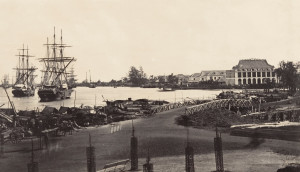
The French schools founded by Admiral de la Grandière have achieved such excellent results, and are appreciated so much by the local people, that not content to send a significant number of their children to these schools, many Chinese leaders now want to learn themselves – if not the French tongue, then at least how to transform Chinese writing into European characters. The main school is run by the Frères de la Doctrine chrétienne (Brothers of Christian Doctrine).

The main city market in Chợ Lớn in the late 19th century

There are in Cholon eight Chinese congregations. The heads of these congregations are responsible for ensuring that all of their members are good citizens and work hard to develop a strong economy

The first Chinese emigrants who came here towards the end of the 17th century were Cantonese, and they settled partly in Bien Hoa, partly in Mytho, which were Cambodian provinces at that time. This first wave of emigration was followed by several others from Fukien and other Chinese provinces.
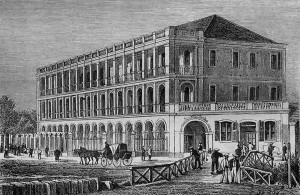
Their advanced civilisation and trade, their spirit of association, and later the religion, customs and writing which they shared with the Annamite conquerors of Cochinchina, gave them an important foothold in the country. As a result of the war between the Tay-Son rebels and Gia-Long King of Annam, they left their original settlements and came to settle in Cholon in around 1778. Despite the fact that in 1783 the leader of Tay-Son massacred more 10,000 Chinese and looted their business houses, despite nine months of a terrible famine in 1802, and despite the ban on export products in the country, the Chinese persevered and eventually overcame all obstacles, so that by 1830 Cholon was a very important market town, known to the Chinese as Tai-ngon, and to the Annamites as Sai-gon.

Today, the Chinese city is designated only by its Annamite name of Cholon, meaning big market (cho-lon).

Cây Mai Pagoda and fortress in 1866

A quarter of an hour from Cholon, on the road to Mytho, is the post of Cay-Mai. An avenue of acacias leads us to the foot of an artificial mountain in a delightful location with a small stream which flows down a stone staircase. A three-entrance gate with a large central arch gives access to the fort, and one finds there on top of the mound an octagonal shaped pagoda with a tower, flanked by palms and sacred cay-may trees. The latter is a type of plum tree with fragrant flowers, which it was once forbidden to touch on pain of death. These flowers were offered to the emperor and used to flavor his tea.
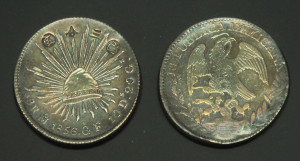
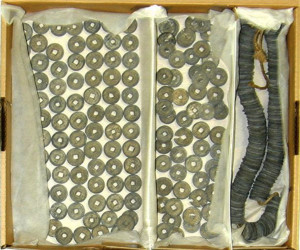
Monks guard the pagoda and the sacred plum trees. This place was once the destination of many pilgrimages. The great mandarin Trinh-Hoai-Duc, provincial governor of Cholon and author of the Gia-Dinh-thong-chi, gives us a lovely description. It is a model of Annamite prose:
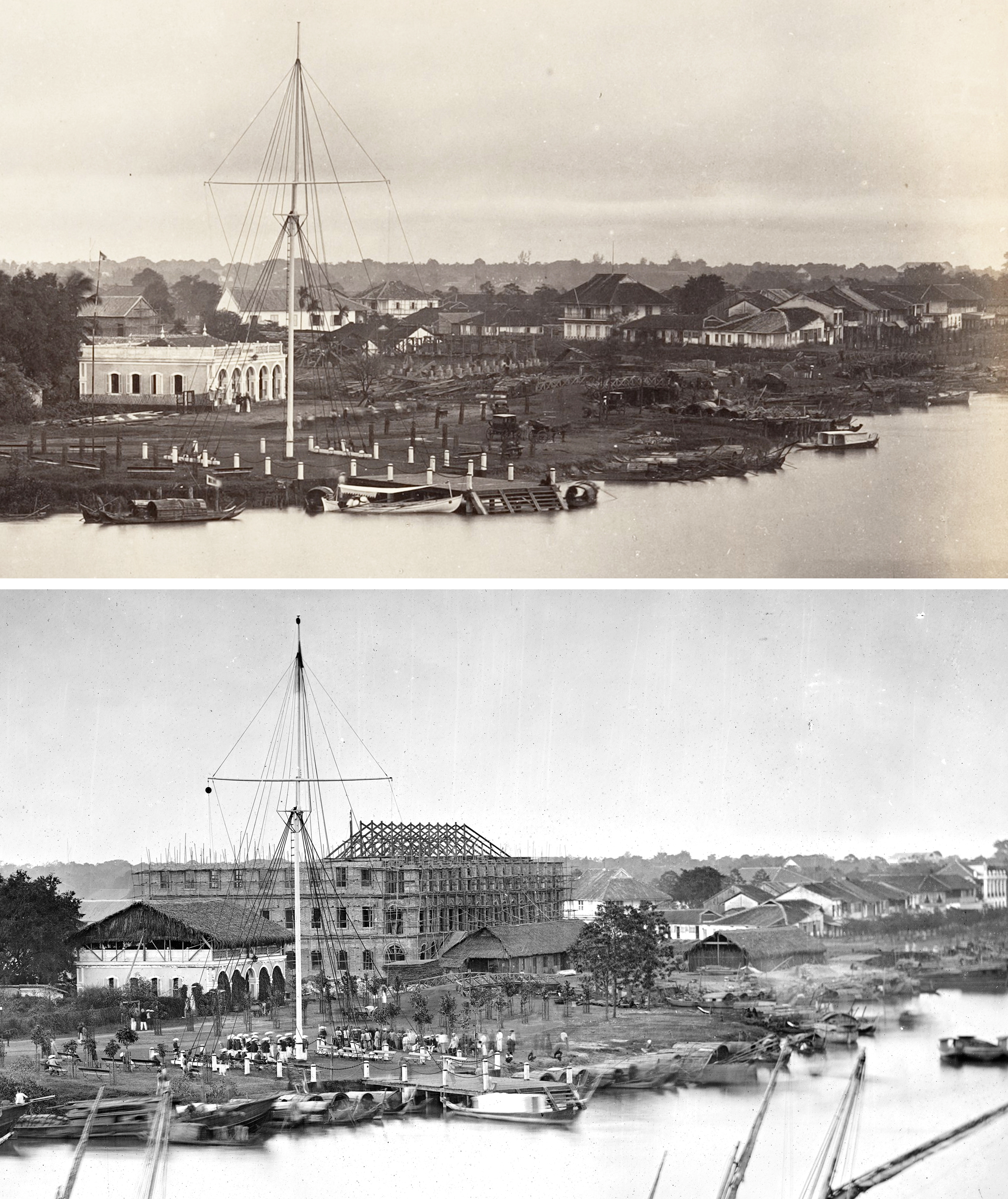
“This hill stands like a kind of peak. It is planted with many southern plum (cay-mai) trees whose old trunks intertwine obliquely with each other. These trees flower during the winter and their leaves spread an aromatic odour.

The cay-mai flowers are in communication with the spirits of the air, which make them open. It is not possible to transplant these trees elsewhere.

At the top of the hill is located a pagoda. It is there, in the middle of the night, that prayers written on the leaves of trees are sung to the Buddha. The bell rings, and a voice rises like smoke rising up among the clouds. A crystal clear moat surrounds the hill, and small boats go there to pluck lily flowers. Girls prepare rice for the good people of the area, and in the evening they go to worship at the pagoda. On festival days, we see mandarins with bachelor and doctorate degrees processing up the ten steps of the temple, a bowl in one hand, a bundle of betel in the other. They sing poetic songs and, sitting on the summit of the hill with flowers their feet, their poetry is lost like incense, as they experience true joy at the sight of such a beautiful place.

A corner of Chợ Lớn in the early colonial period

This pagoda is established on the foundations of an ancient Cambodian pagoda. In 1816, the monks of the pagoda uncovered its ruins and restored it completely. Digging in the grounds, they found a very large number of bricks and antique tiles. They also discovered two long sheets of gold, each longer than a thumb and weighing as much as three sapeques. On each of these sheets was engraved the image of the Buddha, seated on an elephant. These sheets undoubtedly came from the ancient Cambodian pagoda.”

From this location, the view extends over the rice fields bordering the commercial arroyo, the Plain of Tombs, the former Lignes de Ky-hoa battlefield and the fields and woods of Go-Vap, all the way to the Tay-Ninh mountain, a distance of about 30 leagues. Cay-Mai was formerly a Cambodian fort, and at the time of the arrival of the French, the Annamites were occupying it with a detachment of Cambodian soldiers from the southern provinces. However, they subsequently deserted.

We return to Cholon by the road which runs alongside the arroyo-Chinois. On the waterfront is a famous well called the Well of the Bishop of Adran (Puits de l’éveque-d’Adran), which gives the best water in all of Cochinchina and supplies Saigon and surrounding areas as far afield as Go-Cong.

An arroyo at Chợ Quán

On our way back to Saigon, we pass the village of Choquan, where a hospital was founded for indigenous people. This hospital also houses the dispensary. Contagious diseases, sores, scabies and skin lesions are very numerous among the population of Cochinchina and are more dangerous here than anywhere else. So this hospital is of great benefit to the Annamites.

We travel onwards between long rows of huts. The road is cut by several bridges, from where one can enjoy a very picturesque view of arroyo-Chinois, framed at the moment of high tide by scores of junks, boats and canoes manned by both Chinese and Annamites. During the rice harvest, in late January, one may see up to 400 sea junks moored in two parallel lines downstream of the arroyo, waiting to be loaded up with rice destined for the provinces of Upper Cochinchina.

We return to Saigon by the beautiful quai de l’arroyo-Chinois; this is the commercial quarter of the city, and it is also a most agreeable area to visit.

Charles Lemire

Tim Doling is the author of the guidebook Exploring Saigon-Chợ Lớn – Vanishing heritage of Hồ Chí Minh City (Nhà Xuất Bản Thế Giới, Hà Nội, 2019)

A full index of all Tim’s blog articles since November 2013 is now available here.

Join the Facebook group pages Saigon-Chợ Lớn Then & Now to see historic photographs juxtaposed with new ones taken in the same locations, and Đài Quan sát Di sản Sài Gòn – Saigon Heritage Observatory for up-to-date information on conservation issues in Saigon and Chợ Lớn.

Icons of Old Saigon – The Swing Bridge (Pont Tournant), 1903

The Swing Bridge in the early 20th century

This article was published previously in Saigoneer http://saigoneer.com

Many people are familiar with Eiffel’s Pont des Messageries maritimes (Cầu Mống), yet few remember its neighbour the Pont tournant (Swing bridge), which was built by the Eiffel successor company Levallois-Perret in 1902-1903 and stood close to the entrance to the Bến Nghé creek for nearly 60 years.

Saigon’s “Malabar” drivers found the ramps of Eiffel’s pont des Messageries maritimes too steep and dangerous for their horses

In the early colonial period, the need to permit unimpeded access to the arroyo-Chinois (Bến Nghé creek) by freight barges of all sizes precluded the construction of a street-level bridge.

Instead, the authorities commissioned the construction of a grand arched bridge, Eiffel’s pont des Messageries maritimes, to connect the port with the city. Though praised for its elegant design, Eiffel’s bridge was disliked by “malabar” drivers, who complained that the access ramps were too steep and dangerous for their horses.

In 1895, plans were drawn up to install a flat swing bridge close to the mouth of the creek. However, in the following year these plans were abandoned in the face of vehement opposition from Chợ Lớn’s merchant ship owners, who feared that the new bridge would block shipping access.

Another early 20th century view of the Swing Bridge

The swing bridge project was revived in 1900, when the French authorities began planning the new canal de Dérivation (the Tẻ Canal in Khánh Hội) to provide merchant shipping with an alternative entrance to the arroyo Chinois.

At this juncture, the Saigon-Mỹ Tho railway line operator Société générale des tramways à vapeur de Cochinchine offered to part-fund the construction of the bridge, in exchange for permission to install on it a railway track to carry freight trains across the creek to the port.

In the second volume of his Situation de l’Indo-Chine de 1902 à 1907 (1908), Jean Baptiste Paul Beau describes the events which followed:

The quai de Belgique side of the Swing Bridge in the 1920s

“The Pont tournant (Swing Bridge) over the arroyo-Chinois in Saigon was included in the programme of work set out in the decree of 12 November 1900 to improve the commercial port of Saigon. It was built by the Société de constructions de Levallois-Perret, under the terms of a contract approved on 6 July 1901.
Set a little above street level, it connects the city with the port. It gives passage to a railway, carriages and pedestrians, while ensuring river traffic on the arroyo-Chinois by means of a turning span measuring 49.20m in length, supported by and pivoting horizontally on a central pillar. Each of the two fixed sections at either side measure 19.194m in length.
The 7.10m wide bridge incorporates a 5.10m road flanked by two pedestrian lanes of 1m each.
The work began in January 1902 and was completed in July 1903.
Expenditure amounted to 382,755.12 francs for the work by the company and 11,166.12 francs for associated works. These included, notably, the demolition of part of the Customs warehouse and its reconstruction in another part of the quayside, as well as the development of approach roads to the bridge.”

A “colorised” view of the Swing Bridge from the pont des Messageries maritimes in the 1920s

From the outset, the new bridge – known in Vietnamese as Cầu Bắc Bình Vương – attracted much criticism. Despite the opening of the canal de Dérivation in 1906, many merchant ships still used the original entrance to the arroyo Chinois. They found the central pier hazardous to navigation and the channels either side of it too narrow to accommodate the large number of vessels entering and leaving the creek.

However, most complaints about the new bridge focused on its pivoting mechanism. In his 1911 book Ma chère Cochinchine, trente années d’impressions et de souvenirs, février 1881-1910, George Dürrwell comments:

“The bridge swings very badly. Some even claim that it doesn’t work at all, but those are grumpy and biased people who deserve no credit. I can say, indeed, that I saw it open at least once, at a practical time which permitted the free movement of the public. But, as the saying goes, ‘One swallow doesn’t make a summer.’ This unfortunate bridge has thus acquired, from its inception, a true local celebrity; and the rivers of ink that have been spilled talking about it are certainly more tumultuous than the waves of dirty water which agitate the river over which it was thrown.”

Another “colorised” view of the Swing Bridge from the pont des Messageries maritimes, taken after it was transformed into a fixed bridge in 1930

Twelve years later, the Swing Bridge was still the talk of Saigon. The following is taken from an editorial of 14 January 1923 in the newspaper L’Eveil économique de l’Indochine:

“A by-law prescribes that the Swing Bridge must be open from two hours before until two hours after the arrival of maritime courier vessels. Why then yesterday, despite the arrival of the Cordillère at 1pm, did the swing bridge remain stubbornly closed to road traffic until 3pm?
Who doesn’t know about this famous Swing Bridge? Whenever one wants to cross it by car, it’s open to boats, and whenever a boat appears, it’s open to cars.”

The editorial went on to suggest the demolition of both the pont des Messageries maritimes and the Swing Bridge and their replacement by “a transporter bridge, built strong enough to carry heavier trucks and trams.”

An early 1930s view of the Swing Bridge after it was transformed into a fixed bridge

By this time, the canal de Dérivation (now the Kênh Tẻ) had long taken over as the main water gateway to Chợ Lớn, and in 1930 the authorities voted 4,100 piastres to transform the Swing Bridge into a fixed structure. Thereafter, only the smallest of boats could pass underneath it.

One of the most famous pictures of the now fixed Swing Bridge was take in July 1941 when, after landing at the port, occupying Japanese forces crossed it on bicycles to enter Saigon.

Following the return of the French after World War II, a new separate rail lane was added to the east side of the bridge in order to keep rail traffic away from the road vehicles using the central lane.

The former Swing Bridge survived until 1961, when it was demolished and replaced by the reinforced concrete Khánh Hội Bridge (Cầu Khánh Hội). That in its turn was demolished in 2009 to make way for the current structure.

Japanese forces crossing the bridge to Saigon on bicycles in July 1941

The new separate rail (and pedestrian) lane is visible in this photo of the bridge in July 1948 by Jack Birns

The former Swing Bridge in the early 1950s

The Khánh Hội Bridge which replaced the former Swing Bridge in 1961

Tim Doling is the author of the guidebook Exploring Saigon-Chợ Lớn – Vanishing heritage of Hồ Chí Minh City (Nhà Xuất Bản Thế Giới, Hà Nội, 2019)

A full index of all Tim’s blog articles since November 2013 is now available here.

Join the Facebook group pages Saigon-Chợ Lớn Then & Now to see historic photographs juxtaposed with new ones taken in the same locations, and Đài Quan sát Di sản Sài Gòn – Saigon Heritage Observatory for up-to-date information on conservation issues in Saigon and Chợ Lớn.

Some Features of the Viet-Nam Railway System, February 1973

Alsthom 850hp Bo-Bo diesel electric locomotive No. BB-902 stands outside Saigon’s Chí Hòa Depot in the 1960s

A leaflet published in February 1973 by the Directorate of Viet-Nam Railway System, RVN Ministry of Communications and Post.

1. Background of the Transvietnam Railway

The first railway line, which was built in Viet-Nam in 1885, was the Saigon-Mytho line (70km). It was subsequently added to between 1885 and 1902 by the Hanoi-Langson line.

The leaflet “Some Features of the Viet-Nam Railway System” (1973)

The railway linking the North with the South (1,738kms) was achieved with many phases of construction work which were spread between 1903 and 1936.

After the Geneva Agreement in 1954 had partitioned Viet-Nam into two parts, the length of railway line south of the 17th parallel totalled 908kms and included two operational portions:

● In Central Viet-Nam
The portion of line between Dong-Ha and Da-Nang (171kms)

● In South Viet-Nam
The portion of line betwen Ninh-Hoa and Saigon, including the branch lines from Nga-Ba to Ba-Ngoi and Muong-Man to Phan-Thiet (465kms)
The Saigon-Mytho line (70kms)
The Saigon-Loc Ninh line (118kms)
The Thap Cham-Dalat line (84kms)

The first reconstruction of the Transvietnam Railway, which was started in 1955 and completed in 1959, involved the restoration of the section from Ninh-Hoa to Da-Nang (490kms).

However, in 1961, guerilla warfare started again in the Republic of Viet-Nam. The stepped-up sabotage campaign caused traffic interruption on many sections of the line. As a result, the length of operated line shrank from 1,345kms in 1959 to 529kms by 1966.

Re-laying track on the Sài Gòn–Đông Hà line in 1959

The second reconstruction of the Transvietnam Railway began in 1967. From the end of 1967 to April 1969, the Viet-Nam Railway System (VNRS) completed the restoration of the following sections:

● Phu-Cat to Qui-Nhon and Nha-Trang
● Thap-Cham to Songlongsong
● Hue to Da-Nang

2. Personnel and Social Welfare

Railway activities reduced by the war during recent years have led to organizational simplification and personnel compression. Railway personnel, from a figure of 6,200 employees in 1961, now number 3,204 and are distributed as follows:

● General management: 267 employees
● Operations and traffic: 596 employees
● Mechanical: 994 employees
● Track, building and reconstruction: 1,181 employees
● Handling and navigation: 166 employees
The railway personnel drafted into the Army of Viet-Nam amount to 534 men.

The arrival of a train at Saigon station

Railway personnel are classified into permanent cadres and non-permanent cadres. Retired permanent cadres of VNRS are paid a retirement pension from Viet-Nam Railways retirement funds. Non-permanent cadres at retirement are paid a lump sum extra compensation which is computed according to the time of service.

To provide living quarters for staff, the VNRS has built in Saigon 10 groups of houses totalling 415 units, and in provinces 7 housing centers totalling 564 units.

A Central Supply Service (Fair Price Shop) in Saigon and several regional branches have been created to supply railway personnel with necessary commodities for daily use at cost price.

The Railway Medical Service has set up 1 dispensary in Saigon and 11 others in provinces along the railway line to provide medical consultations, treatments and drugs to railway personnel free of charge. The monthly cost of drugs amounts to VN$ 50,000-60,000.

3. Fixed Installations

The track structure with 1 meter gauge consists of laying rails weighing 27 and 30kg per linear meter, on steel sleepers spaced apart, the number of which averages 1,400 sleepers per kilometer of track. The work of replacing 27kg rail with 30kg rail is progressing, together with the installation of pre-stressed concrete sleepers which are produced by the VNRS.

A repair crew installs new railway track on the Tháp Chám to Phú Cát line

The work of welding rail to exclude joints which are the bad points of the track has been performed to provide about 10kms of continuous rail at various locations such as Go-Vap, Ninh-Hoa, Da-Nang, etc.

Aside from the cogged branch line from Song-Pha to Dalat which has a 12% grade, the maximum gradient of the entire flat line is 1.5%, with a 1% grade predominating over 94% of the main line.

Around 80% of the length of the main line has curves of over 300 meters radius, while the remaining 20% has curves with a radius of 300 meters or less.

Projects have been drawn up to improve gradients and to straighten track, so that speed restrictions may be kept to a minimum.

The VNRS structure includes: 413 large bridges more than 10m long with an aggregate length of 17.743m; 27 tunnels totalling 8,767m in length; 78 stations; and a plant at Thap-Cham which manufactures pre-stressed concrete sleepers and girders.

4. Train Working and Signalling on the VNRS

a) Train Working

The railway bridge outside Tuy Hòa in 1970

Single track line operation in Viet-Nam is effected according to timetable.

Crossings are indicated in the timetable and changing of crossings is worked out by exchange of telephone and radio communications between the stations.

Protection of trains running on single track line in the same direction is effected by time interval between the two trains.

b) Signalling

The manual signals in use are as follows:

(i) Main signals
– Home signal (red and white square)
– Distant signal (yellow semaphore)
– Stop signal on sidings (violet square)

(ii) Temporary and movable signals
– Warner
– Speed indicator
– T board: direction indicator, switch dwarf signal

Thủ Đức station in March 1967

The colors used are:
– Red: absolute stop or immediate stop
– Green: proceed
– Yellow-orange: caution
– Violet: stop, for sidings

(c) Interlocking

In through-passing stations, the levers of the distant signals and of home signals are interlocked with the switch levers by means of Boure Keys.

(d) Communication systems

The VNRS has a private system of communications by telegraph to protect and control train operations. However, because of frequent interruptions by sabotage, this system has recently been replaced by a radio communication and teletype service.

The VNRS radio service includes:
● Radio Collins System of single side band for direct communications between the VNRS Directorate and Regional Services at Nha-Trang and Da-Nang;
● Radio Teletype System for daily communications with major stations by messages regarding commercial transactions and distribution of cars and coaches;
● Radio Dispatching Service by VHFFM for communications between stations, and between stations and trains, for the passing of information necessary to train operations. This system is equipped with three types of apparatus: 300 watts for large centers, 25 watts for stations, and 10 watts for trains.

GE U8 diesel electric locomotive No. BB-936 at Cape Varella by Paul S Stephanus, from a March 1969 Trains Magazine article on Vietnam railways

5. Mechanical Division

(a) Locomotives

● Main Line locomotives
“Alsthom” diesel-electric engines (French make): 6 units
“General Electric” diesel-electric engines (American make): 48 units
Total: 54 units
● Switching locomotives: 2 units
● Diesel railcar: 1 unit
● Steam locomotives: 14 units
● Wickham trolleys: 30 units

(b) Coaches and cars

● Passenger coaches
Flat line coaches: 163 units
Rack line coaches: 13 units
● Freight cars
10T freight cars: 344 units
20T freight cars: 222 units
25T freight cars: 486 units
● Protection cars
10T cars: 20 units
20T cars: 64 units
25T cars: 21 units
● Total 1,333 units

A convoy of Wickham armoured trolleys in October 1967, photo Fondation Gilles Caron

(c) Cranes

Orton 75T capacity: 4 units
Cockerill 63T capacity: 1 unit
Bay City 20T capacity: 1 unit

(d) Facilities

● Office of the Mechanical Department
● 3 Car Shops
● 1 Major Car Repair Plant
● 1 Major Locomotive Repair Plant
● 9 Engine Sheds

(e) Some figures showing the efforts of the Mechanical Department during 1970

(i) Repair of sabotaged locomotives and cars
– Rescue at 60 sabotage incidents
– Repair of 49 out of 54 engines damaged by mines
– Repair of 125 out of 202 cars damaged by mines
(ii) Traffic performed by engines
– Number of kilometres performed 662,495kms
– Number of ton-kilometres performed 15,281,101 TK
(iii) Personnel
Total workforce of 994, distributed as follows:
– Enginemen 197 or 20%
– Shop workers 657 or 66%
– Office workers 146 or 14%

A train headed by Alsthom diesel electric locomotive No. BB-902 derailed at Phú Yên in 1967, later repaired at Chí Hòa

6. Railway operating situation as at March 1972

(a) Operating

(i) Lines in operation

● Saigon to Long-Khanh and branch lines (118.4kms)
● Muong-Manh to Phan-Thiet (11.8kms)
● Thap-Cham to Phu-Cat and branch lines (441.9kms)
● Da-Nang to Hue and branch lines (112.8kms)
● Total length (684.9kms)
(see map attached)

(ii) Rehabilitation program

(iii) Record of sabotage incidents from 1960 to 1972

(iv) Situation of rolling stock

Flat cars are in short supply while box cars are in excess. This condition emanates from the fact that flat cars are greatly needed by military shippers for their shipments of palettised cargoes which are suitable for handling by fork lift truck.
Specialized cars for hauling rock, such as hopper cars, are also insufficient to meet the requirements of the four rock loading points at Nha-Trang. The excess of box cars may be attributed to the fact that military shippers are not familiar with this type of car.

A train headed by Alsthom diesel electric locomotive No. BB-902 derailed at Phú Yên in 1967, later repaired at Chí Hòa

The situation of our motive power is under constant threat of shortage, because when an engine is damaged by a mine, it takes many months to repair, while our fleet of locomotives is hardly enough.

To meet such imbalance and shortage, the VNRS has had to adopt the following measures:

– modification of old box cars into flat cars by dismounting car wall and preserving the chassis and floor
– expeditious rotation of rolling stock

The maximum free time for loading and discharging cargoes is 6 hours.

(v) Train operations

Although the movements of passenger and freight trains are secured by the patrol of armored trains, the composition of trains with protection equipment in accordance with the security pattern is very ponderous. Each train must include protection cars coupled in front of the engine and escort cars which take up nearly half the engine trailing capacity.

With the exception of passenger trains transporting civilian workers for the US Army, the movement of freight trains is controlled by a system called “unannounced trains or clearance note issued at station” in order to prevent sabotage.

(b) Commerce

Beginning the cleanup of a wrecked train at Phú Yên in 1970 by Steve, MACV Advisory Team 280

Around 95% of the revenue from freight traffic comes from the transport of military cargoes, because:
– the operational segments of the line are too short to attract freight from civilian sectors; and
– lack of security, cargoes cannot be protected against sabotage as they can when travelling by truck.

The deliberate invasion of the Communist North Viet-Nam by crossing the 17th parallel in early April 1972 has cut Central Viet-Nam into isolated areas and heavily destroyed the axis of communication. This invasion has brought about railway traffic interruption on several sections of the line, namely Hue to Da-Nang, Phu-Cat to Tuy-Hoa and Nha-Trang to Thap-Cham. Besides that, in accordance with the Vietnamization program and the cadence of Allied Forces withdrawal, the transport of rock from Rury to Songlongsong, Song-Luy, Song-Pha, Tuy-Hoa and Phong-Thanh, as well as the transport of fuel and material from Qui-Nhon to Vinh-Lai and Phu-Hiep and returns, were terminated. In other respects, the transportation of passengers and cargoes for the Allied Forces on the section Saigon to Thu-Duc and Long-Binh were subject to a considerable decrease.

The revenues of passengers and freight traffic for the financial year 1972 in comparison with those of 1971 have shown a 37% decrease for passengers and a 63% decrease for freight.
(See the Situation of freight and passenger traffic from 1954 to 1972)

(c) Financial results

Loading freight wagons at Chí Hòa in the 1960s

The monthly receipts in 1972 were as follows:
Jan 1972: VN$24,600,000
Feb 1972: VN$18,300,000
Mar 1972: VN$21,100,000
Apr 1972: VN$14,800,000
May 1972: VN$12,100,000
Jun 1972: VN$9,700,000
Jul 1972: VN$8,100,000
Aug 1972: VN$7,000,000
Sep 1972: VN$8,900,000
Oct 1972: VN$5,300,000
Nov 1972: VN$2,700,000
Dec 1972: VN$3,200,000
Total: VN$135,800,000

In view of the fact that the railway system is not completely restored, railway activities still depend on the territorial security situation, and war destruction still has a tremendously important impact, the VNRS is not in a position to balance its budget with its own resources. In order to make up its budget deficit, the VNRS will:

– use the amount of profit of the trucking and maritime transportation branch;
– request financial support from the Government budget.

7. Railway Rehabilitation and Modernization

After the Cease-fire of January 28th 1973, the VNRS plans a Rehabilitation and Modernization Program which will preserve the metre track gauge.

To begin with, lines that had been in operation before the Quang-Tri Offensive (March 1972) will be reopened. This will call for the temporary repair of 684kms of track, just to allow trains to pass at very low speed (20-30kph).

Phase 1 of rehabilitation will take place in the next six months, related to 883kms of tracks, and will allow to link thoroughly:

● Saigon to Dalat (406kms)
● Saigon to Qui-Nhon (659kms)
● Da-Nang to My-Chanh (140kms)

Near Phù Cát, a train runs with flat wagons coupled in front of the GE B-B diesel electric locomotive in case of landmines in October 1971

By this phase, the railroad will be capable of competing advantageously against automobiles.

Phase 2 is set for the next 12 months after reopening. This will include the rehabilitation of segments of track more seriously damaged (186kms), but which can be repaired by means available in the railroads at the present time. This will permit trains to go further north from Saigon up to Quang-Ngai and from Da-Nang up to Dong-Ha. The average speed will not exceed 20-30kph.

Phase 3 will involve rehabilitation of the remaining segments between Quang-Ngai and Da-Nang (136kms), so heavily damaged that reconstruction will mean construction of a brand new railroad. The work will last at least two years.

****

The modernization of the Vietnamese railway will be carried out during or after the previous three phases of rehabilitation, depending of the financial resources available. It will aim at:

● increasing comfort and speed from average speed of 40kph of prewar period to 60-70kph;
● linking the railway networks of South Viet-Nam and North Viet-Nam and Cambodia;
● performing the recommendations of “Ecafe” for the Transasian Railway Project.

Increasing speed will require the remodelling of track characteristics and the renewal of rolling stock and motive power.

Passengers boarding a Saigon-Nha Trang train in the 1960s

Linking the railway networks of South Viet-Nam to those of North Viet-Nam and Cambodia is perfectly feasible, as they were all once parts of the Indochina Railways. This will result in tremendous economic advantage for Viet-Nam and Cambodia, as well as for the nations of the Ecafe region, from China to Burma.

Starting these modernization schemes will require the co-operation of a survey team of experts in railroad design and construction who will inspect the existing facilities thoroughly and recommend a plan.

Conclusion

In spite of the tremendous difficulties brought about by a protracted war with its extensive destruction, the VNRS has tried hard during the past five years to restore and rehabilitate the Transvietnam railway line, to expand railway operations and to develop the trucking and maritime transportation service.

When peace is completely re-established to this country with the restoration of the railway line from Saigon to Dong-Ha, the VNRS transportation capacity will be much greater than that mentioned above. This potential capacity will constitute a not negligible element in the restoration and development of the national economy.

The VNRS is a means of mass transportation, and in the present technical and economic state of Viet-Nam it is difficult to conceive of any means other than the railway.

It is a practical means of transport of reduced fares and rates, because railway tariffs are approved and promulgated by the Government. The tariffs making policy of VNRS is distinguished by a flexible adaptation to economic necessity; it seeks less to improve the financial results of its operation than to increase the services rendered to the Vietnamese collectivities which benefit from the lowest tariffs at the time being. The railway is still performing the function of harmonizing and stabilizing the prices on the market of the country.

Tim Doling is the author of The Railways and Tramways of Việt Nam (White Lotus Press, Bangkok, 2012) and also gives talks on Việt Nam railway history to visiting groups.

A full index of all Tim’s blog articles since November 2013 is now available here.

Join the Facebook group Rail Thing – Railways and Tramways of Việt Nam for more information about Việt Nam’s railway and tramway history and all the latest news from Vietnam Railways.

Saigon’s Famous Streets and Squares – Ham Nghi

An aerial photograph of Hàm Nghi boulevard from 1955, photographer unknown

This article was published previously in Saigoneer http://saigoneer.com

Once the heart of Saigon’s own Chinatown, Hàm Nghi is one of the city’s three widest boulevards.

Like several other major city thoroughfares, Hàm Nghi boulevard began life as a waterway. Late 19th century scholar Pétrus Ký tells us that this waterway was known in Vietnamese as the rạch Cầu Sấu (“Crocodile Bridge Creek”), because of the pools which once lined its banks, in which crocodiles were bred for their meat (Pétrus Trương Vĩnh Ký, Souvenirs historiques sur Saïgon et ses environs, 1885).

The Crocodile Bridge Creek is pictured on this map from the mid 1860s

The Crocodile Bridge Creek ran from the Saigon river as far as the modern Hàm Nghi-Pasteur junction, where it met another canal which extended along what is now lower Pasteur street and eventually connected with the “Junction Canal,” the forerunner of modern Lê Lợi boulevard. Before 1867, the Crocodile Bridge Creek was used mainly by merchants to access the old city market on what the French designated rue Chaigneau (modern Tôn Thất Đạm street).

At the start of the colonial period, the wharfs on both sides of the Crocodile Bridge Creek east of the junction with rue d’Adran (modern Hồ Tùng Mậu) were named rue No. 3, while those between the rue d’Adran junction and the lower Pasteur street canal were designated rue Dayot.

During the 1860s, the French authorities encouraged large-scale immigration from China’s Guangdong province, with a view to the further development of the economy. Emanating mainly from Guangzhou city and neighbouring Zhaoqing prefecture, many of the Cantonese newcomers chose to settle between the Crocodile Bridge Creek and the arroyo Chinois (Bến Nghé Creek) in Saigon, establishing a second Chinatown with its own assembly hall (the Guangzhao Assembly Hall) at Cầu Ông Lãnh.

The Maison Wang-Tai under construction in 1867, by John Thomson – in the larger images below the Crocodile Bridge Canal entrance may be seen clearly

In 1867, these new Chinese immigrants were joined by one of Cochinchina’s most famous Cantonese businessmen, the opium dealer Wang Tai, who in that year built his imposing headquarters (the Maison Wang-Tai) on the riverfront, right next to the Crocodile Bridge Creek entrance – see Wang Tai and the Cochinchina Opium Monopoly.

The Crocodile Bridge Creek was filled in 1867-1868, forming a 56m wide thoroughfare. In 1870, to accommodate the merchant boatmen, a replacement city market was built several blocks away, on the west bank of the Grand Canal (modern Nguyễn Huệ boulevard). Thereafter, the old rue Chaigneau market continued to function as a local market.

On 14 May 1877, in recognition of the fact that a large number of its residents were Chinese settlers from Guangdong province, the new street was designated boulevard de Canton.

A train waits to depart Saigon for Mỹ Tho on 20 July 1885, the opening day of the railway line, image courtesy Maison Asie Pacific (MAP)

During the first 20 years of the colonial era, numerous government buildings were installed at the lower end of the boulevard, including the Direction du Port de commerce (Commercial Port Directorate) and the Service du pilotage (Piloting Service). After purchasing the Maison Wang-Tai in 1881, the Customs and Excise Directorate had it rebuilt in 1886-1887 as the Hôtel des douanes (Customs House) – see Foulhoux’s Saigon.

The opening of the Saigon-Mỹ Tho railway line in 1885 brought further changes to the boulevard, which by this time extended west as far as the rue Mac-Mahon (modern Nam Kỳ Khởi Nghĩa). Saigon’s first rail terminus was situated at the riverside end of boulevard de Canton, between the Customs House and the Commercial Port Directorate, and the railway line itself ran west along the centre of the boulevard, before heading out towards Chợ Lớn and Mỹ Tho. A large railway atelier was built immediately to the west of the boulevard de Canton-rue Mac-Mahon junction – see The Saigon-Mỹ Tho Railway Line.

On 24 February 1897, the boulevard was split into two separate roads either side of the railway track, each road named after a French admiral – rue Krantz on the northern side and rue Duperré and the southern side.

The development of the boulevard as depicted in maps of 1898 and 1920

Another significant landmark was built on the boulevard in 1906, in the form of the École des mécaniciens Asiatiques (School of Asian Mechanics, now Cao Thắng Technical College), students of which included Nguyễn Tất Thành (Hồ Chí Minh) in 1911 and Tôn Đức Thắng in 1915.

The boulevard attained its current length of 988m in the period after 1910, when the railway atelier was relocated to Dĩ An and extensive marshland drainage permitted the creation of the new Halles centrales (Bến Thành Market) with its spacious square, together with a much larger railway terminus in the area occupied today by 23-9 Park. By 1914, the twin roads Krantz and Duperré stretched all the way from the Saigon river to the place du Marché (modern Quách Thị Trang square) – see The Changing Faces of Sai Gon Railway Station.

In 1914-1915, a new Saigon Railway Station and a CFI railway headquarters building were installed on either side of the square – this second Saigon Station was sited in the area now occupied by 23-9 Park, while the new railway headquarters building was constructed at the junction of place du Marché and rue Krantz.

From that date onwards, passenger trains on the Saigon-Mỹ Tho and newly opened North-South lines no longer ventured beyond it along the boulevard, but the old rail track in the centre of rues Krantz and Duperré was retained, in order to facilitate freight train access to the Saigon port via the swing bridge across the arroyo Chinois (Bến Nghé creek), which had been installed in 1903.

A CFTI electric tram on boulevard de la Somme in the 1930s

In 1911, a tramway line was also installed on the boulevard, and in subsequent years the rue Chaigneau junction became an important tramway terminus.

During the Great War of 1914-1918, more than 92,000 Vietnamese men fought in the French armed forces, and at least 12,000 of these are believed to have lost their lives during that conflict. Numerous war memorials were subsequently built in Saigon – see Hùng King Temple –  and on 22 April 1920, the rues Krantz and Duperré (then still known to many people as the boulevard de Canton) were reunited and named boulevard de la Somme, after one of the First World War’s bloodiest battles.

In the wake of the violence which attended the 1919 Vietnamese boycott of Chinese traders, many Cantonese residents of the surrounding streets relocated to Chợ Lớn for safety. However, several popular Chinese restaurants on the boulevard de la Somme remained in operation, and as tourism started to develop in the mid 1920s, numerous small hotels and guest houses also appeared. Then in 1927, plantation owner Trần Quang Ẩn opened the 60-room Grand Hotel d’Annam at 117 boulevard de la Somme, which in the 1930s and 1940s would become one of the most popular hotels in the city.

The first US Embassy building at 39 Hàm Nghi in the early 1960s

In 1949, having suffered numerous setbacks in the First Indochina War, the French decided to offer limited independence to Việt Nam within the context of a French Union, leading to the creation of the State of Việt Nam, with the former Emperor Bảo Đại as Head of State. The United States of America immediately opened full diplomatic relations with the new entity, and in 1950 the first United States Embassy building was inaugurated at 39 boulevard de la Somme.

After 1955, this building – the “American Legation” described by Graham Greene in his novel The Quiet American – served for 12 years as the American Embassy to the Republic of Việt Nam. In 1967, in the wake of the bombing of 30 March 1965, the US diplomatic mission was relocated to a more secure compound at 4 Thống Nhất (Lê Duẩn) boulevard.

King Hàm Nghi (1884–1885)

Following the establishment of the Republic of Việt Nam in 1955, the boulevard de la Somme was renamed boulevard Hàm Nghi, in memory of the eighth Nguyễn dynasty monarch Hàm Nghi (ruled 1884–1885), who left Huế to join the Cần Vương insurgency against French occupation forces. Replaced on 19 September 1885 by his brother Đồng Khánh (1885-1889), Emperor Hàm Nghi was captured by the French on 1 November 1888 and exiled to Algeria on 12 December 1888.

Sixty years later, the boulevard still goes by that same name.

The bridge over the entrance to the Crocodile Bridge Canal (filled in 1867-1868) may be seen clearly in both of these two photographs of the Maison Wang-Tai under construction in 1867 by John Thomson

Tim Doling is the author of the guidebook Exploring Saigon-Chợ Lớn – Vanishing heritage of Hồ Chí Minh City (Nhà Xuất Bản Thế Giới, Hà Nội, 2019)

A full index of all Tim’s blog articles since November 2013 is now available here.

Join the Facebook group pages Saigon-Chợ Lớn Then & Now to see historic photographs juxtaposed with new ones taken in the same locations, and Đài Quan sát Di sản Sài Gòn – Saigon Heritage Observatory for up-to-date information on conservation issues in Saigon and Chợ Lớn.