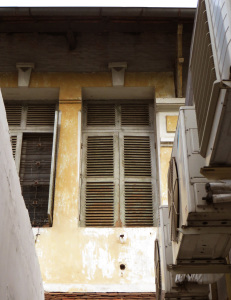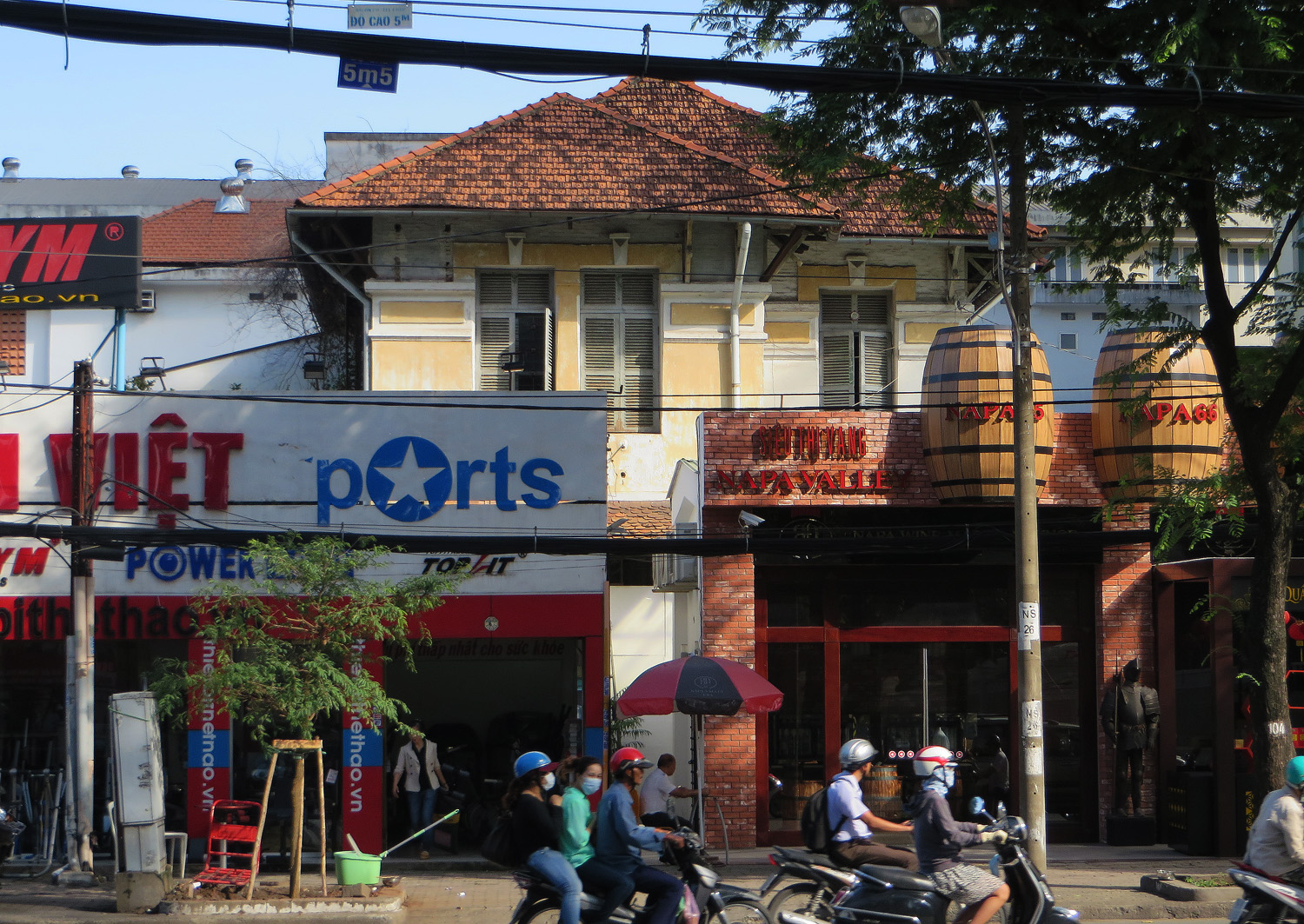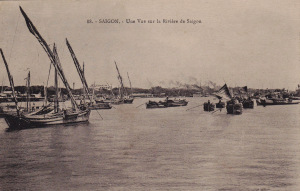
Saigon’s Five Most Endangered Heritage Buildings, December 2014

The Five no title

In recent years, while the fate of Hà Nội’s built heritage has been more closely monitored by specialists from the Ministry of Culture, Sports and Tourism, a very large number of Hồ Chí Minh City’s historic buildings have been systematically demolished with apparent impunity, in the name of economic development.

As the city waits to see which elements of the original “Grands Magasins Charner” design will be incorporated into the façade of the 43-storey replacement for the doomed Saigon Tax Trade Centre, here are the city’s “Top Five” historic buildings which are currently under the greatest threat of redevelopment:

1. District 1 People’s Committee Building, 45-47 Lê Duẩn

IMAGE 5

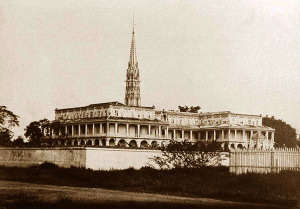
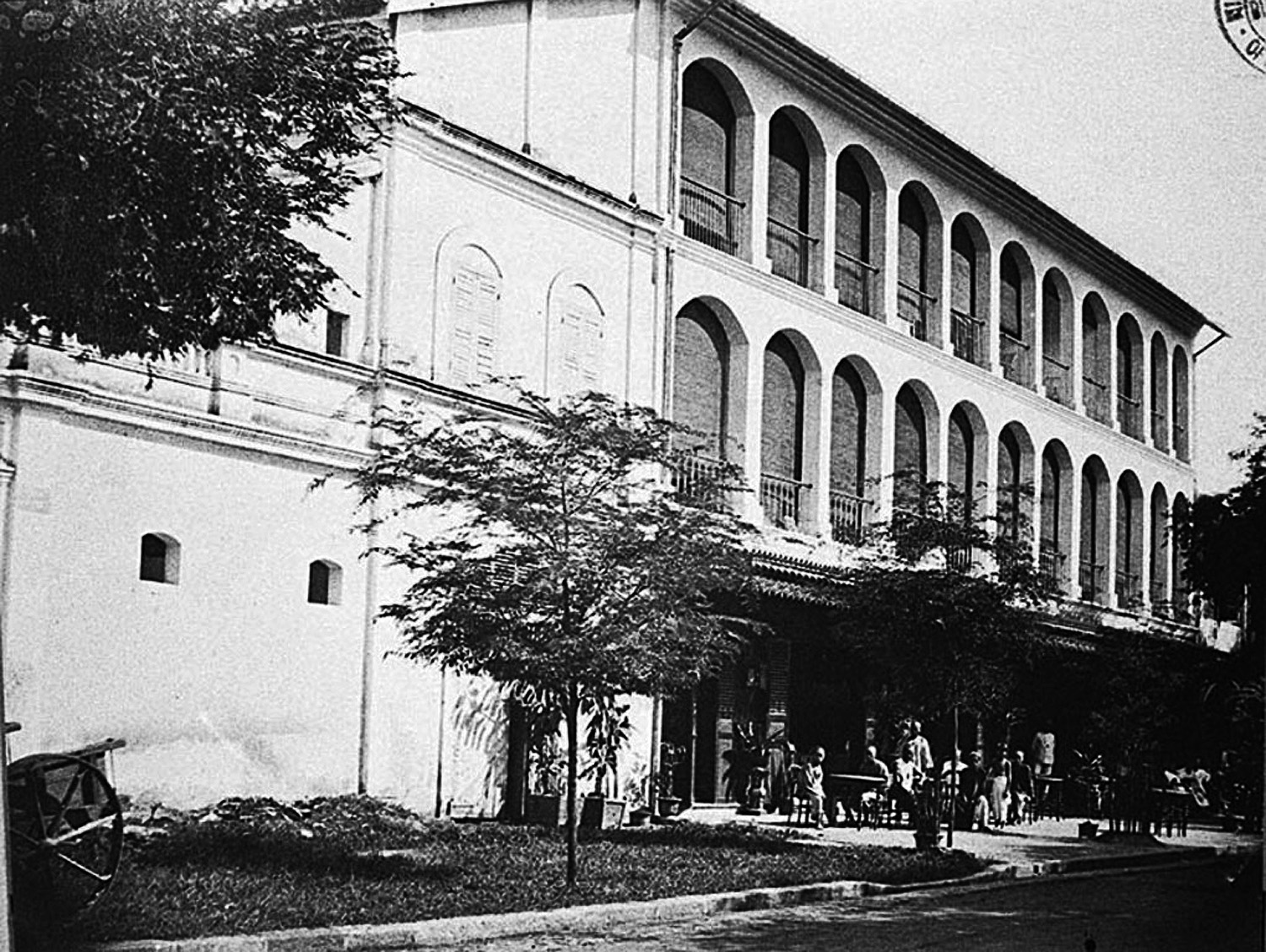
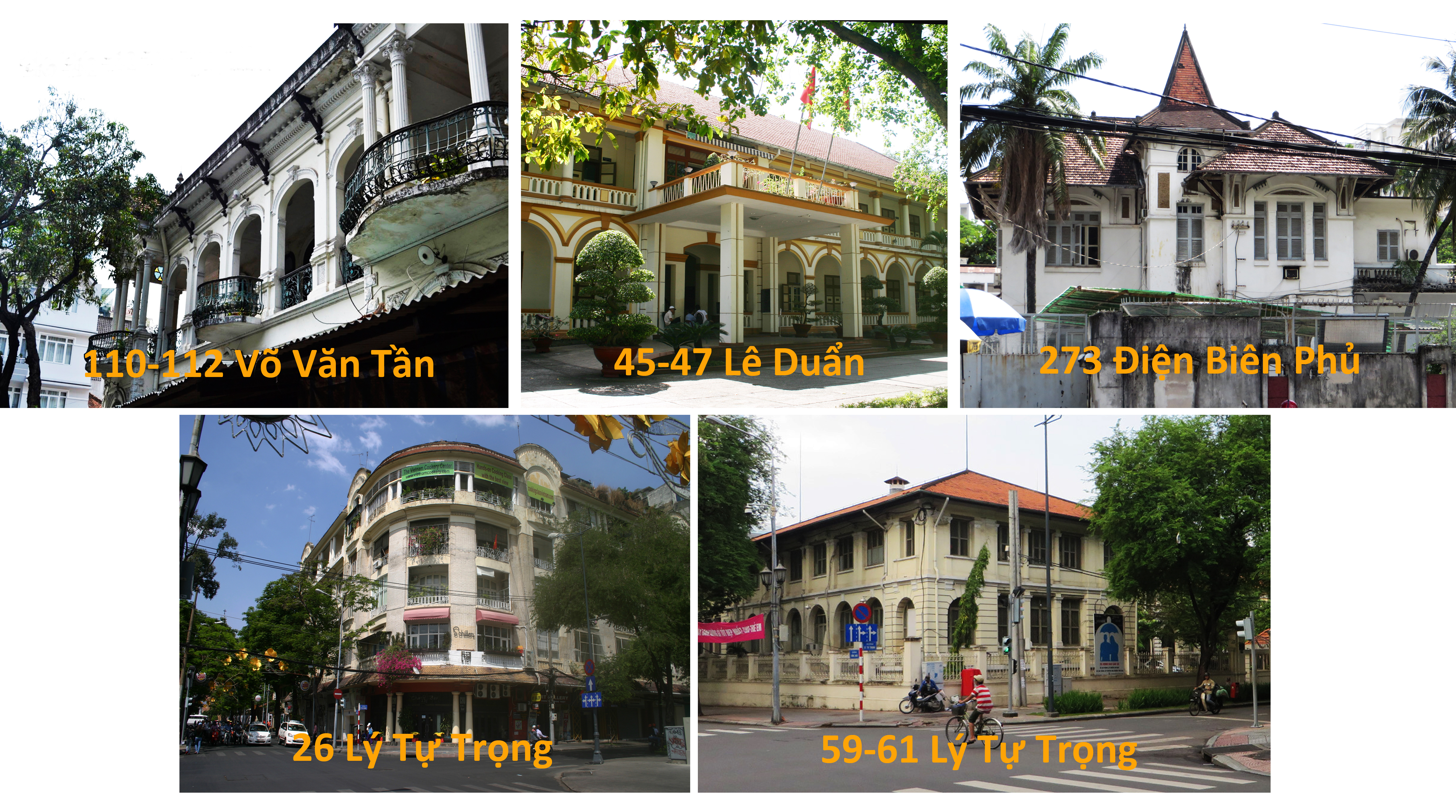
The Cercle des officiers building in the 1920s

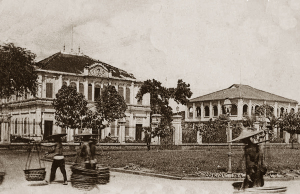
Several weeks ago it was announced that the headquarters of the District 1 People’s Committee at 45-47 Lê Duẩn, housed in the former “Cercle des Officiers” (Officers’ Mess), would be rebuilt. Opened in 1876 and thus one of the city’s oldest colonial structures, it is typical of the colonial civic architecture of its period, with spacious exterior verandahs and shuttered windows. UPDATE: After an initial response to public concern which stressed that the building was not a historic, architectural, cultural or artistic vestige and therefore the redevelopment plan did not violate any regulations, the District 1 People’s Committee has now pledged that the old building will be preserved and the new building constructed behind it.

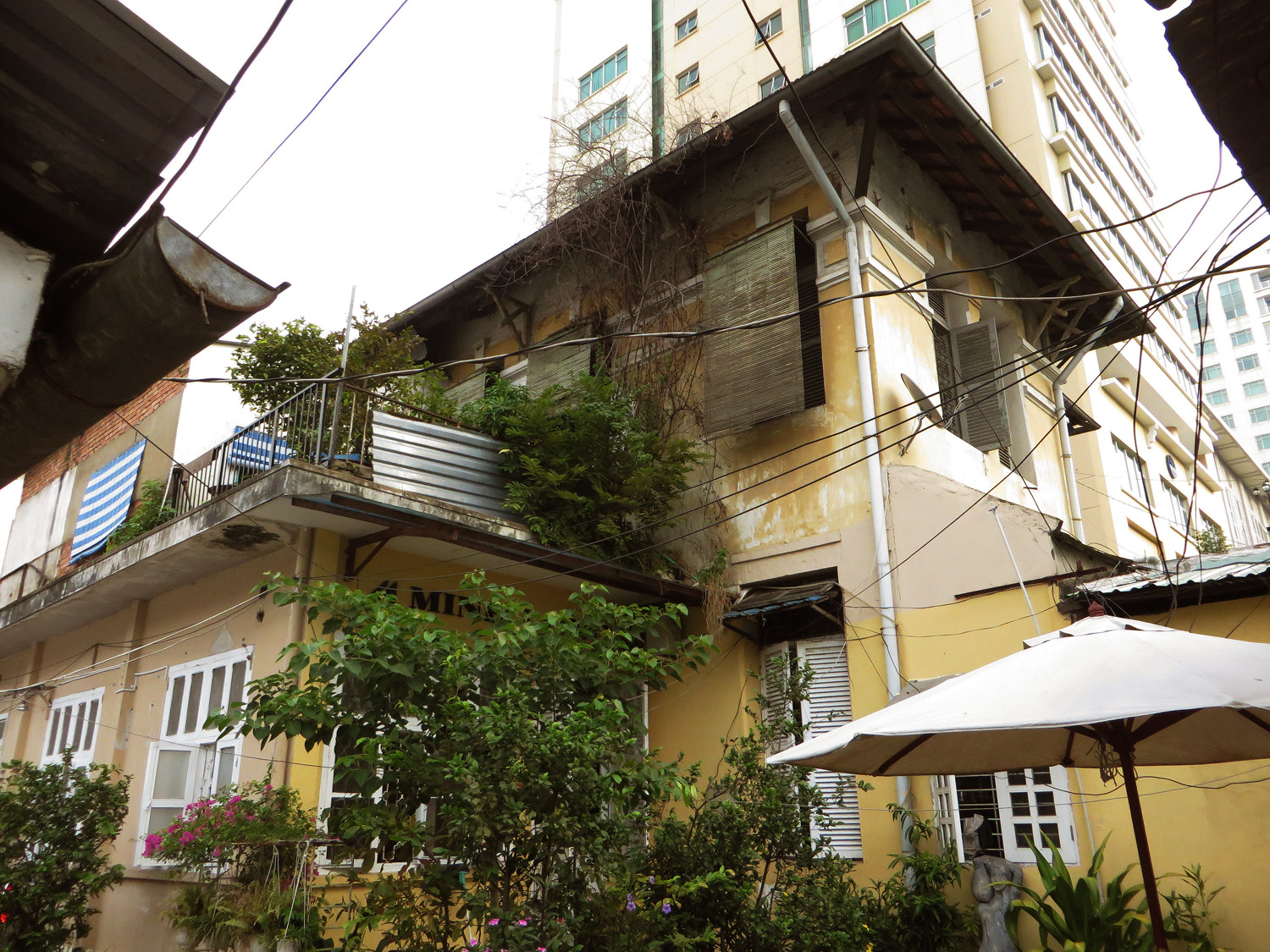
2. Phương Nam Mansion, 110-112 Võ Văn Tần

DSC03122b

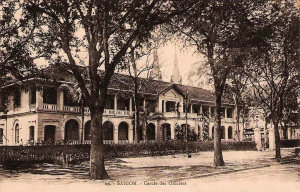
Phương Nam Mansion

The largest and most imposing French building in District 3, the Phương Nam Mansion is believed to have been constructed between 1910 and 1920 for a rich Vietnamese businessman. Its unique design features a spacious surrounding upper verandah with decorative balconies and a high-ceiling interior with intricately carved coving work. The building is currently on the market for US$35 million, and at that price, it’s obvious that only demolition and reconstruction as a tower block will offer prospective buyers a big enough return on their investment.

3. Catinat Building, 26 Lý Tự Trọng

Catinat building

The Catinat Building in the 1950s

This 1927 apartment building stands on the so-called “Gold Land” block enclosed by Đồng Khởi, Lý Tự Trọng, Nguyễn Du and Hai Bà Trưng streets, which, according to newspaper reports, will soon be redeveloped to accommodate “services, culture, luxury hotels, finance offices and exhibition areas.” One of the best-loved icons in the heart of the city, the Catinat Building is known for its classic art deco interior design. For more information see Date with the Wrecker’s Ball (3): The Catinat Building.

4. 273 Điện Biên Phủ

IMG_5497

273 Điện Biên Phủ

The Hồ Chí Minh City Department of Science and Technology recently announced its intention to build a new Centre for Science and Technology Research and Transfer. The new centre will replace the current building, the French mansion at 273 Điện Biên Phủ, which was built in the 1920s and was once the residence and office of the Swiss Consul General to Cochinchina.

5. 59-61 Lý Tự Trọng

Secretariat2

The Secrétariat général du gouvernement building in the early 20th century

A few years back, the former Secrétariat général du gouvernement de la Cochinchine building (c 1888), currently the Department of Information and Communications at 59-61 Lý Tự Trọng, was earmarked for demolition as part of the scheme to build a new 14-storey Government Centre immediately behind the People’s Committee building. However, following the public outcry which attended the early demolition of its neighbour 213 Đồng Khởi and the controversial plan to replace the Saigon Tax Trade Centre with a 43-storey tower block, the authorities have just launched a new design competition which encourages participating architects to incorporate the façade of 59-61 Lý Tự Trọng into the design of the new building. For more information see Date with the Wrecker’s Ball (2): 59-61 Ly Tu Trong.

Tim Doling is the author of the guidebook Exploring Saigon-Chợ Lớn – Vanishing heritage of Hồ Chí Minh City (Nhà Xuất Bản Thế Giới, Hà Nội, 2019)

A full index of all Tim’s blog articles since November 2013 is now available here.

Join the Facebook group pages Saigon-Chợ Lớn Then & Now to see historic photographs juxtaposed with new ones taken in the same locations, and Đài Quan sát Di sản Sài Gòn – Saigon Heritage Observatory for up-to-date information on conservation issues in Saigon and Chợ Lớn.

Old Saigon Building of the Week – 93-95 Dong Khoi, 1900-1910

IMAGE 1

93-95 Đồng Khởi today

This article was published previously in Saigoneer http://saigoneer.com

One of the most elegant old colonial buildings in the centre of the city, 93-95 Đồng Khởi – originally 93-95 rue Catinat – is believed to have been constructed in the period 1900-1910.

Down to the mid 1920s, it seems to have functioned exclusively as an office building, accommodating a wide variety of commercial tenants.

IMAGE 2

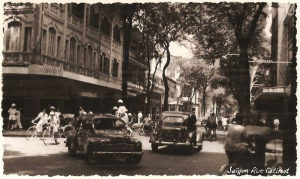
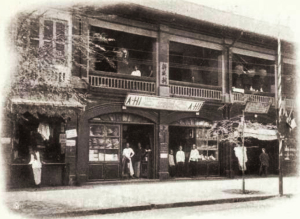
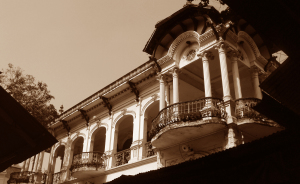
The “Grand Hôtel et Bar Catinat” at 93-95 rue Catinat in the early 1950s

These included the fashion shops Courtinat and Tournier et Cie, the Société Industrielle d’Exportation en Extrême-Orient (SINDEX) which sold chain saws, machine tools, jacks, pumps, dynamos and electric motors, and the Société Phonique d’Extrême-Orient, which sold gramophones and gramophone records.

In around 1927 or 1928, a M. Barthélemi transformed the entire ground floor of the building into the “Bar Catinat,” one of the most popular watering holes of its day, which became famous in the 1930s for its soirées de boxe (boxing nights).

IMAGE 3

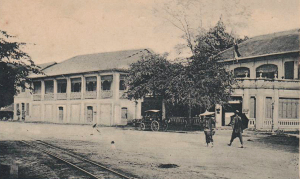
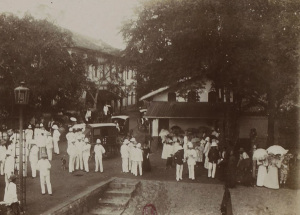
The “Hôtel l’Impérial” at 93-95 Tự Do street in the late 1950s

During this period, the upper floors of the building continued to be used as office space. However, in the early 1940s, a M. Bonelli, the Corsican co-director of one of its tenants, the Plantation Pierlovisi, took ownership of the whole building, turning offices into hotel rooms and transforming the Bar Catinat into the “Grand Hôtel et Bar Catinat.”

After the departure of the French, the Grand Hôtel et Bar Catinat” reopened under Vietnamese ownership as the “Hôtel l’Impérial” at 93-95 Tự Do street. However, just a few years later the hotel closed and the name changed yet again to “Café and Bar l’Impérial.”

IMAGE 4

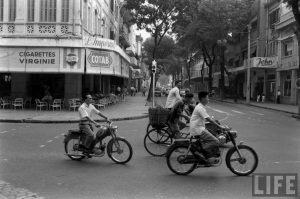
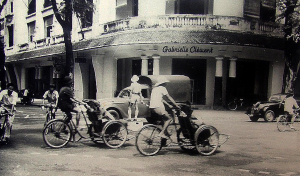
A Life magazine image of the “Café and Bar l’Impérial” at 93-95 Tự Do street in 1961

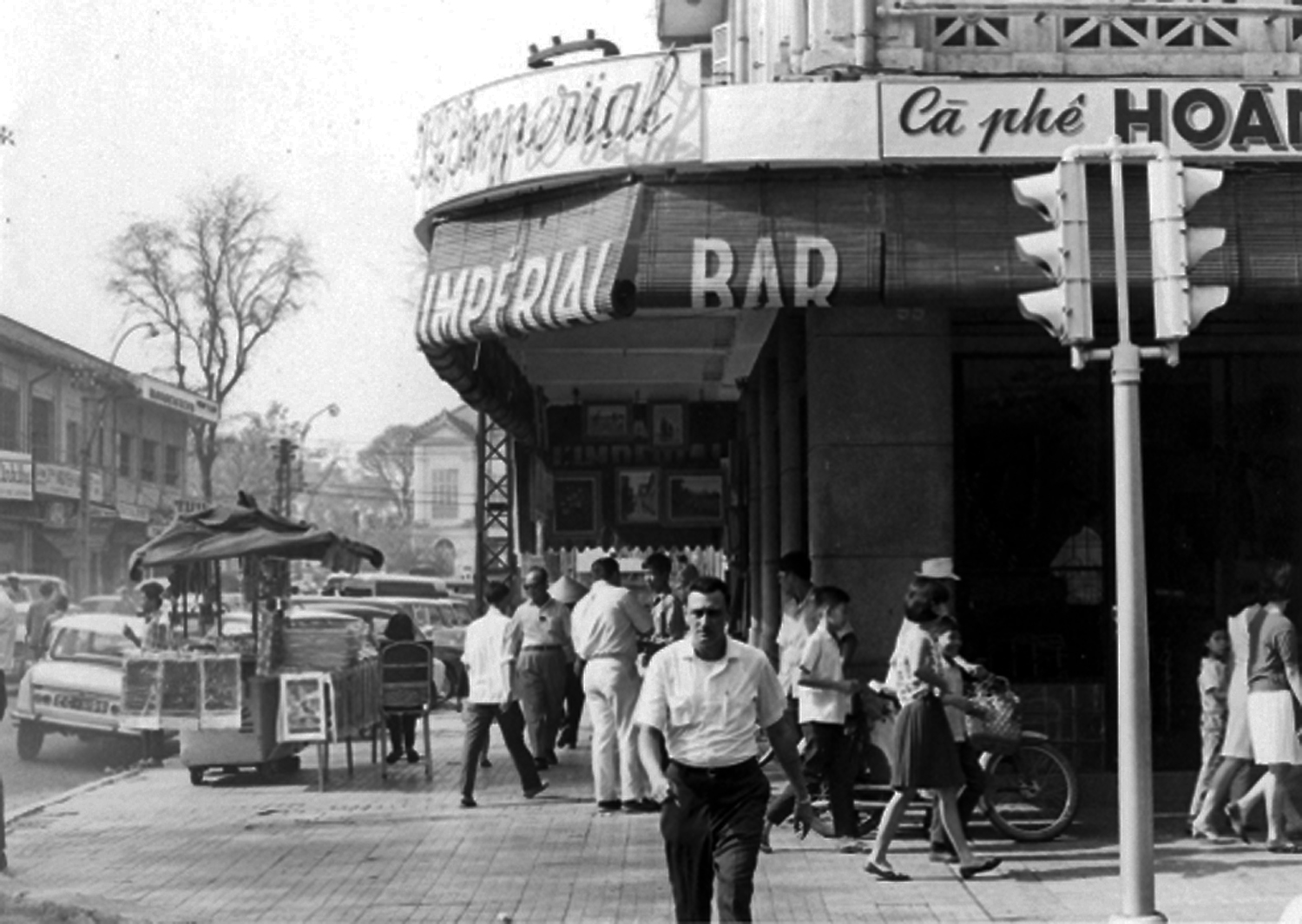
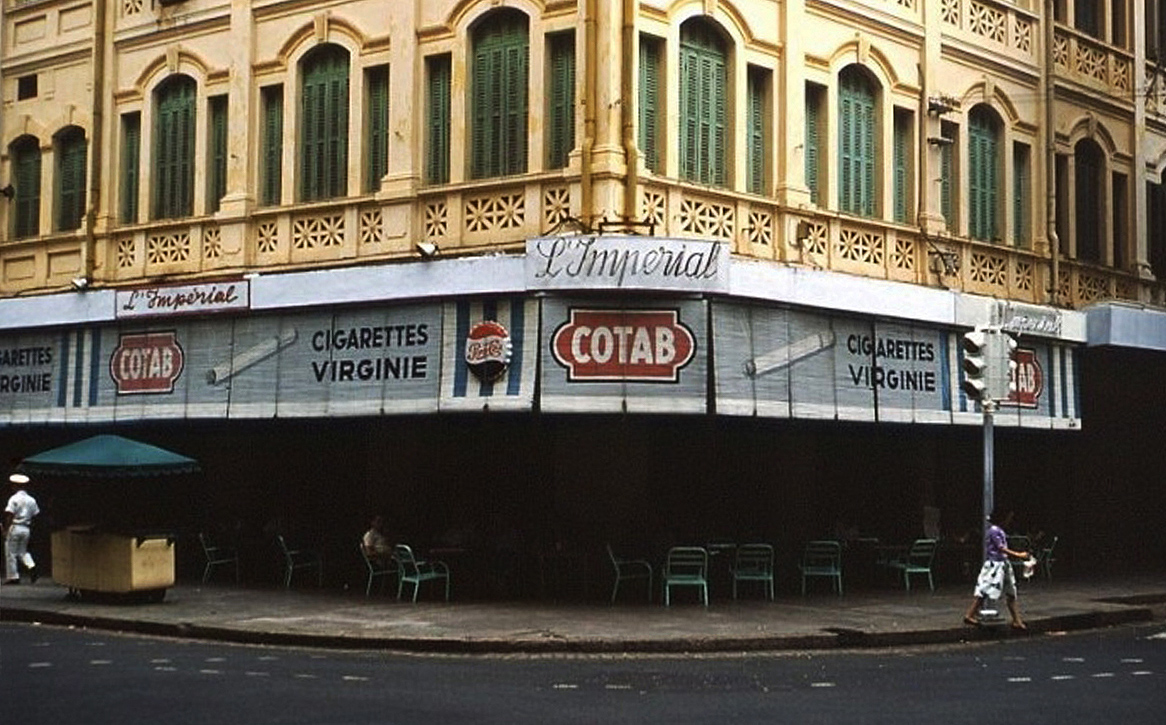
As the American presence in Saigon increased in the 1960s, the Café and Bar l’Impérial became a popular meeting spot for GIs, and was thus targeted on several occasions.

One account of a grenade attack on the building in 1963 describes it as “a little French open-air corner bar… classic French, tile floor, zinc top bar, uncomfortable stools, bistro menu, maybe a dozen tiny tables open to the street on two sides, ancient Vietnamese waiters in khakis, white shirts and flip-flops, no girls…”

Since 1975, 93-95 Đồng Khởi has been used for a variety of purposes, but in the early 1990s it became home to its current occupant, the Vietnam House restaurant.

IMAGE 5

Another 1961 image of the “Café and Bar l’Impérial” at 93-95 Tự Do street (John Proe Collection, Vietnam Center and Archive)

IMAGE 6

A 1962 image of the “Café and Bar l’Impérial” at 93-95 Tự Do street (Barry M’s Gallery)

Tim Doling is the author of the guidebook Exploring Saigon-Chợ Lớn – Vanishing heritage of Hồ Chí Minh City (Nhà Xuất Bản Thế Giới, Hà Nội, 2019)

A full index of all Tim’s blog articles since November 2013 is now available here.

Join the Facebook group pages Saigon-Chợ Lớn Then & Now to see historic photographs juxtaposed with new ones taken in the same locations, and Đài Quan sát Di sản Sài Gòn – Saigon Heritage Observatory for up-to-date information on conservation issues in Saigon and Chợ Lớn.

Saigon Through the Eyes of Early Travellers – Arthur Delteil in 1882, Part 3

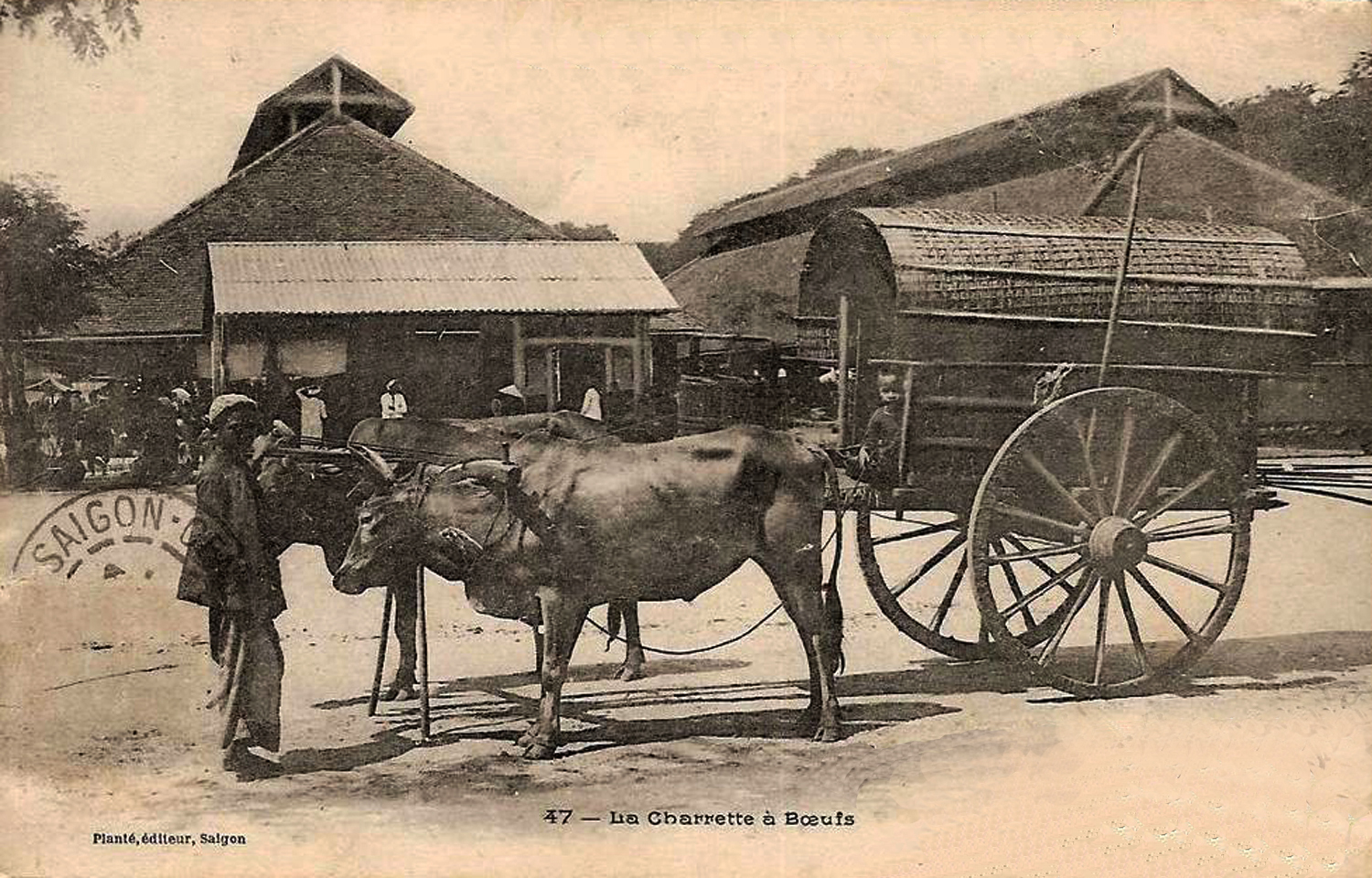
Buffalo cart and Charner market i

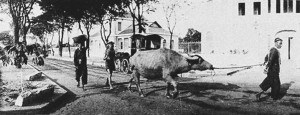
A buffalo cart stands in front of the old market on boulevard Charner (now Nguyễn Huệ boulevard)

In March 1882, Arthur Delteil, retired Chief Pharmacist of the Navy, left Marseille on the Messageries maritimes vessel Oxus and travelled to Saigon, where he stayed for a year. This is the third of three translated excerpts from his book Un an de séjour en Cochinchine: guide du voyageur à Saïgon, published in 1887.

To read part 1 of this serialisation click here.

To read part 2 of this serialisation click here.

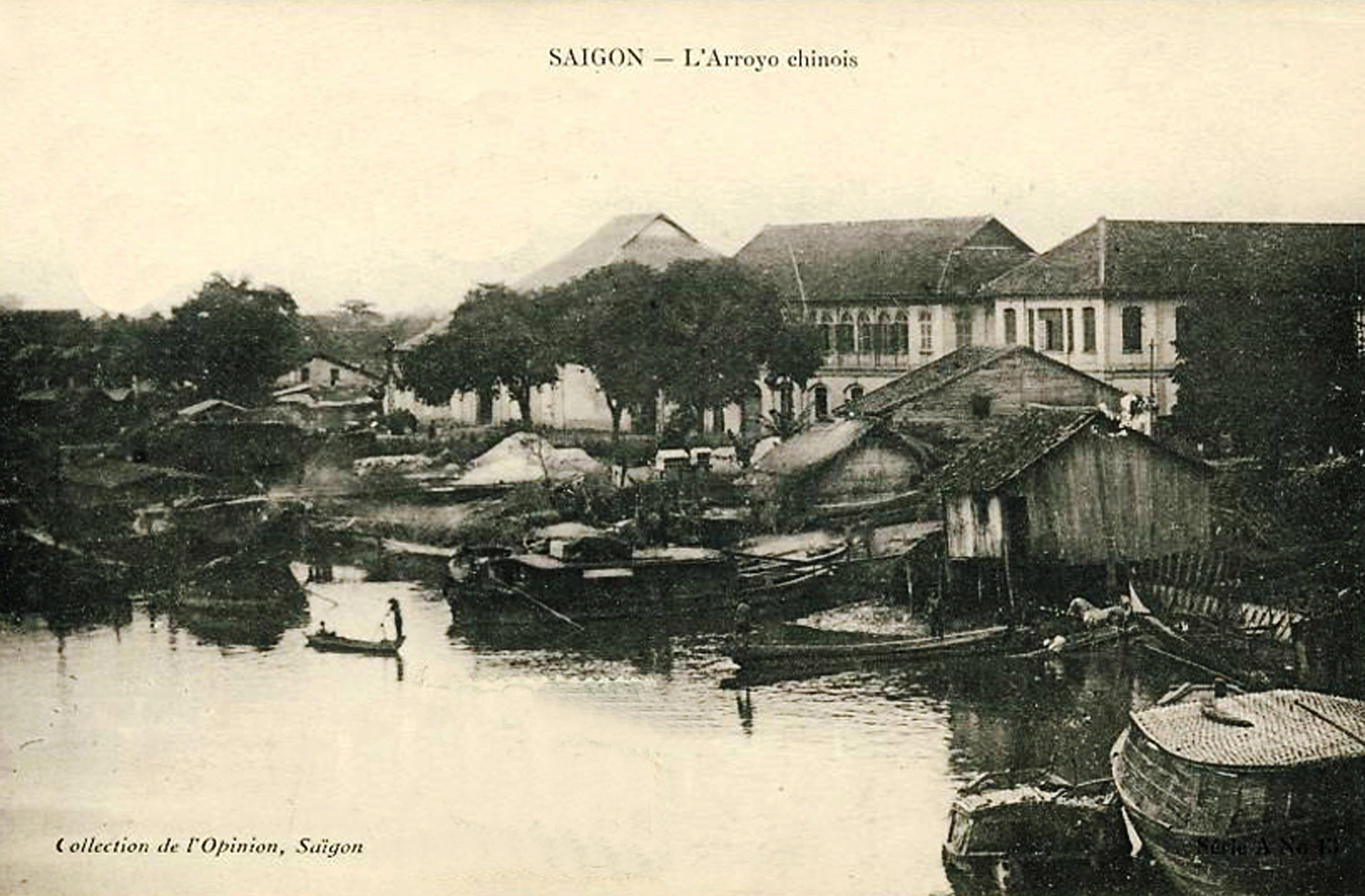
From the end of the arroyo Chinois which opens into the Saigon River, we will first cross boulevard de Canton [Hàm Nghi] where may be found the homes of several wealthy Chinese merchants, low wooden houses with no more than two storeys, designed in the particular style of this nation.
4498253703_09c39e679f_o

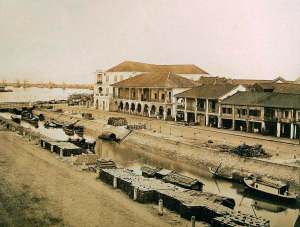
The Grand Canal (now Nguyễn Huệ boulevard), the lower section of which survived until 1890

Then we cross a bridge over the Grand Canal, which leads some 200 to 300 metres into the city. On the right and left sides of this canal are the quai Charner and the quai Rigault de Genouilly, and it is on the latter that the city market was built. It occupies considerable space and is divided into four large covered compartments: one is for fish, another for fruits and vegetables, the third for poultry and meat, and the fourth for small industries and local restaurants. The market is frequented by a large crowd of Chinese and Annamese of both sexes, who buy food and often consume it on the spot at their convenience.

In the fish hall, one may see large water tanks filled with live fish; those caught in the arroyos are mud coloured and have a viscous appearance which makes them rather uninviting. Only the Annamite population consumes them; in the language of the country, they are called ca-ro, ca-lac, ca-bong, ca-chiai, ca-gay, ca-hop, ca-tre, ca-tien and luong (eel).

Marine fish, caught in deep waters off Cap Saint-Jacques, have a more appetizing appearance. We may buy many fine species of saltwater fish here, including tuna, mullet, bream, shad, sardine and anchovy. The market also sells delicious clams, winkles, oysters, crabs, prawns and lobsters, which are not inferior in any way to those of Europe. Fish are also caught each year in the great lakes of Cambodia for drying, and these occupy an important place in the market, because they are the basis of Annamite food. These are also used to make nuoc-mam, which I will describe later.
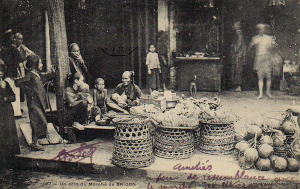
4498250979_dd6bf767f1_o

A corner of the old market on boulevard Charner (now Nguyễn Huệ boulevard)

The fruit and vegetable market contains a great variety of products, including bananas, mangoes, mangosteens, cucumbers, cabbages, asparagus and lettuce.

In the meat section, pork dominates; it is of good quality and comes from rather small animals with curved spines and bellies which drag on the ground in a rather unsightly way. The beef costs 7-8 sous per pound and its quality is not bad; eggs cost a few sous per dozen. Game and poultry are very abundant: ducks, green pigeons, plump capons, wild roosters, peacocks, guinea fowl, snipe, quail, hares, wild boars … we are indeed spoiled for choice!

The most curious part of the market is the section devoted to food, and in particular the Chinese food stalls. There you will find a huge variety of the special dishes which are consumed by local people, including every different kind of rice and noodle dish, pastries, roasted duck and suckling pigs adorned with large red peppers. The consumers throng around the stalls and choose from among 10 or 12 dishes which have been spread before their eyes. These are served on small plates and consumed with the aid of small chopsticks which are manipulated with remarkable dexterity. One particular dish which I saw looked very appetizing; this was a small omelette, inside which the cook placed two or three shrimps, tender bean sprouts and two or three other substances I could not recognise.
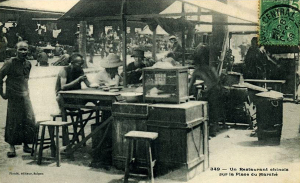
4533174701_f142d72ba1_o

A Chinese food stall near the old market on boulevard Charner (now Nguyễn Huệ boulevard)

I was particularly interested to see an old woman making pancakes; instead of using a skillet, she took hold of a piece of stiff dough with two small wooden chopsticks and then held it above her stove. At every moment it seemed that the dough, sometimes swollen and sometimes stretched beyond measure, would fall into the fire; but not at all, she handled those small chopsticks with such skill that the pancake was cooked perfectly, with a delicious golden yellow appearance.

In the evening, the market is surrounded by open tables topped with Chinese lanterns which spill out onto the sidewalks. It is here that jolly feasts take place where Annamite people, essentially following their mouths, have a field day. This is a very funny show and I attended frequently. One never sees arguments, all we hear is laughter.

Leaving the market through the front door, we note the Malabar moneychangers squatting on their heels behind stacks of piastres, rupees and sapeks. The latter is the metal Annamite coin; it is made from zinc with a hole in the centre so that bunches of coins can be strung together. It takes 600 sapeks to make a ligature, which is equivalent to 0.80 Francs.

We continue our journey along the quayside, passing on our left the beautiful three-storey building constructed by a rich Chinese named Wang-Taï, and currently occupied by the Administration of Indirect Contributions.
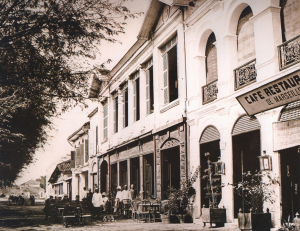
1882

Riverside cafes on the quai du Commerce (now Tôn Đức Thắng street)

Then we pass a row of riverside cafés, which are arranged just like their European counterparts. Here we may see young ladies of dubious virtue – many of whom came to Saigon with visiting French theatre groups and decided to stay on – serving beers and vermouths to their customers.

Nearby are the facilities of the Messageries fluviales, which has a fleet of steam ships of all sizes, perfectly fitted for hot countries. These ships transport passengers and goods to Tonkin, Cambodia and all intermediate stations. Still following the river, one reaches the Port Directorate, opposite which is moored an old demasted vessel known as the Tilsit, which is used as a pontoon and barracks for sailors; then come the Naval Stores, the Artillery and the Arsenal with its floating dock, where steamships are repaired and small boats built. The Arsenal, which occupies an area of 22 hectares, has not, for the moment, the importance it might have. In future it will become necessary to construct dry docks and provide this installation with all other necessary equipment to repair and maintain a powerful fleet. The recent events in Tonkin probably oblige the Government of the mother country to realise this project which has been studied for so long.

Travelling up the boulevard de la Citadelle, we pass the Sainte-Enfance, which receives orphans and children abandoned by their parents; the Collège d’Adran, run by the Christian Brothers; the St Joseph’s Seminary, led by priests of the Paris Foreign Mission Society; the Carmelite Convent, occupied by unfortunate nuns who it seems came to this deadly climate looking to intensify their already harsh discipline; and finally the Zoological Gardens, facing the arroyo de l’Avalanche [Thị Nghè creek].
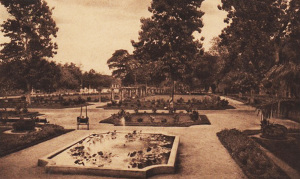
Jardin botanique la pergola

The Zoological and Botanical Gardens

This wonderful garden, where all the useful plants of Lower Cochinchina and neighbouring countries are gathered along with the main wildlife specimens living in the colony, was established and organised by M. Pierre, a native of La Réunion endowed with an undeniable zeal and dedication to science.

All to which art and good taste can give birth with limited resources has been created in this garden, which on weekdays is the popular rendezvous of the Saïgonnais. It its elegant birdhouses we may see most of the bird species indigenous to Cochinchina, including cranes, marabous, peacocks, vultures, pheasants and swamp hens. Nearby is the monkey palace, which contains a young chimpanzee with a frightening resemblance to a human; and further along, cages containing tigers, jaguars, bears and snakes. In the parks, deer roam freely. Pelicans and other waterfowl swim on miniature lakes. On the south bank of the arroyo de l’Avalanche, a large area has been set aside for visitors to enjoy this beautiful river, covered with Chinese bridges and traversed by junks and sampans.

Leaving the Zoological Gardens, we pass on our right the Naval Stores and arrive, via the rue Tabert, at the Citadel. It has the shape of a square, each angle of which terminates in a pentagon. Its parapets are surrounded by a broad ditch without water. It is, in fact, a rather formidable fortress.
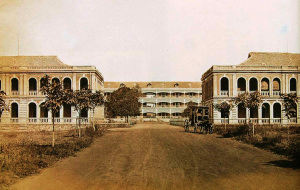
3888736098_f1256cf13e_o

The Marine Infantry Barracks, built on the site of the 1837 Citadel in 1870-1872

It was built in 1790 by French officers during the reign of Emperor Gia Long [this is incorrect; the Citadel occupied by the French was built in 1837 during the reign of Minh Mạng to replace the larger 1790 citadel]. Within the walled enclosure we built a magnificent Marine Infantry Barracks of iron and brick, where our soldiers may find the comfortable and hygienic conditions which are so necessary for Europeans in these hot and humid regions. They are housed in superior buildings and very well nourished. We must offer the military genius responsible for these barracks the fair praise he deserves for having designed buildings which are so well adapted to the needs of the climate.

Continuing along the rue Tabert, we arrive at the Military Hospital, also worthy of the admiration of foreigners. It strikes the eye with its beautiful proportions and the perfect intelligence that governs the distribution of all the parts that make up the whole. More praise to the officers of Marine Engineering Corps!

One is particularly inspired by its beneficial system of separate pavilions, which were built, like the Marine Infantry Barracks, of iron and brick. The Military Hospital extends over a wide area and includes all the facilities that we are accustomed to seeing in larger French establishments of the same kind. Absolutely nothing has been neglected, so that our soldiers and our sailors may enjoy the best possible conditions to speed their return to health.
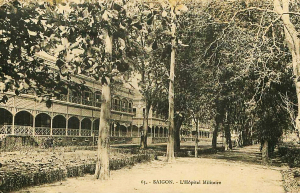
4919069256_0957bd006f_o

The Military Hospital, today a Children’s Hospital

I made a long visit to the sisters of the Hospital, with whom I was destined to stay for some time. In the parlour that serves as their living room, I met Mother Superior Benjamin, who did not seem to feel the fatigue of her 20 years of Cochinchina, along with five or six other sisters who welcomed me with affability and motherly kindness. I was moved to tears; I felt that I had found a family. When illness descends upon you, as happens so often in our unhealthy colonies, especially in Cochinchina, you are always assured of meeting with these excellent creatures, who not only provide constant and delicate care, but also to offer the consolation which only women know how to give.

Let me mention above all Sister Germaine, the nun responsible for the officers ward, all for the good, I think! It was providential that she entered the Military Hospital, for never has the Christian religion produced a more accomplished woman. Her face of angelic sweetness and her inexhaustible goodness have made her extremely popular in Cochinchina. Her name is pronounced with respect and tenderness by many officers who have received her care, and not one of her former patients will pass through Saigon without visiting this holy woman and giving her a little present.

I also visited Father Thinselin, the hospital chaplain, who combined the size of a battleship and the beard of a sapper with a face of a childish sweetness. This colossus was a true friend of his patients and all those who attended the hospital.

IMAGE 5

The Cercle des Officiers, now the District 1 People’s Committee building

On leaving the hospital, we travelled along boulevard Norodom, a wide and busy thoroughfare which is home to the Hôtel du Général, the Cercle des Officiers, the Cathedral, and right at the other end, the Palace of the Governor.

The Cercle des Officiers is a large two-storey building which owes its existence to the munificence of a Governor, who had it built in order to create a meeting place for officers of all arms. The ground floor is devoted to the marine infantry officers’ mess. On the upper floor there is a library, a reading room, a billiard room and a bar. The subscription is one piastre per month.

Close to the Cercle is a rather ugly bandstand, in which a military band plays twice a week. On those days, all the elegant people of Saigon love to promenade along this boulevard. They travel in carriages, they walk, they engage in conversation, they laugh. One could believe oneself to be in any of those cities of France where military music always draws crowds of people.

The Cathedral, which faces the rue Catinat, is far from being a pretty monument. Built entirely of brick, its great mass sitting on granite bedrock, it recalls one of those heavy pastries that are commonly referred to as pâtés. This pretentious and ugly building cost the colony several million.
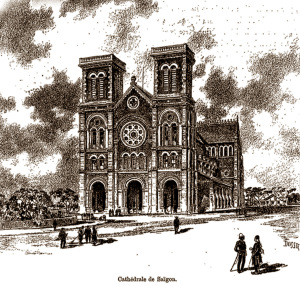
Cathedral no spires

The Saigon Cathedral before spires were added in 1897

Externally, it has the shape of a long rectangle bounded by two square towers and a portal. Inside, the nave is wide and very hot, since fresh air does not penetrate; it is almost like entering a diving bell. Instead of a light, elegant church with a double gallery to permit air to circulate freely, they constructed a large building without taste and without style, far too big for the small number of faithful who attend mass. It seems that they wanted to capture the imagination of the Annamites with the imposing spectacle of a grandiose church building dedicated to the Christian God; I do not know if they succeeded. But in my opinion, the design of this church is lacking.

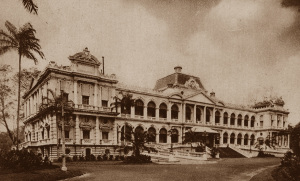
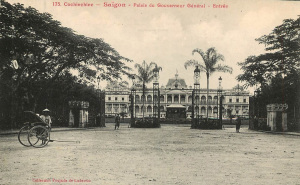
The Palace of the Government, on the contrary, is a monument worthy of the capital of our future colonial empire in the Far East. It strikes the eye with its purity and the simplicity of its lines, as well as the beautiful proportions of its architectural mass. It quite reminds one of the Palais de Florence with its white colonnades. Located at the end of a beautiful park, the dark green colour of which highlights the whiteness of the marble facade, the palace may be seen from afar.

The two most noteworthy parts are the vestibule and the events hall, which are in no way inferior in their richness and ornamentation to any of those that we admire in our most famous Parisian palaces.

The vestibule, which is accessed by a grand marble staircase, is circular in shape, decorated with a profusion of tropical flowers and plants.
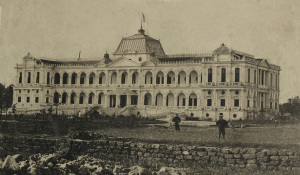
Norodom Palace i

The Palace of the Government

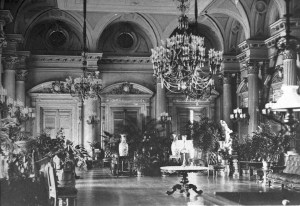
The events hall, which can hold up to 800 people, has a grand appearance. Its rich ceiling, consisting of boxes with gilded mouldings, is supported by columns of the finest style; on each side are galleries which allow air to circulate throughout, and at the end a rotunda balcony which overlooks the park. When the room is lit and decorated for a reception or a great ball, we can see nothing more beautiful and more imposing.

Behind the palace is the Jardin de ville (City Park), a huge park of virgin forest which becomes very busy on Sundays at the time of “la Musique” [a Sunday afternoon military band concert].

On days such as this, the Jardin de ville becomes the “Bois de Boulogne of Saigon.” Between 5pm and 6pm, the carriages are so numerous that they have to file in two rows, at walking pace. This is the rendezvous of all of Saigon’s belle société, a veritable assault of fashion and elegance. Among the crowd are the pretty Congaïs, wearing rich silk clothing. We can get a good idea of the elite crowd which attends “la Musique,” a weekly promenade which has now become a regular event in the lives of the population.
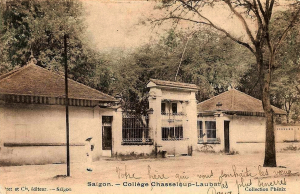
IMAGE 3

The Collège Chasseloup-Laubat, now Lê Quý Đôn High School

Leaving the gardens of the Palace of the Government, we continue up to the rue Chasseloup-Laubat where the College of the same name is situated. This institution receives young Annamites from good families who are taught the French language and elements of our science and our arts. They are intended primarily for careers as government interpreters. There is also, on the rue d’Espagne, a secular school for the children of Europeans, and on the rue Nationale, a school run by the priest of Saigon where indigenous and mixed-race children are taught.

Now let’s conclude our journey of exploration through the city by travelling down the rue Catinat, the busiest and most hectic street in Saigon.

It is in this street that we find most of the public institutions: the Treasury, the Post and Telegraph Office, and the Department of the Interior, along with the residence of its Director; these latter two monuments are veritable palaces. Further down, we find the Hôtel Favre, which I have already mentioned, the Hôtel de Ville (Town Hall), which has no special character, the Theatre, and then several cafés, Chinese and European stores and clubs. The street is filled with horse-drawn carriages of all descriptions, Annamite rickshaws, and both Chinese and Annamite pedestrians who circulate all day long in crowds, producing scenes of great animation.
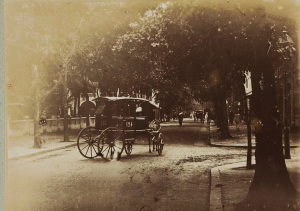
1895 rue Catinat

A Malabar carriage on rue Catinat (modern Đờng Khởi street)

The rue Nationale, which follows rue Tabert and boulevard Norodom, is also full of noise and movement. Other areas of the city have little which is worth mentioning.

Private houses are nearly all built on the Bourbon model, either of brick or wood. They are rarely more than two storeys in height and are usually composed of a main building with a courtyard and garden, decorated with a verandah in front and behind. Usually buried in the midst of a clump of greenery, they have a graceful and stylish appearance, with large and airy interior rooms. Down towards the lower part of the city, there are many houses built of brick in the European style, which serve both as shops and as housing to the traders.

The city’s drainage system leaves nothing to be desired; it is so comprehensive and well-designed that the torrents of water which inevitably follow the storms of the rainy season seem to vanish in just a few hours.

The supply of water in homes and on street corners, where good fountains and pumps are located, is provided by an elegant Chateau d’eau (water tower), built at the top of the rue Catinat extension. Abundant groundwater which has been percolated through the sands of the Plain of Tombs is brought together in a vast underground aquifer. From there, a powerful steam pumping apparatus conducts the water to the top of the water tower, whence it is distributed to different parts of the city.
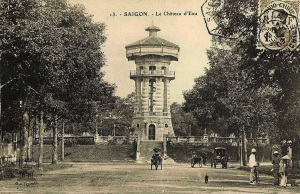
C d'eau 1

The Water Tower which stood on the modern Turtle Lake intersection until 1918

Outside the boulevards, the public gardens, the squares and the parks that I mentioned, there are still, in the vicinity of the city, some charming promenades which are well frequented by city dwellers in the evenings after sunset: these are the Tour de l’Inspection and the Route de Cholon.

The Tour de l’Inspection involves a tour of the city. It leads you along a wide and well-maintained road, lined with trees, past beautiful houses, cultivated fields to the Inspection de Gia-Dinh, the residence of an Inspector of Native Affairs and an important centre of population.

There’s nothing as graceful as this small town, which quite reminds one of a clean and well-maintained European village. All the carriages stop here, then they resume their journey and pass through villages, rice fields and bridges over the arroyos.

In the summer months, from 5pm to 10pm, this route is crowded with horse-drawn carriages, which pass each other and weave their way through crowds of walkers who lazily and blissfully enjoy the fresh air.

1867

The Pigneaux de Behaine Mausoleum (demolished in 1985)

A little further on, located in a very picturesque spot, is the tomb of the Bishop of Adran, M. Pigneaux de Behaine, who died in 1779. The Bishop, who played a major role in the last century during the reign of King Gia Long, was buried here under the care of his royal friend. After giving him a magnificent funeral, the king built this beautiful monument of Annamite art.

The road to Go-Vap, which passes through some of the best-cultivated and richest areas around the city, is another well-frequented promenade. It’s here that one can see those little Annamite houses on plots of one hectare surrounded by trees where they cultivate tobacco, corn and sugar cane. They bring to mind those fragmented farms in some parts of the French countryside which are equally well cared for by our farmers.

The two roads which lead to Cholon, 5 or 6 kilometres west of Saigon, are also a favourite promenade for carriages. The first, which is accessed from the upper part of the city, is the route Stratégique; it is wide, comfortable and the more attractive of the two. The countryside along this route is beautiful and well cultivated; Annamites of high class live in small and pretty domains, where their houses disappear amidst a tangle of mango, banana and areca nut trees.
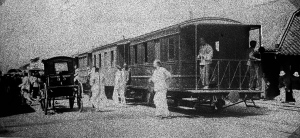
Le chemin de fer Saïgon-My Thô Maison Asie Pacific (MAP)

A Saigon-Mỹ Tho train calling at Chợ Lớn station

A short distance from the city, there is a model farm known as the Ferme des Mares, where we are carrying out research into the cultivation of cane, indigo and coffee, which to date have not given very brilliant practical results.

The second road to Cholon runs along the entire length of the arroyo de Chinois; it passes through several Annamite villages which teem with a very dense population, and leads to the Hôpital indigène de Cho-Quan (Cho-Quan Indigenous People’s Hospital), which receives Annamites and Chinese of the poor class.

Those who have no carriage can reach Cholon in only 20 minutes by taking the steam tram that leaves from the bottom of the arroyo Chinois, or the newly-built railway which now goes all the way to Mytho.

After visiting the city of Saigon in all its details, I went to see Cholon, a city of 50,000 souls, exclusively inhabited by Chinese and Annamites. This is the most commercial city of Cochinchina, a great marketplace for rice, silks and teas. I arrived at 9am on a day of great celebration and went directly to the Inspection, where I received hospitality. Outside was a procession preceded by musicians beating tom-toms, clashing cymbals and playing horribly piercing flutes. It was abominable, discordant music, without rhythm and without musical theme. All one could hear was the piercing noise.
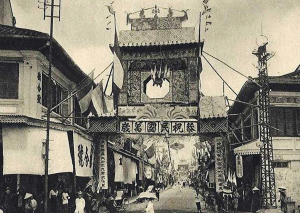
4763230046_19ecf945c7_o

Rue de Canton (now Triệu Quang Phục street) in Chợ Lớn

After the orchestra came a group of little girls aged 6 to 7 years, adorned with magnificent costumes, their faces heavily made up, mounted on richly decorated platforms raised aloft by pages in bizarre and colourful outfits.

Other small girls were grouped together on floats, sitting in front of tables laden with dishes or doing various small handicrafts. Behind them walked guards carrying fantastic weapons and wearing brilliant costumes; others held banners, parasols and huge fans. Then came the penitents, monks in saffron robes, followed by the literati, venerable old scholars in glasses. And finally the procession of the dragon. The parade lasted half an hour. To close the ceremony with dignity, firecrackers were exploded in profusion. The whole thing was very original, but it would have been necessary to stand next to an interpreter in order to grasp the real meaning of the procession, which for us seemed more like a mascarade than a religious festival.

The city of Cholon is very much a Chinese city; it is devoted exclusively to trade, and the streets near the arroyo Chinois, covered with many high bridges, are full of shops that sell all kinds of special food for Chinese and Annamite consumption.
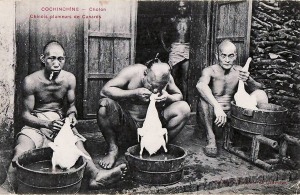
4722781721_acff7ccdd4_o

Chinese duck merchants in Chợ Lớn

Traders from the Celestial Empire, naked to the waist, with plump bellies and noses adorned with large spectacles, sit in front of their shops taking care of business. The accountants among them move their nimble fingers across their abacus, with which they perform the most complicated calculations.

Through a nearby doorway, I saw a Chinese schoolteacher surrounded by a gang of mischievous kids who were making a thousand efforts to appear attentive to their lesson. Further along the arroyo I passed several large rice husking factories, owned by French businessmen but run in collaboration with the Chinese.

I briefly entered the Central Market, which sold the most varied products ranging from fish and rice to clothes, shoes, books, mirrors and fabrics of all kinds.

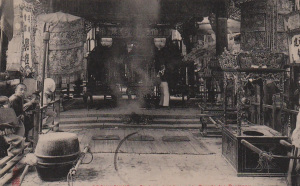
My curiosity was aroused when I saw a Chinese pagoda surrounded by a dense crowd of people. I entered and found its main hall packed with a mob whose gaiety seemed decidedly out of keeping with the respect due to a place of worship. Cake and sweet sellers had set up stalls here, surrounded by eager customers. The ceiling in this hall was decorated with a multitude of gaudy lanterns of the worst possible taste; were these votive lanterns, or had they been installed just for the festival?
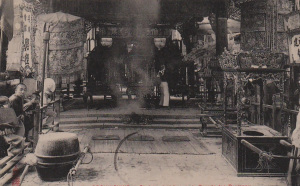
029_001

The interior of a Chinese temple in Chợ Lớn

Leaving this noisy room, I entered the main sanctuary of the temple. At the entrance was the horse of the Buddha, which resembled a harmless quadruped, its attitude recalling nothing of its divine role in Chinese religion. At the rear of the sanctuary were shrines decorated with statues, candles and sacred urns. A priest looked at me good-naturedly and seemed not the least bit scandalised by my mocking smile which was inspired by the sight of the big-bellied Buddha, enthroned amidst the lesser gods that surrounded him.

An old woman kneeling on the steps of the shrine burned josticks before the images of her gods and made an offering to the priest, who responded by turning his prayer wheel at the feet of the divinity, thereby taking care of her wishes. Such a simple and uncomplicated system! However, the crowd seemed to delight more in the first enclosure than in the sanctuary, as the few devotees in the latter appeared to have a distracted air and soon rushed back to the noisy party to see what would happen next.

In the afternoon, a carriage drove me to the Cay-Mai ceramics factory, located next to a military barracks of the same name [the former Cây Mai Pagoda] occupied by a company of marines. To get there, we crossed an area of barren land scattered with Annamite mounds and tombs resembling headless sphinxes.

L0055713 Cochin China [Vietnam].

The Plain of Tombs

A cadaverous stench coming from a freshly dug grave suddenly filled me with nausea; the Annamites have, in fact, the bad habit of burying their dead in ground of very little depth, so that the putrid fumes of decay spread easily throughout the area, to the great detriment of public health.

The Cay-Mai ceramics factory consists of a long low shed covered with a roof of reeds and a brick oven. The Chinese workers here artistically manipulate the clay that is drawn from the soil and give it a variety of forms according to their own imagination or the needs of their customers. In general, the objects produced by this factory – mainly vases and household utensils – are of rather coarse quality. However, some of the Cay-Mai ceramic artists are endowed with a greater ability and create groups of figures or plates and vases decorated with crabs or fish that do not lack character. What a surprise it was to see how, with such rudimentary means, they were able to make relatively fine objects.

Above the main workshop area I saw a balcony containing the modest bunk beds used by the workers of the factory. Nothing can give a better idea of the minimal requirements of the Chinese worker. He works hard and never complains; he also saves hard and contents himself with the bare essentials of clothing, food and housing. Despite this, he always seems happy and contented.
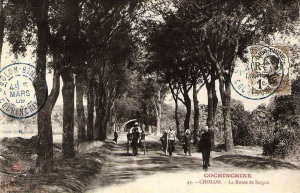
5813761451_060a401667_o

The “High Road” which led from Saigon to Chợ Lớn

How different he is to the workers of our major cities, who are in general so exacting and so unscrupulous! It seems that the Chinese, who we so often treat like an old and corrupt race of barbarians, have long since solved the social problems that we have pursued in vain for so many years. When we know better the manners and habits of this people, we will, no doubt, draw from them lessons in wisdom, moderation and social organisation.

I returned to Saigon by carriage along the road through Choquan. As I left Cholon, I was pleasantly surprised by the sight of many wonderful vegetable gardens, cultivated with talent and expertise by Chinese gardeners, where delicious vegetables such as lettuce, cabbage and asparagus are grown largely for the Saigon market.

However, since time immemorial, these people have used human manure to fertilise their crops, a
scarcely aromatic treatment which has the serious drawback of spreading intestinal worms, whose eggs are well spread over the vegetables we eat.

I stop for a moment to shake hands with the Navy doctor who heads the Choquan Hospital, and then head back to Saigon, delighted with my journey and all of the interesting things I have seen.

Tim Doling is the author of the guidebook Exploring Saigon-Chợ Lớn – Vanishing heritage of Hồ Chí Minh City (Nhà Xuất Bản Thế Giới, Hà Nội, 2019)

A full index of all Tim’s blog articles since November 2013 is now available here.

Join the Facebook group pages Saigon-Chợ Lớn Then & Now to see historic photographs juxtaposed with new ones taken in the same locations, and Đài Quan sát Di sản Sài Gòn – Saigon Heritage Observatory for up-to-date information on conservation issues in Saigon and Chợ Lớn.
Date with the Wrecking Ball – Former Cercle des Officiers, 47 Le Duan, 1876

IMG_2196

The District 1 People’s Committee Building, originally the Cercle des Officiers

This article was published previously in Saigoneer http://saigoneer.com

In November 2014 it was announced that another old French civic building, featured earlier this year as an “Old Saigon Building of the Week,” would be redeveloped.

The colonial pile at 45-47 Lê Duẩn, right opposite the Diamond Plaza, is one of the oldest surviving French buildings in the city.

Le Cercle des officiers -1870s

The Cercle des officiers in the late 1870s – note the Cathedral under construction in the background

It was built in 1876 at the command of Rear Admiral-Governor Victor Guy Duperré (30 September 1874-30 January 1876) as the Cercle des Officiers or Officers’ Mess, to provide social and recreational facilities for high-ranking members of the French armed forces. The no-nonsense design by the Cochinchina Department of Public Works, typical of the period, features a surrounding verandah and high ceilings to enhance ventilation.

Visiting Saigon in 1882, retired Chief Naval Pharmacist Arthur Delteil described the Cercle des Officiers as “a large two-storey building which owes its existence to the munificence of a Governor, who had it built in order to create a meeting place for officers of all the armed forces.”

Cercle des Officiers A i

The Cercle des officiers in the early 20th century

He continued: “The ground floor is devoted to the marine infantry officers’ mess. On the upper floor there is a library, a reading room, a billiard room and a bar. The subscription is one piastre per month.”

Between 1955 and 1975, the old Cercle des Officiers building was repurposed to house the South Vietnamese Ministry of Justice (Bộ Tư pháp).

Since Reunification it has served as the headquarters of the District 1 People’s Committee (Ủy ban Nhân dân Quận 1). However, on 17 November 2014 it was reported by VNExpress  that following an estimated windfall profit of over 6,000 billion đồng in the current year, the District 1 People’s Committee planned to proceed with the construction of a new administrative centre at 45-47 Lê Duẩn.

UPDATE: After an initial response to public concern which stressed that the building was not a historic, architectural, cultural or artistic vestige and therefore the redevelopment plan did not violate any regulations, an official of the District 1 People’s Committee pledged in an interview with Thanh Niên newspaper on 11 December 2014 that the old building will now be preserved and the new building constructed behind it.

EPSON scanner image

The Cercle des officiers in the 1880s

Mess des Officiers

Another image of the Cercle des officiers in the 1880s

Cercle des Officiers C i

The Cercle des officiers in the 1920s

SAÏGON - Cercle des Officiers

Another view of the Cercle des officiers in the 1920s

Saigon 1929 - Le Cercle des officiers

The Cercle des officiers in 1929

Ministry of Justice 1967 - 1968 i

In 1955-1975 the old Cercle des officiers building became the Ministry of Justice of the Republic of Việt Nam. It is pictured here in 1967.

Tim Doling is the author of the guidebook Exploring Saigon-Chợ Lớn – Vanishing heritage of Hồ Chí Minh City (Nhà Xuất Bản Thế Giới, Hà Nội, 2019)

A full index of all Tim’s blog articles since November 2013 is now available here.

Join the Facebook group pages Saigon-Chợ Lớn Then & Now to see historic photographs juxtaposed with new ones taken in the same locations, and Đài Quan sát Di sản Sài Gòn – Saigon Heritage Observatory for up-to-date information on conservation issues in Saigon and Chợ Lớn.
Saigon Through the Eyes of Early Travellers – Arthur Delteil in 1882, Part 2

4784925905_79c9343907_o

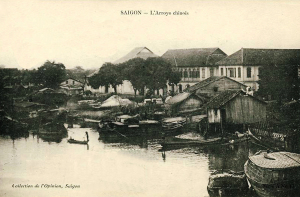
The “ville basse” or lower town viewed from the arroyo Chinois (Bến Nghé creek)

In March 1882, Arthur Delteil, retired Chief Pharmacist of the Navy, left Marseille on the Messageries maritimes vessel Oxus and travelled to Saigon, where he stayed for a year. This is the second of three translated excerpts from his book Un an de séjour en Cochinchine: guide du voyageur à Saïgon, published in 1887.

To read part 1 of this serialisation click here.

Le_Myre_de_Vilers,_Charles,_par_Otto_van_Bosch,_BNF_Gallica

Cochinchina Governor Charles Le Myre de Villers (1879-1882)

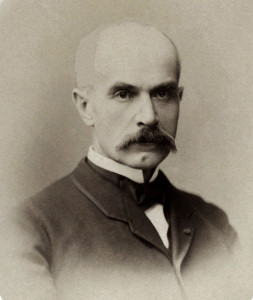
The day after my arrival, I went to visit the Governor of the colony, M. Charles Le Myre de Villers [Governor of Cochinchina 1879-1882), who is now the Résident général in Madagascar. He received me and my fellow travellers with the utmost cordiality and invited us to join him for dinner the next day.

That first interview and the very frequent ones which followed have stayed with me, as M. Le Myre de Villers was one of the most welcoming governors I have ever known. I would therefore like to share my personal impressions of the man.

M. Le Myre de Villers carried out the high functions with which he was invested with great energy and dignity. Industrious, well-educated, familiar with all administrative and colonial questions, skilled in business, seeing and studying everything himself, and never resting unless strictly necessary, he devoted all of his strength and intelligence to the service of colony, which he sought to administer in a wise and progressive manner. Approachable and friendly to hard-working people, yet hard on the lazy and disorganised, this is how the man has been variously judged in the colony.

One may say that this civil governor was greatly loved by European officials of the Navy, by important traders and by the Annamites, criticised by some senior civil servants whose pretentions and jurisdictions he sought to diminish, and cordially hated by a small coterie of ambitious yet talentless people who raised their voice in quarrelsome opposition.

Le_Myre_de_Vilers

Charles Le Myre de Villers visiting a provincial centre in 1881

Physically, M. Le Myre de Villers was then a man of 50, tall, dark haired and lean, though of robust constitution. His stern demeanour, with strongly accentuated features and pale complexion, brought to mind that of Otto von Bismarck, with whom he shared a square face, broad forehead, black sunken eyes in a very pronounced brow, and strong black moustache covering the upper lip.

What dominated his whole person was an air of authority and decision-making which made one believe from the outset that this former sailor knew exactly what he wanted and was able to enforce his will with indomitable energy. His courage was up to all situations. When it involved stifling an insurrection fomented by the Chinese and Annamese in a distant province, he went there accompanied by just a single aide-de-camp. Finding himself suddenly in the midst of the rebels, he bravely arrested the instigators of revolt, and very soon everything returned to normal. His presence and moral lead sufficed to achieve this result.

On the occasion of the last cholera epidemic, which raged so cruelly amongst the Annamite class, how many times did I see the Governor himself enter the villages which had been infected by this scourge to visit the sick who had been abandoned by everyone else, reviving them with good words and distributing to these poor people all the relief and medicines that they needed! In instances such as this, nothing could stop him, neither the fear of sunstroke in a country where the sun can kill you as surely and sometimes as quickly as a gunshot, nor the prospect of a forced march through a filthy swamp.

$_57 (6)

A village on the arroyo

He once said proudly that a colonial governor should be the first to place himself in danger, in order to set a good example to his officials and to the population; for only in this way would the Annamite people learn to love or at least to respect the nation that had conquered them.

M. Le Myre de Villers has often been described as a hardened authoritarian, yet this description of him is not quite accurate. He was a superior man of fixed opinions, who, for the successful completion of the work he had been commissioned to do, did not let himself be impressed by the clamour of a small clan of malcontents, nor by those who sought to impede improvements which were detrimental to their personal interests. In any case, isn’t every great man necessarily a little authoritarian? History tells us that. And in the last analysis, this Governor of Cochinchina was as good a diplomat and politician as he was a good administrator.

Only once did he fail to measure up to the task and was led to commit an act which in part caused his recall to France. Even in these circumstances, the metropolitan government supported him, because the initial damage did not come from his side, and it was felt that we should look twice before depriving such a large colony as Cochinchina, for such a trivial reason, of a Governor who had rendered such great services and was so appreciated. Attempts have since been made to remedy the injustice that was committed against him at that time, and he has recently been sent to La Réunion as Résident-general, a position which requires the utmost energy, capacity and patriotism.

Norodom Palace again A i

The Palace of the Government

M. Le Myre de Villers will, of course, be up to this task, and the Republic will not have to repent of having placed its trust in a man of such value. He will worthily represent France, forcing the Malagasy and foreigners to respect our protectorate and establish our influence in a country that we so often watered with our own blood, and from which our good friends the English would have us evicted.

In Saigon, the seat of his government, M. Le Myre de Villers had a simple way of receiving guests, which contrasted with the habits of his predecessors.

In the past, governors were content to give several grand formal dinners during the year to members of the Colonial Council, the main authority of the colony, but they rarely interacted with the “mere mortals” who were their constituents. However, M. Le Myre de Villers proceeded quite differently. He still received his Colonial Councillors in full regalia once or twice each year; but every evening he had at his table five or six guests chosen indiscriminately from amongst the civilian and military communities, ranging from simple sub-lieutenants and office clerks to generals and high administrators.

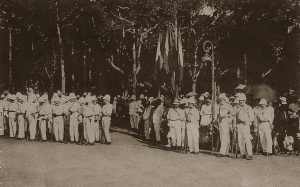
Here is how things usually went. One paid a first visit, which was always invariably followed by an invitation to return for dinner. So we went to the Palace of the Government in uniform or dressed in black. There, M. Le Myre de Villers, immaculately dressed in black coat and white tie and surrounded by his two aides-dc-camp, received us in the kindest way, with a hearty handshake.

Norodom Palace gates i

The front gate of the Palace of the Government on boulevard Norodom

At 7pm exactly, a maître d’hôtel came to inform the Governor that dinner was served and we went into the dining room. In the middle of the beautifully-prepared dinner table was spread a basket of flowers almost the size of a small flowerbed. Each diner was placed at table in order of precedence; this was one of the most difficult functions of the aides-de-camp. Dinner, without being excessive, was very delicate and worthy of the householder who received us.

The conversation was sometimes a bit cold, since some of the guests were not known to us, although the governor did his best to animate the conversation. But the essence of his character is very serious and he has little love for banalities, so that despite all the freedom of speech we enjoyed, everyone remained within the limits of respectful politeness.

After dinner we went into the events hall, which was decorated in a profusion of tropical plants, making it look almost like a greenhouse of colossal proportions. There were whist and écarté tables, and in the centre a large billiard table which was used to play cochonnet (a type of indoor boules), in which the governor excelled. He chose three willing opponents, and for half an hour he made windfall after windfall, soundly beating his novice companions in the art of this rather outmoded game.

ID_31901_building.JPG

The salle des fêtes (events hall) of the Palace of the Government

At 8pm, a dozen more people arrived to talk with the Governor. Like all great workers, he did not like to receive his staff in the daytime and waste his time in idle conversation. On the contrary, he reserved his evenings for all those who might have to speak to him. He devoted about 10 minutes to each person, talking in a playful and familiar way. Meanwhile, his dinner guests enjoyed greater freedom, playing card games, smoking and drinking cold beer which the Chinese servants brought frequently on trays.

At 10pm we took leave of the Governor; this was the time he set aside to plan new invitations for the following day.

We soon found that if we paid regular daytime visits to the Palace of the Government, we were pretty sure to be invited to dine there twice a month.

It was during these intimate evenings, in a relaxed environment and on “neutral ground,” that I was able to get to know the outstanding persons or notables of the colony.

Alleyron

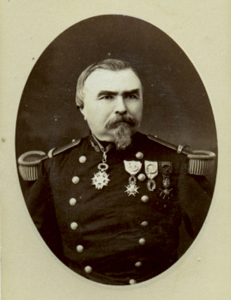
General Louis Eugène Alleyron (1825-1891)

People like General Alleyron, Commander-in-Chief of Troops, a friendly but rather sickly old man who had been posted here after a glorious career in the service of his country.

M. Belliard, Director of the Interior, who on his own merit and through his strong work ethic had risen from the modest position of sub-officer to the eminent position he now occupied. He was a cold, uncommunicative man, with an iron constitution that had already withstood 15 years of residence in the colony.

M. Bert, Attorney General, head of the judiciary of the colony, a kind and well-educated man whom I had known previously in La Réunion.

Dr. Chastang, Chief Medical Officer of the Navy and one of my old colleagues. He was an energetic man and an informed and conscientious doctor, thoroughly acquainted with the diseases in this country.

M. Sergeant, Chief of the Navy’s Administration Service, the most charming, jolly and healthy-looking of all senior officials of the colony. Despite spending several years in Cochinchina, he had retained a magnificent appetite and a robust state of health on which the climate of Saigon seemed to have no effect.

M. Cornu, Mayor of Saigon, one of those men who are indispensible to the colony: honest, hard-working, respected by all, a man of boundless devotion to the interests of a town he has lived in almost since the conquest. He and his younger brother made their fortunes mainly from the rice trade and are now two of the city’s leading businessmen.

Officers of the colonial infantry

Colonial marine infantry officers

M. Denis, the representative of a large trading house from Bordeaux, who like the Cornu brothers enjoys a prestigious position and a great fortune honestly acquired from his large commercial interests.

It was at the Palace of the Government that I also made the acquaintance of M. Nortel, Inspector of Indigenous Affairs, and now Governor of New Caledonia; Colonel Bichot, who has since won his General’s stars thanks to his brilliant conduct in Tonkin; and M. Silvcstre, who rendered such brilliant services in Annam and Tonkin by organising the civil administration there.

After completing my social duties, I formed a plan to visit the cities of Saigon and its neighbour Cholon. I will try to describe as quickly as possible the appearance of these two cities, their principal monuments and the most interesting places to see.

The present city of Saigon is scarcely 25 years old. When Vice Admiral Rigault de Genouilly seized Saigon on 17 February 1859, the Annamite city consisted of the citadel, the camp des Lettrés [the Trường Thi field where the triennial Mandarinate examinations were held] and some dirty and poorly-built huts scattered here and there in a mess that was far from being a work of art. Almost all of the area now occupied by the docks, the market, boulevard Bonard and the centre of the city was a vast swamp intersected by muddy arroyos.

It took the deployment of true creative genius to fill this swamp, firm the soil, dig sewers, create wide tree-lined boulevards with spacious squares and water fountains, and build elegant homes and remarkable monuments, in such a short period of time.

Road roller i

Surfacing boulevard Charner (Nguyễn Huệ boulevard)

To bring together all of these components and create a city which is partly oriental and partly European, elegant, beautiful, convenient to live in, full of life and movement and now occupied by a population of 35,000 souls.

It was the combined efforts of Admiral-Governors Rigault de Genouilly, Charner, Donnant, de la Grandière, Dupré and Duperré and Civil Governor Le Myre de Villers which brought about this rapid transformation. With their efforts, a muddy and filthy cesspool became one of the most beautiful and healthy cities of the Far East!

It took just 25 years to complete such a work, not to mention the civil, political, military and financial organisation of an entire colony of 2 million souls. Is this not a real tour de force?

I wonder if any of the nations who are considered the most skilled in colonisation would have achieved more or better in such a short time. The English, who think themselves more righteous than us in these matters, though jealous of our progress in Indochina, have repeated so often that we performed true wonders in Cochinchina in the few years that elapsed between our conquest and its definitive organisation. Sadly, there are still some French people who all too often like to disparage our work with a lightness and silliness that borders on a complete lack of patriotism.

Bến Bạch Đằng, đoạn giữa Charner và Catinat

Planting trees on the riverfront

Taken as a whole, the city of Saigon is bounded to the north by the arroyo de l’Avalanche [Thị Nghè Creek] and the Saigon River; to the south by the arroyo Chinois [Thị Nghè Creek] and to the west by the vast sandy Plain of Tombs, so named because the Annamese have buried their dead there since time immemorial.

All of the streets are straight, wide, parallel to each other and connect with the quays which line the Saigon River and the arroyo Chinois. Many cut at right angles across other streets, forming spacious squares containing the busts or statues of admirals whose names are closely linked with the conquest or the grandeur of the colony.

To provide shade for pedestrians, we had the good inspiration to plant double rows of trees – mainly tamarind, almond and teak – along most of our streets and boulevards. Intelligent sollicitude can never be excessive in a country where the sun is so hot and dangerous!

Now let’s follow a route through the city which will take us to the most interesting places to visit.

To read part 3 of this serialisation click here.

Tim Doling is the author of the guidebook Exploring Saigon-Chợ Lớn – Vanishing heritage of Hồ Chí Minh City (Nhà Xuất Bản Thế Giới, Hà Nội, 2019)

A full index of all Tim’s blog articles since November 2013 is now available here.

Join the Facebook group pages Saigon-Chợ Lớn Then & Now to see historic photographs juxtaposed with new ones taken in the same locations, and Đài Quan sát Di sản Sài Gòn – Saigon Heritage Observatory for up-to-date information on conservation issues in Saigon and Chợ Lớn.
Old Saigon Building of the Week – 128 Nguyen Thi Minh Khai, 1900-1910

IMAGE 2

The former Canavaggio villa at 128 Nguyễn Thị Minh Khai

This article was published previously in Saigoneer http://saigoneer.com

In the early 20th century, the colonial villa at 128 Nguyễn Thị Minh Khai (the former rue Chasseloup-Laubat) was home to one of Saigon’s best-known Corsican families, the Canavaggios.

nongco1

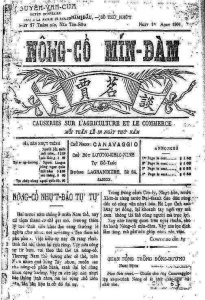
The newspaper Nông cổ mín đàm (Matters of Agriculture, 1901-1924), founded by François Canavaggio

Canavaggio family members were amongst the first colonial settlers who arrived in the service of the French armed forces in 1859. Of these, the most successful was François Canavaggio, whose subsequent business activities enabled him to acquire a large plantation at Xuân Vinh, near Thủ Đức. By 1907, he was Vice President of the Cochinchina Chamber of Agriculture and a member of the Colonial Council of Cochinchina. It was François Canavaggio who acquired the villa at 128 rue Chasseloup-Laubat.

As Philippe Peycam has shown in his book The Birth of Vietnamese Political Journalism: Saigon, 1916-1930, François Canavaggio founded the first quốc ngữ (Vietnamese-language) business newspaper Nông cổ mín đàm (Matters of Agriculture, 1901-1924), which aimed to “expand the agricultural and industrial knowledge of the Annamite people.”

Gilbert Trần Chánh Chiêu

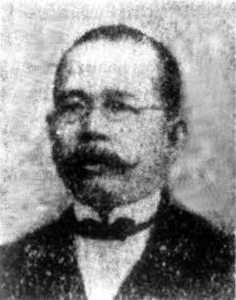
Gilbert Trần Chánh Chiếu (1868-1919), first editor of Nông cổ mín đàm

The paper’s first editor-in-chief was Vietnamese businessman, attorney at law and independence activist Gilbert Trần Chánh Chiếu (1868-1919), who – with the blessing of the liberally-minded Canavaggio – published a series of increasingly anti-colonial articles from 1907 until his arrest in 1908 as an agent of the Duy Tân movement. Thereafter, the newspaper came under much stricter government observation and control.

After Canavaggio’s death in 1922, ownership of Nông cổ mín đàm passed to his Vietnamese widow, but two years later it was closed down by the colonial authorities following a series of outspoken articles on the Saigon port monopoly scandal.

François Canavaggio had several sons, including Marie-Ange who practiced law in Cần Thơ and Jules who served as a Catholic priest in Thủ Đức.

IMAGE 1

Another view of the former Canavaggio villa at 128 Nguyễn Thị Minh Khai

However, perhaps his best-known offspring was Paul-François Canavaggio, who owned a large rubber plantation at Long Chiêu near Thủ Dầu Một and opened stores in both Phnom Penh and Saigon. In the 1920s and 1930s, his Saigon store (initially at 118-120 rue Catinat, but later at 173-175 rue Catinat) was one of the city’s leading suppliers of men’s hats, shirts, hosiery and footwear.

Sadly for this member of the Canavaggio family, having survived the economic crash relatively unscathed, he went bankrupt in 1935 and was forced to sell up and leave Indochina.

The old Canavaggio villa is one of several old buildings currently hidden behind ugly hoardings on Nguyễn Thị Minh Khai street, opposite the former Cercle Sportif Saïgonnais.

IMG_2079

The former Canavaggio villa at 128 Nguyễn Thị Minh Khai, hidden behind shophouse buildings

Tim Doling is the author of the guidebook Exploring Saigon-Chợ Lớn – Vanishing heritage of Hồ Chí Minh City (Nhà Xuất Bản Thế Giới, Hà Nội, 2019)

A full index of all Tim’s blog articles since November 2013 is now available here.

Join the Facebook group pages Saigon-Chợ Lớn Then & Now to see historic photographs juxtaposed with new ones taken in the same locations, and Đài Quan sát Di sản Sài Gòn – Saigon Heritage Observatory for up-to-date information on conservation issues in Saigon and Chợ Lớn.
Saigon Through the Eyes of Early Travellers – Arthur Delteil in 1882, Part 1

Oxus-01

Delteil travelled to Saigon on the Messageries maritimes vessel Oxus

In March 1882, Arthur Delteil, retired Chief Pharmacist of the Navy, left Marseille on the Messageries maritimes vessel Oxus and travelled to Saigon, where he stayed for a year. This is the first of three translated excerpts from his book Un an de séjour en Cochinchine: guide du voyageur à Saïgon, published in 1887.

Prisoners on Poulo-Condor 1895 by Jean-Marc Bel (1855-1930)

Prisoners on Poulo-Condor in 1895 by Jean-Marc Bel

At 6am on 18 April, we passed the large island of Poulo-Condor [Côn Sơn], which belongs to us and serves as the penitentiary for our colony of Cochinchina. At 5pm, on a calm sea, we anchored off Cap Saint-Jacques [Vũng Tàu] at the entrance of the Saigon River, waiting for our pilot and for the hour of the high tide.

Cap Saint-Jacques is the point where all ships coming to Cochinchina converge before making the journey up river to Saigon. It may be seen from afar, provides an easy landing and is topped by a first class lighthouse.

At the foot of the mountain in Cap Saint-Jacques, we built some houses for the staff who manage the under-sea telegraph cable which leads north from this part of the coast and is used to report the impending arrival of ships to the authorities in Saigon.

Cap Saint-Jacques 1895 by Jean-Marc Bel (1855-1930)

Cap Saint-Jacques in 1895 by Jean-Marc Bel

Cap Saint-Jacques forms part of the granite mountain massif of the province of Baria. In the early years of their occupation of Cochinchina, the French authorities were attracted by the location of Cap Saint-Jacques on the coast and conceived the idea of building a convalescent hospital there.

However, after two years of testing, they were obliged to abandon this hospital, because they found that the soldiers who were sent there became even sicker than the ones who had been left in Saigon. A similar attempt made briefly on Poulo-Condor, an island swept by strong sea winds and situated at an altitude of several hundred metres, was no more successful.

However, this is a project which should be returned to later, when we have better studied the causes that made these early attempts fail; because it seems that both Poulo-Condor and Cap Saint-Jacques enjoy healthy conditions far superior to those of Saigon, which is located a long way inland and only rarely receives sea breezes after they have already passed over the muddy rice fields.

Une Vue Sur La Riviere De Saigon, Saigon, Vietnam, Asia, 1900-1910s

The Saigon River in 1900

At 3am on 20 April, we finally entered one of the mouths of the Donaï, one of two major rivers which flows through Cochinchina. The only obstacle which we encountered on this beautiful artery was a large bank of coral located near its mouth which can only be surmounted at high tide. Surely some dynamite and several hundred thousand francs would quickly blow away those madrepores.

It took about three hours for us to reach Saigon. As we sailed up river, we felt the sea breeze abandon us, its place taken by a hot, heavy and humid atmosphere. The thermometer read 31°30 and our bodies began to sweat profusely, leaving us anxious and exhausted as we breathed in the damp mist which rose from the marshes and extended in all directions, as far as the eye could see.

Glancing over the land which surrounded us, we were gripped by the impression which all Europeans feel when travelling through this country. The river which carried us rolled its yellow waters between two almost drowned shores, lined nearly all the way by stilted hits and clusters of trees and coconut palms.

MM

The Messageries maritimes quay

Behind this picturesque and charming backdrop of villages arranged scenically amidst nests of greenery, we could see nothing but flooded rice fields crossed by many arroyos. Everywhere was water and mud; it resembled a primeval scene of land in the process of formation from alluvial soil carried by the Mekong and Donaï.

By midday, as the hot sun beat its perpendicular rays down on this vast muddy plain gorged with moisture and decaying organic matter, we understood that the climate of this country, with its heavy rain and humidity, was little suited to the constitution of Europeans accustomed to more temperate latitudes.

The country was so flat and so low that the river flowed at the same level as the banks. From a distance, we could see the square towers of the Cathedral, the Palace of the Governor and several other monuments of Saigon. The panorama of the city was far from ungracious, and indeed, this view of the capital of our colony caused our hearts to rejoice, for we were very eager to reach the end of our long journey.

Messageries maritimes 3 by Jean-Marc Bel (1855-1930) 1895

Greeting arrivals at the Messageries maritimes quay in 1895 by Jean-Marc Bel

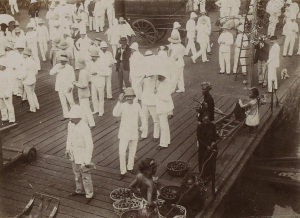
At 8am on 19 April, the Oxus finally moored at the quay of the Messageries maritimes, after 32 days at sea and six stops!

Our arrival had been reported the previous day in Saigon by the Cap Saint-Jacques telegraph, so we were expected by colleagues and friends, who came aboard to welcome us and make themselves available to conduct us to our accommodation.

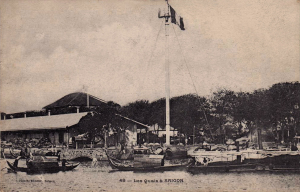
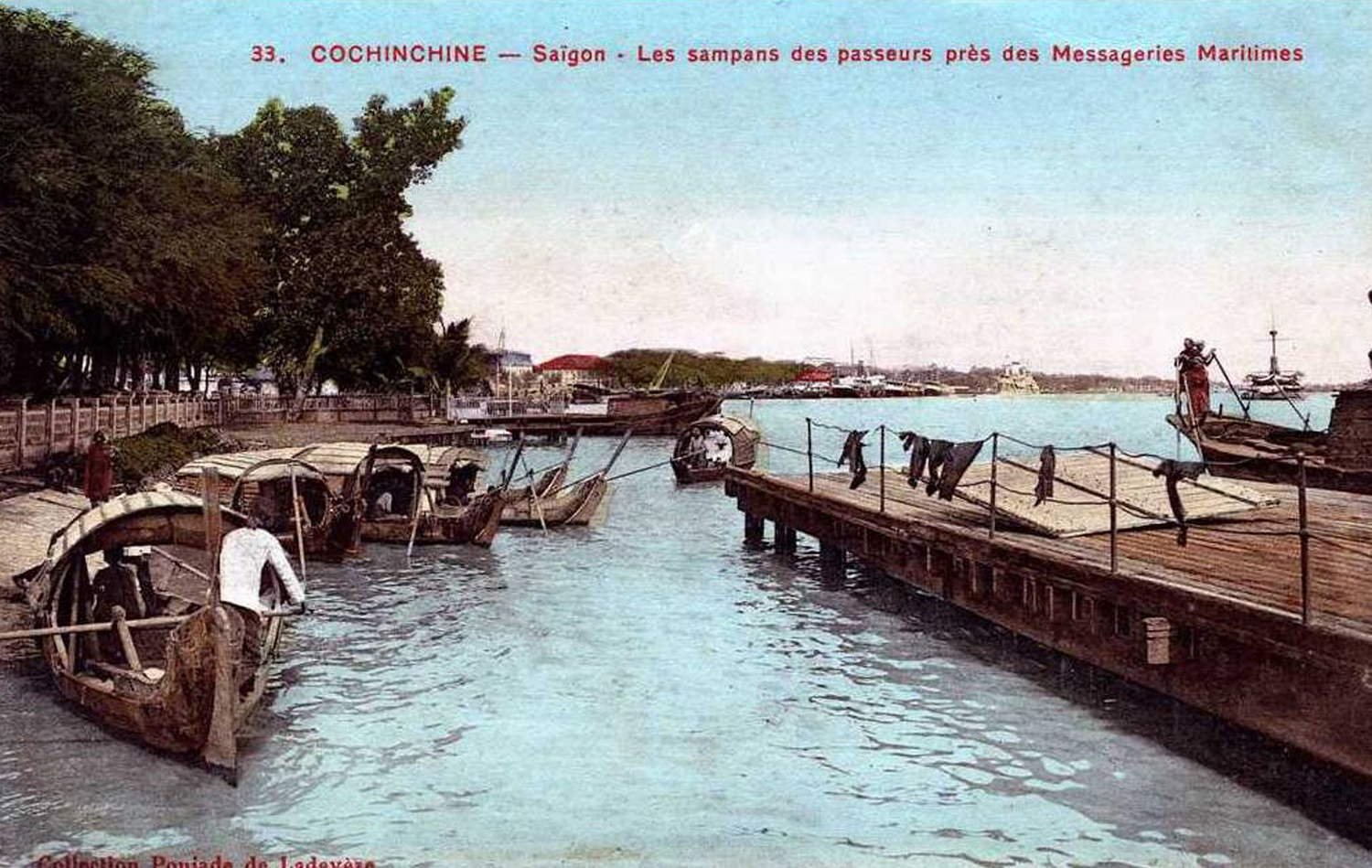
Gathering our luggage, we boarded a sampan, a lightweight indigenous boat piloted by an Annamite and his “congaï.” We crossed the arroyo Chinois [Bến Nghé Creek], a tributary of the Saigon River which separates the Messageries maritimes from the city, and on the other side we landed on a masonry pier lined with benches and topped by a large flagpole known as the Signal Mast.

This place is known by the familiar name of Pointe des Blagueurs (“Jokers’ Point”), and it becomes very crowded in the evenings, as after-dinner walkers come to breathe the fresh air of the river and watch the incessant coming and going of junks carrying their rich cargoes to the Chinese city of Cholon.

Les quais à Saigon

The Pointe des Blagueurs (“Jokers’ Point”)

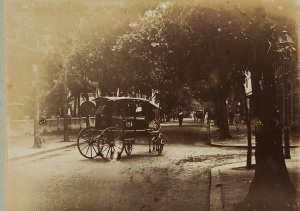
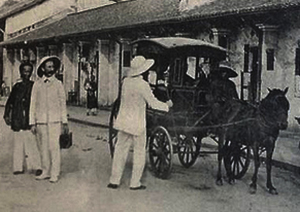
From there, we got into one of the carriages of the country known as the Malabar, a type of square box on wheels drawn by a skinny little horse and driven by a Chinese driver who did not understand a word of French. By touching his shoulder with a cane, we could get him to go right, left or straight on.

Many new arrivals to the colony have found themselves in big trouble after entrusting their persons to the mercy of these Malabar drivers in the belief that they would make trustworthy guides. Instead, they delight in taking advantage of newcomers’ naïvety by driving them around the city at random and then demanding payment for a journey of several hours’ duration!

We travelled along a part of the quai du Commerce [Tôn Đức Thắng], then up rue Catinat [Đồng Khởi] to the Hôtel Favre, a large “caravanserai” in the style of the English hotels in Ceylon and Singapore. This hotel is a real boon for travellers; indeed, it is the only one among our colonies which has such good facilities.

5729302440_37e0ffd9d8_o

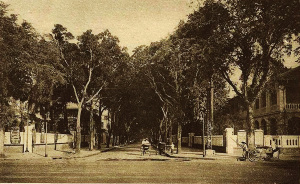
Rue Catinat in the late 1800s

The man who designed and built the hotel [Elisée Favre] was a skilled cook and organiser of the first order. He saw the very large number of military and civilian passengers who arrived in the colony each year, and decided that he would build a hotel with all the facilities they needed. By offering large and well furnished rooms, an excellent restaurant, meeting facilities and good service, he succeeded in creating not just a temporary asylum for the newcomers’ first few days in the colony, but a decent hotel which attracted longer-stay guests. Indeed, so successful was M. Favre’s design that he eventually returned to France with quite a large fortune, leaving his successor a flourishing business.

The Hôtel Favre occupies almost the entire part of rue Catinat between boulevard Bonard and rue d’Espagne. It is located in the centre of the city, in the most lively and commercial street, close to the docks, the Messageries maritimes and the naval port.

1895 rue Catinat

A Malabar carriage on rue Catinat in 1895

On the ground floor there is a billiards room, a large restaurant for guests who want to eat alone or in small groups, and two or three other smaller dining rooms for long-stay residents. During meals, diners are kept cool by immense slowly-moving punkah fans, which are suspended above their heads.

Verandahs surround the building in front and behind. The first and second floors are occupied by rooms numbered from 50 to 60. A large, airy corridor divides them into two groups, those which have courtyard views and those which overlook the street. The latter are the most expensive and the most popular. The rooms are built and furnished to a uniform standard, without luxury, yet nonetheless with a certain level of comfort. Beside each is a bathroom with a shower, a bath and a tap which one only has to turn to enjoy fresh water in abundance.

This latter facility is a real stroke of genius on the part of the designer of the property, because in a place as hot as Saigon, being able to take cold water ablutions at any hour is a luxury which cannot be compared to any other!

5530626507_d5b6e89241_o

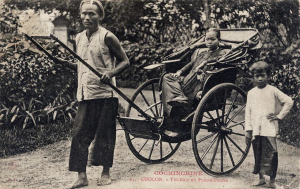
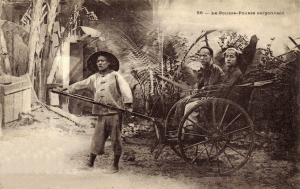
A Saigon pousse-pousse

During the stiflingly hot months of April and May, when the thermometer never drops below 31° day and night, the greatest physical pleasure that one could have is to plunge into a bath of relatively cold water, bringing about a subtraction of heat and resulting in a relaxed state of well-being which lasts for several hours. These cold water baths permit us to endure the warmer months of the year without too much irritation.

This eager pursuit of guests’ well-being has contributed more than anything else towards the hotel’s success. So many officers have not hesitated to make it their home for the duration of their stay in Cochinchina, rather than renting a private house, with its obligation to furnish and the certainty that one would not be so well served with amenities of the type I have just mentioned.

4784925905_79c9343907_o

Merchant houses on the banks of the arroyo Chinois in the late 19th century

The room rate at the hotel ranges from 13 to 15 piastres (63-73 Francs). As for full board, it offers a very affordable price to officers who have come to serve in Cochinchina, whose salaries are generally quite high.

For 30 piastres (130 Francs) per month, the long-stay guest will have 10 dishes to choose from, plus wine, ice, coffee and liqueurs – service included! This is why I opted to settle at the Hôtel Favre for the duration of my stay in Saigon.

Those who prefer to find their own place to live in Saigon are spoiled for choice. They can find small houses for rent at 75 to 100 Francs per month, or larger houses for rent at 125 to 150 Francs per month. It pays, therefore to share, which costs a lot less. A family is obliged to spend at least 100 Francs per month in rent.

As rental buildings can generate a lot of money in Saigon, those people who have made money in business, or have a small amount of capital to invest, frequently spend their money on building or buying properties to let.

076_001

Colonial buildings in Saigon

In this way, there are now many rental properties available, and it is relatively easy for those who don’t wish to live in a hotel to find a place to live.

However, renting a property means that one is obliged to furnish the house oneself, and also to meet the costs of installation. In this instance, one goes to the auction room on rue Catinat, which is located opposite the Hôtel Favre. This is where furniture, bedding, crockery, pots and pans and other household items are sold at a relatively cheap price on behalf of those who are leaving the colony.

For modest purchases, I also recommend the Chinese stores on rue Catinat, which sell lightweight, strong and comfortable beds and bamboo chairs at a really reasonable price. If one is not too fussy, one might also consider buying a Cambodian mattress, which can be folded for travel. A mosquito net must also be purchased to cover the bed, after which one is equipped with everything it takes to get a good night’s sleep.

5530626157_b42478d064_o

Another Saigon pousse-pousse

The next task, if one is to eat at home, is to hire a domestic and a cook. The domestic is usually an Annamite and he costs a lot – 30-40 Francs per month, excluding food. Annamite domestics are usually young men aged 18 to 20 years, known as “boys.” Cooks are usually of the Chinese race and can cost up to 40 or 50 Francs per month. One is almost always satisfied, since the Chinese cook will rapidly become aware of the habits of European cuisine and the tastes of the people he is called to feed.

In the morning, one should give him money to go to the market and say: “With this you will buy me enough food so that I can eat well.” With the amount given to him, he will always manage to provide a good table for a relatively low price. But one should never count the change with him; if there is a difference to his advantage, that’s his business.

IMAGE 3

The Saint-Enfance

Families with children will require a female domestic. We can find fairly good ones at the Sainte-Enfance. They come straight from the care of the Sisters of St-Paul de Chartres, knowing how to sew, work and speak French. Unfortunately, when they are pretty they often turn bad, as frequently happens to girls of the same category in France. I’ve heard that these domestics provide adequate services. We must make do with them for lack of anything better.

On my first day in Saigon, I was visited by several Chinese suppliers – launderers, tailors, shoemakers – who came to me offering their services. Each one of them presented certificates which commended them to the benevolence of newcomers to the colony.

For a subscription of 12.50 Francs, the launderer washes and irons all the clothes that one is likely to get dirty during the month. And God knows, in a country where we are always sweating, we must change clothes often enough!

274_001

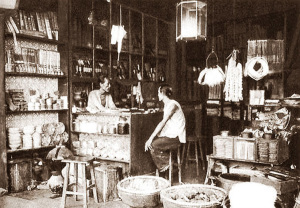
Chinese shops on rue Catinat

In Saigon, the laundry is done only by men. You will find these Chinese launderers in the rue Catinat, where most members of their corporation are based. Ironing is one particularly interesting aspect of their work which deserves to be described. The ironer fills his mouth with a mixture of water and starch and uses his lips to spray a very fine mist of this liquid onto the garment in front of him, at the same time pressing the well-watered item of clothing over a heated pan filled with hot coals. Despite the primitive means used, the linen is always returned dazzling white and beautifully ironed.

As for clothing and footwear, the Chinese can make these so cheaply that that there is simply no need to bring a wardrobe full of clothes and footware out from France. Judge for yourself – a complete light blue flannel suit consisting of trousers, waistcoat and jacket will cost no more than 40 Francs, cloth included. Chinese shoemakers, in turn, will make a strong pair of boots from flexible black material for just 5 Francs.

Messageries maritimes 1 by Jean-Marc Bel (1855-1930) 1895

French colons wearing flannel suits and helmets at the Messageries maritimes in 1895 by Jean-Marc Bel

Their work is not particularly elegant or refined; Chinese tailors and shoemakers do not create fanciful or trendy fashion items; they would be incapable of that. They just slavishly copy the models that you give them and their amibition is limited to this imitation. But their creations are convenient and quite in keeping with the needs of the climate.

A flannel suit and helmet is, in general, the costume worn by the majority of Europeans in Saigon. However, some young people have adopted the fashion of British officers in India and Singapore, that is to dispense with a shirt and wear next to the skin a white cotton jacket, buttoned up and down, which is changed every morning. This is clothing reduced to the bare essentials!

To read part 2 of this serialisation click here.
to read part 3 of this serialisation click here.

Tim Doling is the author of the guidebook Exploring Saigon-Chợ Lớn – Vanishing heritage of Hồ Chí Minh City (Nhà Xuất Bản Thế Giới, Hà Nội, 2019)

A full index of all Tim’s blog articles since November 2013 is now available here.

Join the Facebook group pages Saigon-Chợ Lớn Then & Now to see historic photographs juxtaposed with new ones taken in the same locations, and Đài Quan sát Di sản Sài Gòn – Saigon Heritage Observatory for up-to-date information on conservation issues in Saigon and Chợ Lớn.
Ngo Dinh Diem’s Secret Tunnels

IMG_1260i

Recently-unearthed photographs and documents suggest that the network of underground tunnels built beneath Saigon was much more extensive than originally believed.

While the Independence Palace was under construction in 1962 to replace the bombed Norodom Palace, South Vietnamese president Ngô Đình Diệm ordered his architect Ngô Viết Thụ to dig underground tunnels beneath both the new building and his temporary replacement, the Gia Long Palace (the former Lieutenant Governor’s Palace, now the Hồ Chí Minh City Museum).

Both sets of tunnels may now be visited by tourists, but with sections of each still cordoned off, the rumour that a connecting tunnel was built between the two palaces remains alive and well.

But what about these two intriguing images from the George Krizansky Collection in the Vietnam Center and Archive, taken in the aftermath of the November 1963 coup which overthrew Diệm?

99B This innocent looking building housed a tunnel exit from the Palace. It is located at the Saigon Zoo. 15 November 1963

“This innocent looking building housed a tunnel exit from the Palace. It is located at the Saigon Zoo. 15 November 1963.”

99A Police and army drive curious spectators from seeing exit of tunnel located at the basement of this deceiptive building at Saigon Zoo

“Police officers and army men drive curious spectators away from seeing the exit of the tunnel located at the basement of this deceptive building at the Saigon Zoo.”

The original images can be found online here:

http://www.flickr.com/photos/13476480@N07/8345358888/in/set-72157632427779423

http://www.flickr.com/photos/13476480@N07/8344300353/in/set-72157632427779423

The existence of a tunnel leading from the Gia Long Palace to the Zoo is confirmed in a US Department of State document entitled The Coup Against the Diem Government, October 23-November 2, 1963: Differing Interpretations of U.S. Policy Toward Coup Plotting, Efforts To Obtain Information on a Potential Coup, Lodge-Diem Discussions, U.S. Assessments of a Coup, The Coup, The Deaths of Nhu and Diem (Foreign Relations, 1961-1963, Volume IV, Vietnam, August-December 1963) http://2001-2009.state.gov/r/pa/ho/frus/kennedyjf/iv/12652.htm

“The Generals [General Trần Văn Đôn and Trần Thiện Khiêm] are aware that there are two underground tunnels of escape from Gia Long Palace. These terminate at the [Mạc Đĩnh Chi] Cemetery [now Lê Văn Tám Park] at the corner of Phùng Khắc Khoan and Phan Thanh Giản [Điện Biên Phủ] and at the Zoo. These were formerly part of the sewers, but the sewerage has been diverted into other channels.”

Tunnels leading from the Gia Long Palace all the way to the Mạc Đĩnh Chi Cemetery and to the Saigon Zoo? Clearly the tunnel network under Saigon was once far more extensive than any of us imagined!

Thanks to Tyler Watts for providing this information.

Tim Doling is the author of the guidebook Exploring Saigon-Chợ Lớn – Vanishing heritage of Hồ Chí Minh City (Nhà Xuất Bản Thế Giới, Hà Nội, 2019)

A full index of all Tim’s blog articles since November 2013 is now available here.

Join the Facebook group pages Saigon-Chợ Lớn Then & Now to see historic photographs juxtaposed with new ones taken in the same locations, and Đài Quan sát Di sản Sài Gòn – Saigon Heritage Observatory for up-to-date information on conservation issues in Saigon and Chợ Lớn.
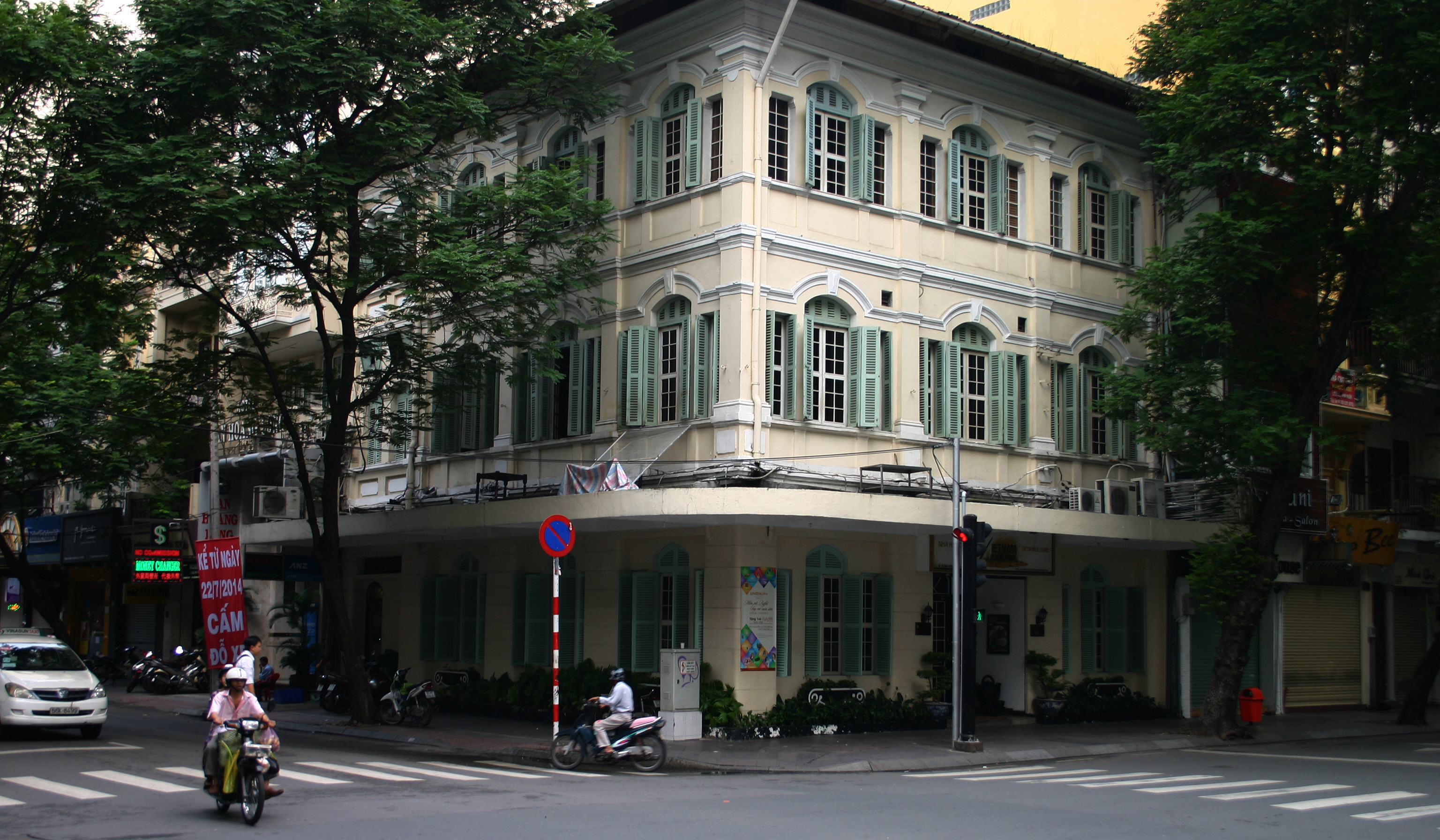
Icons of Old Saigon – The Hotel de l’Univers, 1872

Saïgon l'Hôtel de l'Univers MAP

The Hôtel de l’Univers in the late 19th century (MAP)

This article was published previously in Saigoneer http://saigoneer.com

Contrary to what many tourist websites would have us believe, the Grand Hôtel Continental was not Saigon’s first up-market hotel.

IMAGE 2

The Hôtel Cosmopolitan, aka the Hôtel Wang-Taï

That title may legitimately be claimed by the Hôtel Cosmopolitan, aka the Hôtel Wang-Taï, housed in the former riverfront residence and office of Cantonese opium dealer Wang Tai, which as early as December 1869 provided “sumptuous apartments” for the state visit of King Norodom of Cambodia – see Wang Tai and the Cochinchina opium monopoly.

However, from the 1870s onwards, most French visitors to Saigon chose to stay not at the Hotel Cosmopolitan, but rather at the Hôtel de l’Univers, which opened in around 1872 under the management of a Monsieur A Lacaze. Initially a two-storey building on rue Vannier (now Ngô Đức Kế street), it was later rebuilt as a three-storey structure with its main entrance (and also its café and bar) at 1 rue Turc (now Hồ Huấn Nghiệp street).

In her 1892 book Les Indes et l’Extrême Orient, impressions de voyage d’une parisienne, wealthy French widow Louise Bourbonnaud describes how, during her 1888 stay at the Hôtel de l’Univers, she rented “a suite comprising two rooms on the first floor” which included “a beautiful bedroom with a large covered balcony overlooking the garden courtyard” and another room “overlooking the street and furnished with a dressing table, a writing desk, a sofa and three side tables.”

IMAGE 4

Hugues Krafft, who stayed at the Hôtel de l’Univers in 1881

It seems that the hotel’s reputation was based more on the quality of its cuisine than on the comfort of its rooms. In his 1885 book Souvenirs de notre tour du monde, wealthy Parisian photographer Hugues Krafft commented that the hotel, in which he stayed during his 1881 visit, “had been recommended to us for its cuisine, the reputation of which was maintained by Monsieur Ollivier, former head chef of the Governor.”

By 1886 chef Ollivier and his brother had taken over the management of the hotel from Lacaze. However, it seems that the Ollivier Brothers failed to overcome the popular perception that the best thing about the hotel was its restaurant. Describing his 1887 stopover in Saigon in the 1891 book Souvenirs chinois, Léon Caubert recounted the popular adage that one should choose “the Hôtel Laval for sleeping and the Hôtel de l’Univers (Ollivier) for eating.”

As there was no plumbing in the hotel rooms, guests wishing to take a bath or shower were obliged to visit the hotel’s “hydrotherapy annex,” located opposite the hotel on rue Vannier.

In 1885, Hugues Krafft described this installation as “primitive and unkempt,” accusing its Chinese staff of being “sullen and unpleasant individuals, who most of the time couldn’t even be bothered to respond to the requests of the guests.”

IMAGE 3

Louise Bourbonnaud, who stayed at the Hôtel de l’Univers in 1888

However, staying at the hotel three years later, Louise Bourbonnaud was somewhat more charitable about the annex: “Back at the hotel, I prepared myself for a cold bath, as always. But I found that the hydrotherapy unit, which did so much to gain my admiration when I first arrived, didn’t always work properly. When I went to turn on the stopcock, I succeed only with great difficulty and end up showering myself a little more than I would have desired. I laughed, of course, because when travelling, this kind of thing can be expected.”

By the turn of the century, the choice of up-market hotels in Saigon had expanded significantly and the golden age of the Hôtel de l’Univers was over. In addition to the Grand Hôtel Continental, these included the Hôtel des Nations, the Hôtel de la Paix and the Hôtel de Bretagne on boulevard Charner, the Hôtel de la Gare on boulevard de Canton, and the Hôtel de France and the Hôtel de la Rotonde on rue Catinat.

This grand old Saigon institution made its last appearance in a French government directory of 1923, when it was listed as being under the management of Messrs Ange Frasséto and Eugène Sicé, then owners of the Grand Hôtel Continental. The Hôtel de l’Univers is believed to have shut shop in the mid 1920s.

Hotel de l'Univers 1906 i

The Hôtel de l’Univers in 1906

Tim Doling is the author of the guidebook Exploring Saigon-Chợ Lớn – Vanishing heritage of Hồ Chí Minh City (Nhà Xuất Bản Thế Giới, Hà Nội, 2019)

A full index of all Tim’s blog articles since November 2013 is now available here.

Join the Facebook group pages Saigon-Chợ Lớn Then & Now to see historic photographs juxtaposed with new ones taken in the same locations, and Đài Quan sát Di sản Sài Gòn – Saigon Heritage Observatory for up-to-date information on conservation issues in Saigon and Chợ Lớn.
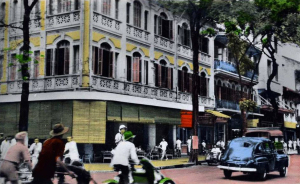
Saigon Through the Eyes of Early Travellers – Hugues Krafft in 1882

Cochinchine - saïgon - les sampans des passeurs pres des messageries maritimes

Sampans moored near the quai des Messageries maritimes

In 1881, wealthy Parisian photographer Hugues Krafft (1853–1935), his brother Edouard Hermann and his two friends Louis Borchard and Charles Kessler, embarked upon a world tour modelled on that of Phileas Fogg in Jules Verne’s Around the World in 80 Days. This translated excerpt from Krafft’s 1885 book Souvenirs de notre tour du monde (Memories of our World Tour) describes their 48-hour stopover in Saigon in August 1882, during a five-month trip which took in India, Ceylon, Java, China and Japan.

Hugues_Krafft-by-Léon_Bonnat-1892

An 1892 painting of Hugues Krafft by Léon Bonnat

After two days at sea, the Djemnah arrived in Cochinchina. As it’s easy to see from the map, Saigon is located some distance from the coast, and reaching it involves around three hours’ navigation from Cap Saint-Jacques. This is where the telegraph cable passes to facilitate communication with China, and where a pilot comes on board ships to guide them up the Saigon River.

Once we’d entered the river – a yellow-coloured arm of the great Mekong, the “Nile” of Cochinchina – we quickly lost sight of the promontory of Cap Saint-Jacques, and soon we could see nothing but submerged brush and endless rice fields. As we progressed, the river began to turn in zigzags like the Seine near Paris, so that as we approached Saigon we could see, sometimes to the right and sometimes to the left, the square towers of the cathedral, which seemed to be the only high point in the midst of a uniform plain.

Arriving in Saigon harbour, which had a quiet aspect, we were transferred ashore by sampan, a type of native canoe rowed by Annamite boatmen. These first members of the Annamite race that we encountered did not charm us.

The Djemnah, built 1874 and weighing 3785 tons

The Djemnah, built 1874 and weighing 3785 tons

They were nervous little men with bad expressions, garbling a few French phrases in a rude and guttural way and revealing teeth blackened by betel. Their attire, and especially their hairstyle, was far from picturesque. The latter consisted of a red or green handkerchief, carelessly knotted around a small bun and hung like a rag over their ears and necks.

“Oh what a pretty harbour! What beautiful trees! Victoria carriages! Houses with balconies! A café!” we cried as soon as we set foot on the quayside. One might easily have mistaken this place for Chatou, for it would surely have been impossible to find anywhere else so far from home and yet so reminiscent of France.

We took rooms at the Hôtel de l’Univers, a two-storey building located in the first street which intersects at right angles with that great Saigon artery, the rue Catinat.

Hotel de l'Univers 1906 i

The Hotel de l’Univers, pictured in 1906

This hotel, which had its name written on a blue sign with white letters, had been recommended to us for its cuisine, the reputation of which was maintained by M Olivier, former head chef of the Governor.

The best thing about the Hôtel de l’Univers was indeed the cuisine. Everything else about this place brought to mind a small provincial hotel; the walls of the rooms were hung with drab wallpaper and decorated with coloured lithographs representing the Bal Mabille or the sentimental allegories of Louis-Philippe.

If the comfort of the rooms was higher than that of the Indian hostels we had stayed in, the hotel’s hydrotherapy annex left a great deal to be desired. These facilities were as primitive as they were unkempt, and their Chinese staff were also in urgent need of some retraining. These boys with pigtails were very sullen and unpleasant individuals, who most of the time couldn’t even be bothered to respond to the requests of the guests.

7189065397_39e2af583b_z

Calling a malabar in colonial Saigon

Taking advantage of the obliging offer of two of our fellow travellers from the Djemnah, we went with them early next morning to Chợ Lớn, a very important city located just a few kilometres from Saigon.

This is the major rice market of the country, and the Chinese, who are very numerous there, control all of its trade. The ponies pulling our Victoria carriage ran like the wind, but in a very ugly way which seemed typical of their species.

The dusty soil was of a pronounced red brick colour, which lent a strange hue to the shrubs and hedges lining our route. A large plain known as the Plaine des tombeaux (Plain of Tombs) lay to the right of the road, alongside which ran the new steam tramway connecting Saigon with Chợ Lớn.
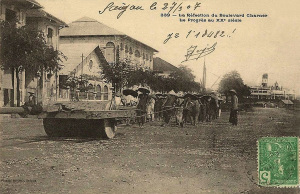
IMAGE 5

The grand Chợ Lớn residence of Đỗ Hữu Phương

The main purpose of our trip was a visit to a well-known Annamite personage, Đỗ Hữu Phương, the local prefect and Deputy President of the Chợ Lớn Municipal Council. Given that it was still quite early in the morning (7am!), we were not surprised when M Phương received us in his dressing gown.

He was quite the Annamite type. Very proud to have been in Paris, he jabbered a little in French, but as he stuttered badly, we found him very hard to understand. However, he was on very good terms with one of our companions and seemed delighted to receive us. He showed us the many objects in his famous antique collection, including ancient weapons, porcelain and Chinese and Tonkinese furniture, as well as articles specially reserved for the worship of his own ancestors, including an ornate shrine adorned with calligraphic works and incense burners.

029_001

The interior of a Chinese Assembly Hall in Chợ Lớn

We were offered cognac, vermouth and… Caporal tobacco! Clear proof that in M Phương’s house, some French habits prevailed over those of his own country. We also met his wife and several of his nine children, who gathered timidly in the doorway to observe us! Madame Phương presented everyone in our group with bouquets of small yellow flowers, a gesture accompanied by a frightening smile which revealed her betel-blackened mouth.

M Phương showed us his garden, in which, following the widespread taste in the East, he raised all sorts of animals, including birds, deer and crocodiles. Then he took us to one of the main Chinese pagodas in Chợ Lớn. This was a large and luxurious temple, fairly new and decorated at all corners with brightly-coloured ceramic sculptures, porcelain decorations and grimacing statues.
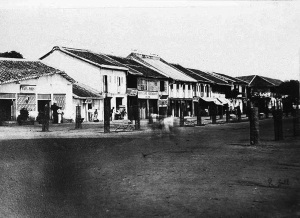
5837885715_6de05d0a70_o

A late 19th century Saigon street scene

Returning to Saigon, we had lunch and then followed the example of all Saïgonnais by taking a nap until 2pm. At that hour, the city’s shops and offices, closed since 11am, reopened. In the late afternoon, as the heat began to abate, the city streets slowly regained their animation.
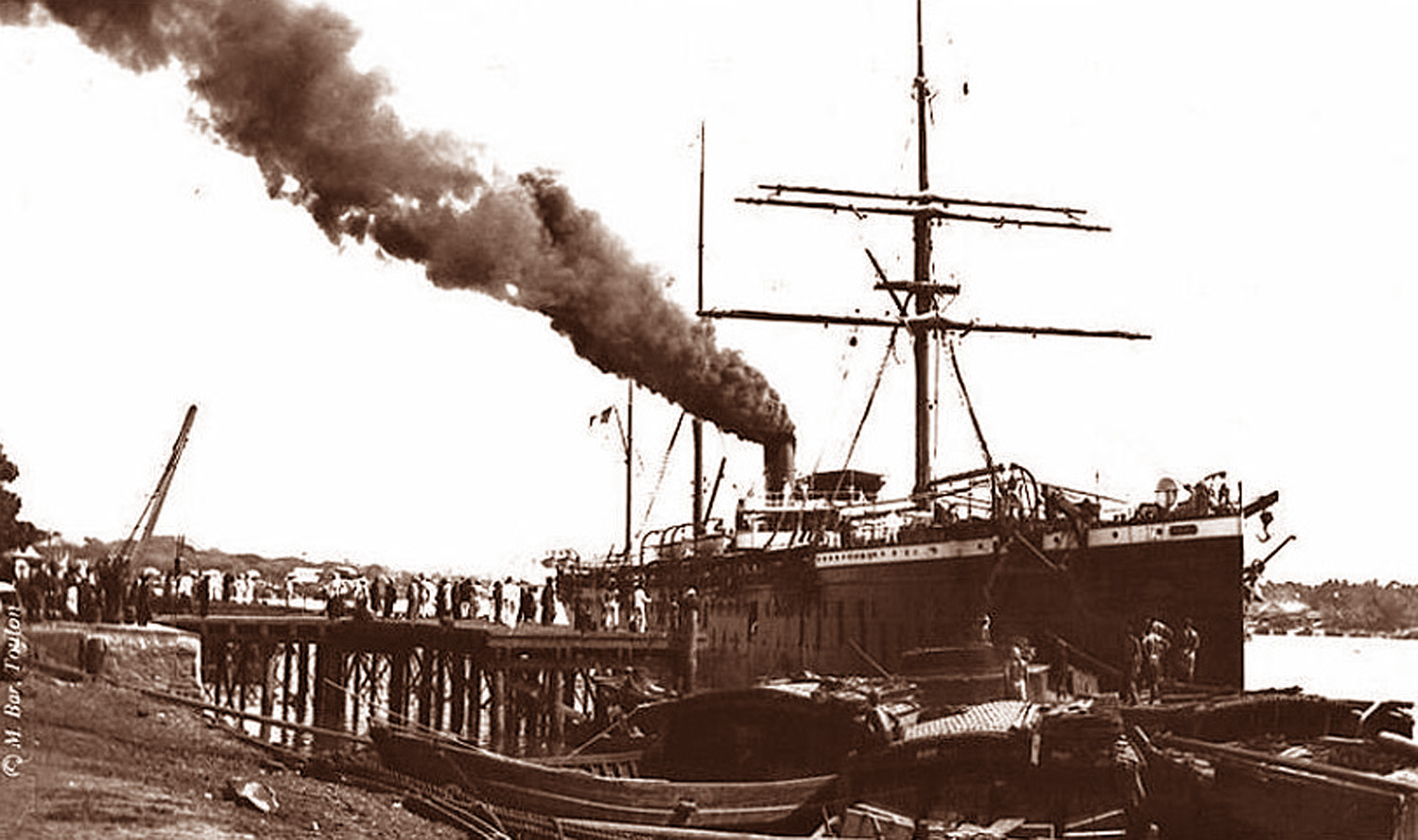
Making the most of the little time remaining, this traveller quickly inspected the local sights: the Cathedral, a beautiful monument of brick and stone; the Palace of the Governor, a large and brand new edifice, doubtless imposing in the imaginations of local people, but in our view looking rather too much like a casino; the Botanical and Zoological Gardens; the Water Tower; and the Citadel with its Marine Infantry Barracks. The latter, very airy with iron verandahs on every floor, had been very well built.
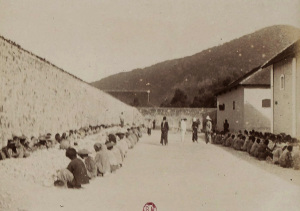
961_001

Colonial military personnel in Saigon

But we saw very few of our soldiers there. I should mention that, despite the tropical heat, they are required to wear a collared shirt, a black tie and a jacket, all made from material thick enough for the icy slopes of the Himalayas! We must sympathise with those among their number who must stand guard wearing this uniform, and ask why we cannot learn from the practices of the British military in India and Ceylon, instead of allowing such errors to continue?

How shall I sum up Saigon? This city – perfectly clean, with streets which intersect tidily at right angles, are equipped with sidewalks, manholes, hydrants and lined with symmetrically-planted trees – seems better administered than any city we’ve seen so far on our trip. However, I would add that, in the light of the city’s precarious state just 20 years ago, the recent improvements tend to make us forget the misconduct in failing to establish the capital at Cap Saint-Jacques.

17 Boutique Chinois

A Chinese store in colonial Saigon

The 1,300-strong population comprises French, Malay, Tamil, and above all the active and industrious Chinese, who account for most of its small businesses and industries. It is from their ranks that the city’s tailors, launderers, carpenters and shoemakers are drawn, centralising in the hands of one race all the trades necessary for the needs of the Europeans and even the native Annamites.

Tim Doling is the author of the guidebook Exploring Saigon-Chợ Lớn – Vanishing heritage of Hồ Chí Minh City (Nhà Xuất Bản Thế Giới, Hà Nội, 2019)

A full index of all Tim’s blog articles since November 2013 is now available here.

Join the Facebook group pages Saigon-Chợ Lớn Then & Now to see historic photographs juxtaposed with new ones taken in the same locations, and Đài Quan sát Di sản Sài Gòn – Saigon Heritage Observatory for up-to-date information on conservation issues in Saigon and Chợ Lớn.